





Listen instead on your Monday Morning Drive:
You can’t fix every problem in your business. And if you tried, you’d never have time to run it. Rough edges are fine. The question is where to put your energy.
Most owners spend their days removing small bottlenecks. Fewer steps in the warehouse. Better parts delivery. Faster prep times. Each improvement is worth making, but each one only shrinks the bottleneck a little. At some point, the effort isn’t practical.
Scalability solves a different problem. It’s the single practice that fixes more issues, faster, and more efficiently than any other approach I’ve taught.
What Scalability Means
A truly scalable business adds revenue without adding permanent resources and stays profitable doing it. More shows, same overhead. Busier months with fatter margins. Slower months that still make money.
If your business isn’t profitable 11 months out of the year, you’re not close to scalable. If it’s profitable all 12, you probably are.
Non-scalable companies live in fear. Every new piece of business requires new hires, gear, and fixed costs. Income becomes desperation fuel. Scalable companies ride the ups and downs. They’re profitable when they’re slow and more profitable when they’re busy.
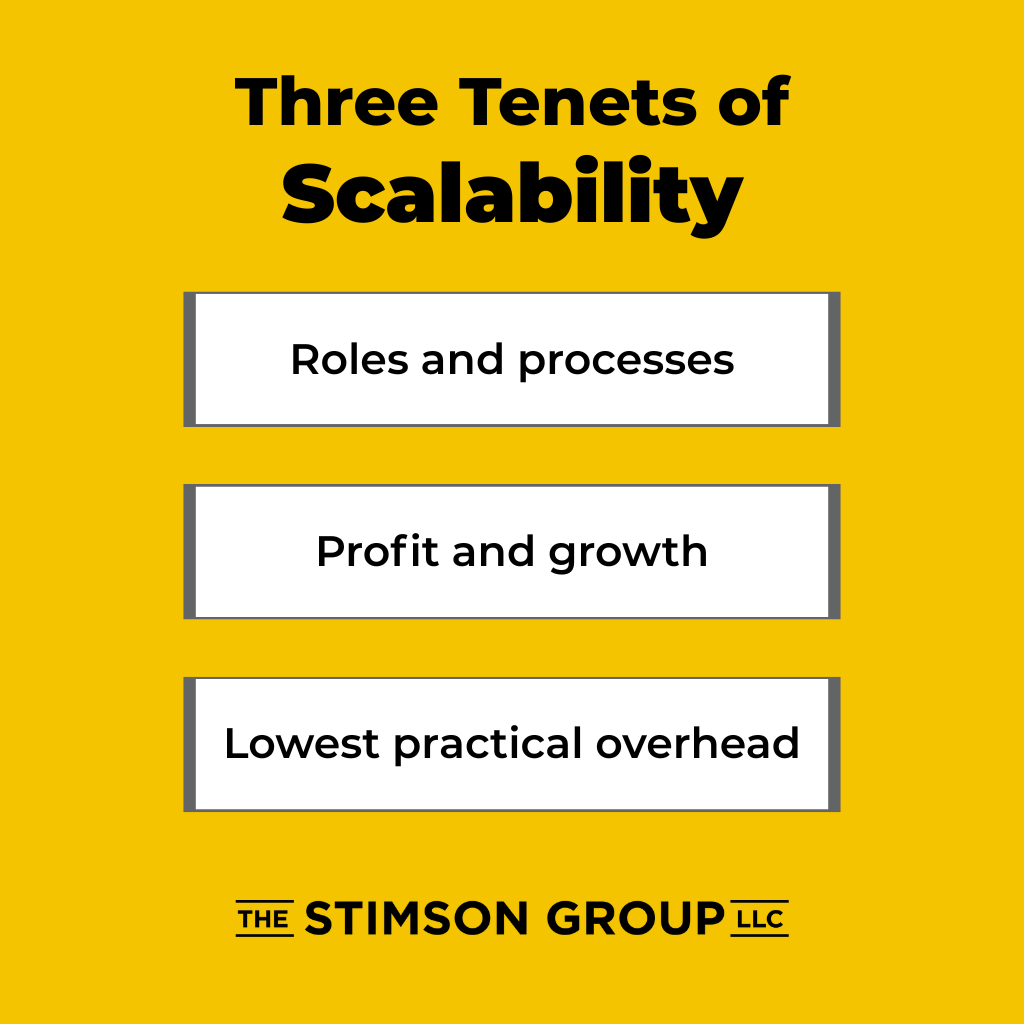
Three Tenets of Scalability
Roles and processes. Forget org charts. Org charts tell you who reports to whom. That’s the wrong question. The right question: what’s each person’s primary role, and can they do it without interference?
If your best production manager draws CAD files for other shows when they need to be managing a project, you’ve got a role conflict. That’s a process problem hiding behind a staffing shortage. Start by defining the right job titles.
Every company has four spheres: selling, planning, administration, and execution. Scalable companies keep people in one sphere most of the time. A salesperson who project-manages and then goes on-site is working across three spheres. That’s why your team feels “too busy”.
Your spheres don’t need to be staffed entirely in-house. Outsourcing gets a bad rap, but it’s how you keep your spheres complete without bloating your payroll. Outsource marketing, drawings, and project management if the math supports it.
And forget documented processes as a cure-all. Writing down a process never kept the ball from being dropped. People drop balls when they assume somebody else will handle it. Information sharing matters more than step-by-step documentation. Centralize the information. Let people in their defined roles act on it.
Profit and growth. These are math problems. Revenue minus cost of goods equals gross profit. Gross profit minus overhead equals operating profit.
If you made 20% operating profit in October, that’s great for October. But October doesn’t matter in isolation. Look at your trailing 12 months. The goal is 20% operating profit for the full year, which means your busy months need to run closer to 40% to offset the slow ones.
Once you know how to make a profit, you’ve created an environment where growth becomes safe. If new business starts losing money, either your pricing broke or you need to add internal capacity. One new buyer doesn’t change your whole year. It changes a period. Get good at forecasting and budgeting, and profit and growth stop competing with each other.
Lowest practical overhead. Scalable companies don’t throw bodies at problems. They hire for a different reason: the business is growing, and they need the work done at the highest quality level.
I often say scalable companies have half the employees of non-scalable ones, but those employees need to be twice as good. Half the headcount is cheaper per year. Better people cost more per head, but I’d rather pay 10 people well than manage 25 whose salaries are all over the place. Ten people create far fewer bottlenecks than 25.
Project managers are bad math. The title is fine. Project management is a legitimate process. But when one person walks an order through the system from quoting to show site, you’ve got the wrong structure, not too few people. Your best production-minded people belong in planning. Your field leaders belong in execution. They collaborate closely, but they stay in their lanes.
Signs You’re Getting It Right
Your key employees stay in their lanes and trust the people in adjacent lanes to do their jobs. You outsource with a deep bench of freelancers and sub-rental vendors, not the same three companies for every show. You price with confidence and without illusions about “industry standard” rates.
You’re picky about your buyers. Right now you might need every project you can get. The whole point of scalability is reaching the place where you turn down better business.
You reduce wasted time at every turn. A clean, organized warehouse pulls shows faster. Standardized quoting eliminates wheel-reinvention. And when a bottleneck appears, you ask one question: “Is this temporary, or do I need to fix it?”
Clean, Friendly, and Efficient
The most valuable qualities you can offer buyers, vendors, and employees are free. A clean workspace. A friendly environment. An efficient process. These are standards, not expenses.
An old office in a tired building can be spotless and organized. Friendly is free. Efficiency is a mindset. Scalable companies get all three right. And the owners of those companies follow the roadmap to balance, take more vacations, pay their people better, and sleep a lot easier.


Leave a Reply