




Listen instead on your Monday Morning Drive:
Somebody asked me recently what I’d do differently if I were starting a professional technical production company today. The same question landed on my desk during the pandemic.
The answer hits harder now because the old rental model is quieter every year: Services are where the work is, where the margin lives, and where the risk actually fits.
I built my career as a freelance AV tech on a four-hour minimum at ten bucks an hour. I tried buying gear. I tried writing business plans for a rental company. Neither path fit me.
What worked was picking up the technical director role for producers who needed a calm hand on a level five or six show. That’s the accidental entrepreneur story, and it still shapes how I look at this question.
If I were starting over in 2026, I’d build a services company before a rental one. Here’s how the math works.
Two Paths Into the Business
Most technical production companies come from one of two origin stories:
- The freelancer with gear starts as an in-demand technician, buys the gear to keep up, and eventually hires crew to keep up with the gear.
- The TD starts as the person who knows how to get a show done for a client and builds a company around that ability.
The freelancer with gear model (story one) peaks. At some point, the inventory has to meet the demand, or the demand has to meet the inventory. Either way, you’re no longer a technician. You’re a business.
The TD path is different. You win on outcomes, not on what’s on the truck. That’s a scalable starting point in a way a rental truck never will be.
Both paths can work. One of them ages better than the other.
Own the Glue, Not the Endpoints
The single biggest change in how I’d set up a company today is what I’d actually buy.
Take video as an example. The switcher, the server, and the control chain are the glue. The displays, the cameras, and the source inputs are endpoints.
Endpoints are easy to source. Nobody cares where the LED panel came from as long as it’s the right pitch and the right brightness. The glue is where the show actually lives, and that’s where your philosophy shows up on every gig.
Own the control items. Outsource the endpoints.
The same logic applies to audio and lighting, where front-of-house and control are worth owning and the dumb boxes downstream aren’t. Outsourcing done well is how you run a bigger company with fewer people on payroll.
Price for Services, Not for the Gear
Most technical producers still bill like technicians. Day rate on site, maybe a little for prep, done. That pricing ignores half the work you actually do.
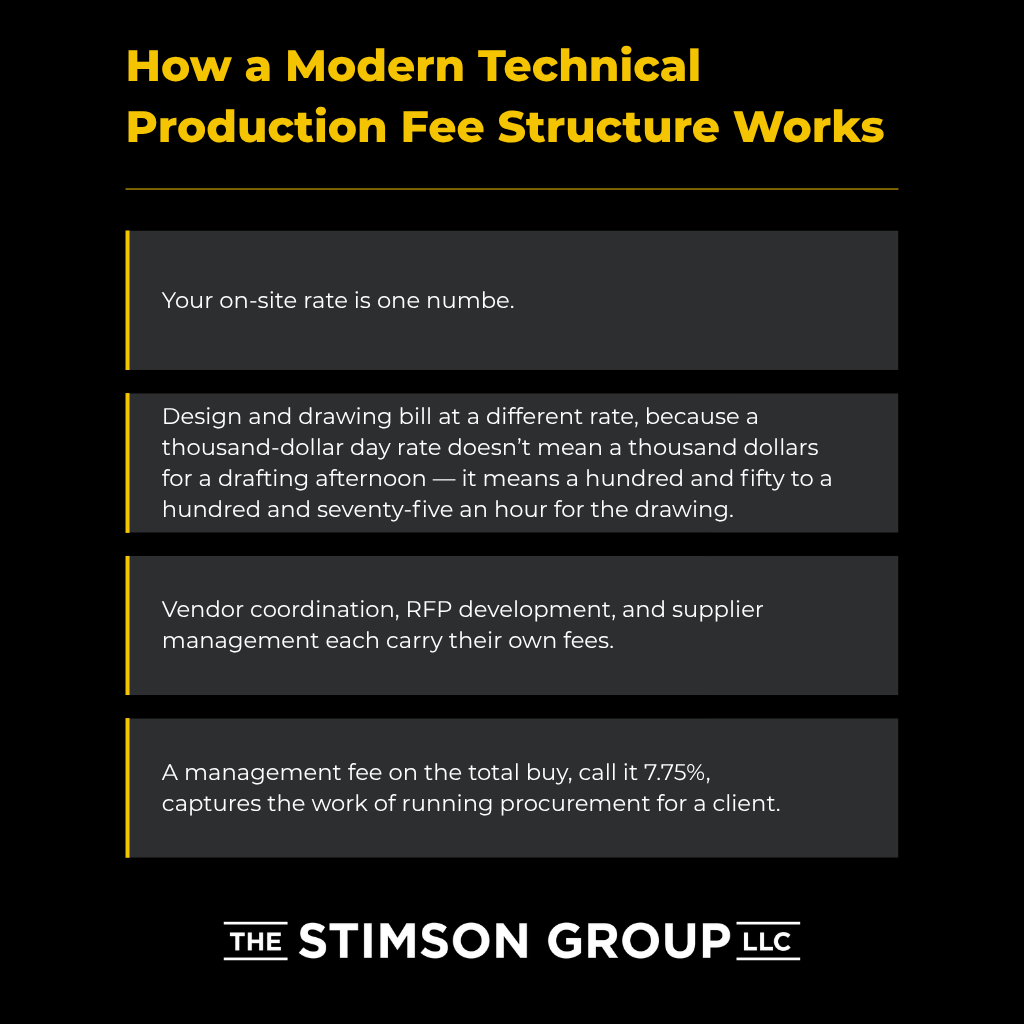
A modern fee structure separates the parts:
- Your on-site rate is one number.
- Design and drawing bill at a different rate, because a thousand-dollar day rate doesn’t mean a thousand dollars for a drafting afternoon — it means a hundred and fifty to a hundred and seventy-five an hour for the drawing.
- Vendor coordination, RFP development, and supplier management each carry their own fees.
- A management fee on the total buy, call it 7.75%, captures the work of running procurement for a client.
One rate on site. Different rates for the work off site. That kind of pricing sells your whole brain, not a single role at a time, and it protects your margins the way a flat day rate never does.
Half the People, Twice as Good
Scalability is the theme that runs through this conversation. A technical production company built on sourcing can do millions of dollars of work with six or eight people on staff, because the muscle comes in on a project basis and goes home when the job’s over.
Windfall jobs don’t reshape the overhead. I don’t rush out and buy a thousand LED panels because a windfall landed on the calendar. I’m not hiring six more technicians because three weeks in Q3 got busy. I have a clear RFP for my control needs, suppliers who can fulfill it, and a freelance pool that knows my philosophy.
Customers who work with you long enough figure out that the value is you. Not the gear. Not the inventory depth. You walking in with a bespoke branded package and your best technicians, every time.
Half the people with twice the expertise is how the best shops in this industry achieve higher revenue per head than companies twice their size.
Shift the Risk Into Your Services
The risk profile changes at every step on this path.
When a freelancer buys gear, the risk is financial. Loan payment. Lease payment. Tied-up cash that has to stay rented out, or the math breaks.
When a technician moves into the TD role, the risk shifts into leadership and relationships. The technical director lives on paper, puts the show on the page, and delivers the strategy. The technical producer lives in oversight, owns execution, and ensures it actually works on site.
At some point on that path, you become a general contractor. That’s when you’ve taken on the customer’s risk, and your fees have to reflect the scope and complexity of what you’re delivering. Defining the role cleanly is how you charge for it.
You shifted the risk from the gear to your services. Price accordingly.
The New Model Is Sourcing, Not Insourcing
The old model said you had to own the gear and staff the people or you weren’t a real player. The new model says you need to be known for getting what a job requires, on any scale, for any kind of show.
The value of insourcing is owning the stuff. The value of sourcing is the customer trusting you to procure what the show needs, assemble the right crew, and deliver. The second one is harder to replicate and easier to scale.
Drop the word “rental” from your lexicon entirely. Replace it with sourcing. “I’ll source what you need for this job, and I’ll charge you for what I source.” That’s the sentence that sells services, and it’s the sentence that protects the company when the next recession hits.
Services are the business. Rental is a tool you use when the math works.
Start Where You Are
If you’re a freelancer with gear and the gear keeps pulling you deeper into the rental model, figure out whether the gear is earning its keep. If you’re a TD who’s been billing like a technician, pick a fee structure that matches the value you actually deliver. If you’re somewhere in between, start fresh on the parts that aren’t working without gutting the parts that are.
Build a services company. Own the glue. Source the endpoints. Price for your brain, not for your inventory.
That’s the company that’ll be standing in 2035.


Leave a Reply