





Listen instead on your Monday Morning Drive:
Back in the late 90s, the company I worked for got bought into a roll-up. Lots of mergers and acquisitions in those days. We were profitable, well-run, and didn’t have a lot of financial issues.
Once we became one of 10 operating entities under a parent company, we found out what we were really good at. Among the skills on the list, we were really good at managing cash flow.
So the parent company put us on a swept-cash schedule. Every Tuesday, the CFO called us and asked how much cash he could pull from our accounts to cover payroll for the other entities.
It was a nightmare.
Cash that gets swept out of your business is money you can’t reinvest, capex you can’t spend, supplies you can’t buy, raises you can’t give. The crunch forces decisions you wouldn’t make on the merits.
You take revenue that isn’t ideal. You withhold spending that would improve the business. You build the next problem with the same hand that’s trying to fix this one.
Healthy businesses don’t have cash flow problems. They manage cash flow. Building a scalable business starts with knowing how cash actually moves through it.
Cash Flow Is the Hardest Problem to Fix
Cash flow has been the number-one coaching topic in my practice for 20 years. Almost every new client who comes to me has struggled with some version of it.
Most of the inquiries I’ve turned down over the years were companies with severe cash flow problems. Here’s why.
Cash flow is the hardest problem to fix in a business. It isn’t hard to diagnose. It can take years to solve.
If you’re already in the crunch and running behind on payroll, take the advice you get. No magic solution exists. No windfall job will make the problem disappear.
A windfall makes the problem disappear once a year, and that’s why some owners have a perpetual cash flow problem. The windfall covers the symptom, and they never fix the cause. Planning around the calendar is what catches a real cash flow problem before it becomes a habit.
Start With Profit
Don’t talk to me about your cash flow problem until we’ve talked about your profit.
This is a binary question. Are you profitable, or not?
If profit is poor, you have a cash flow problem. That’s the easy case. If profit is good and cash flow is still bad, the diagnosis takes a different path.
Most cash flow problems are profit problems. Most profit problems are overhead problems or cost-of-goods-sold problems. Neither one gets fixed by chasing more revenue.
Revenue is the band-aid most owners reach for first. It works in the short term and makes the underlying math worse over time. Start fresh on what’s actually broken, and the cash flow follows.
Overhead Is the First Stop
Your overhead is the first place to look. Too much overhead, too little overhead, or wrong-shape overhead.
If you’re carrying more headcount than the work supports, fix the roles. Reduce the number of seats and raise the bar on the seats that stay. Cash flow problems often start with a predisposition to overstaffing the business in anticipation of business.
The other side of the trap is too little overhead. When you’re under-resourced, every job costs you more to deliver.
You’re patching with freelancers at premium rates, spending owner time on entry-level work, and your cost of goods sold creeps up on every job. Why the team is always too busy is usually an overhead-shape problem, not a workload problem.
Cost of Goods Sold Comes Next
If overhead is lean and you still have a cash flow problem, look at your cost of goods sold next. Most cost-of-goods-sold problems are pricing problems.
If your business runs on a 45% to 55% cost-of-goods-sold ratio, the jobs that don’t meet that ratio are dragging the average down. Find them. Fix them, or fire them.
Eliminating jobs that don’t generate enough profit to justify the overhead it takes to service them is one of the fastest cash flow fixes you can make. More revenue won’t fix this. More revenue at the same ratio gives you the same problem at a bigger scale.
Pricing at the point of sale is where most cost-of-goods-sold issues actually live.
Look at the Revenue Mix
Now the revenue side. The question isn’t, “Do we have enough revenue?” The question is, “Is each kind of revenue actually a profit center?”
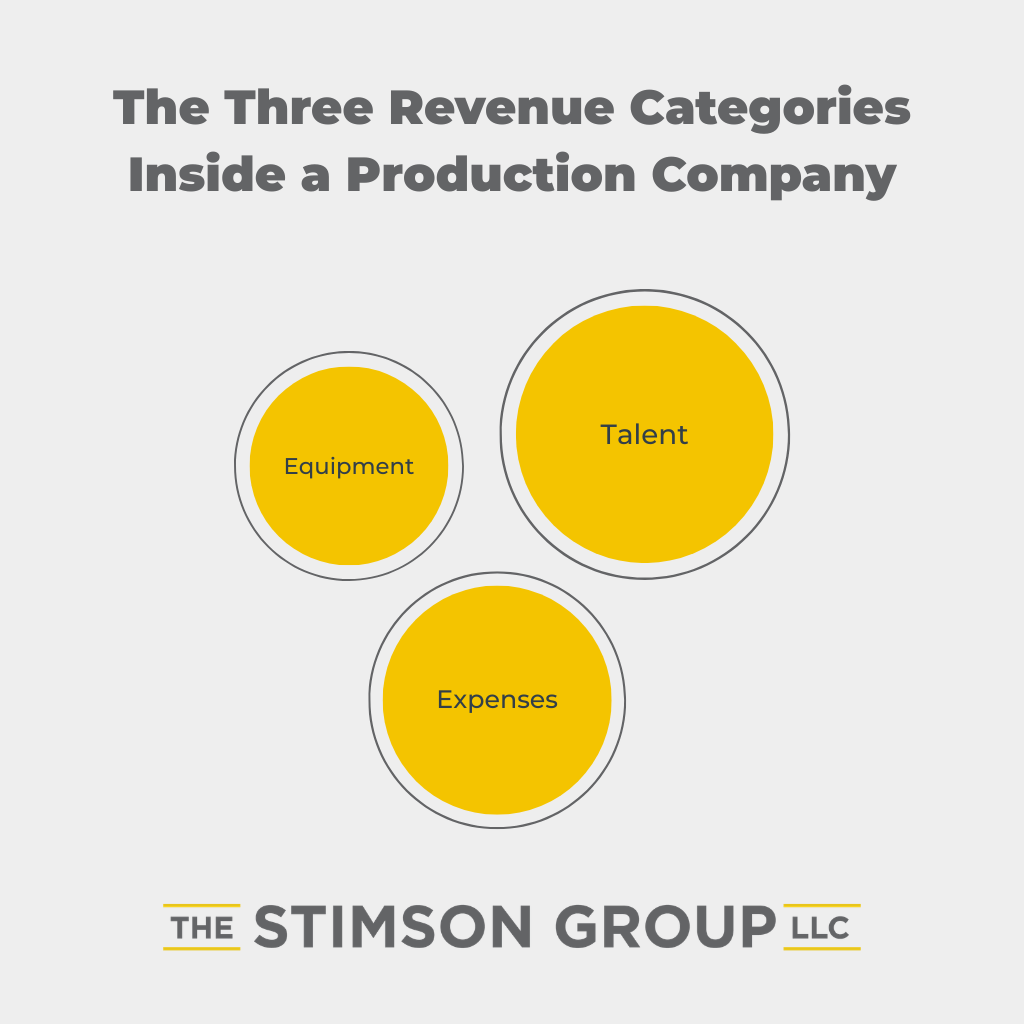
Three categories live inside most production company revenue. Equipment, talent, and expenses.
Equipment you own carries a high margin. Equipment you outsource carries a low margin.
Talent and labor tend to be priced too low because owners are afraid of scaring customers with the real number. Expenses get passed through at cost, which means the busier you are, the more money you’re moving through the books without earning a dime on it.
If equipment revenue is inflated by deflating labor revenue, you’ve traded a high cost-of-goods-sold line for a low cost-of-goods-sold line and made the math worse. Salespeople on commission won’t load enough labor onto a show if there’s no margin in it.
Every category of revenue needs to be a profit center. Not equally profitable, just all profitable. Outsourcing done right is the lever that makes equipment revenue work either way.
Fixed Costs Are Risk
Full-time technicians on staff are the textbook example. You pay them whether or not the revenue shows up.
That’s fixed cost of goods sold, and fixed cost of goods sold burns cash on the slow weeks.
You can’t run a scalable business without some fixed cost. The trick is keeping the fixed cost small enough that a slow month doesn’t hurt and a busy month doesn’t strain.
Most companies in this industry carry too much fixed cost on the operations side. Staff technicians, staff trucks, staff warehouses.
The right number of full-timers is smaller than most owners want to admit. Hire the team that fits, and outsource the rest.
The 30/50 Question
I ask every potential client a version of this question early in the conversation:
“If I could show you that reducing your revenue by 30% would increase your profit by 50%, would you be interested in figuring out how to do that?”
If the answer is no, I know I don’t have the right client in front of me. The no tells me the owner is attached to revenue as a trophy.
If the answer is yes, we can do business. The yes tells me the owner cares about profit, the team, and the family.
Revenue is a vanity metric. Profit pays the bills.
So before you go looking for more revenue, run the diagnosis. Overhead first. Cost of goods sold second.
Revenue mix third. The roadmap to balance starts with that order, every time.


Leave a Reply