





Listen instead on your Monday Morning Drive:
The longest-running fight in this industry is the one between sales and operations. I’ve watched it for 40 years.
Same fight, different decade. The names change, the headcount changes, the platforms change. The two sides still talk past each other.
Operations says the work is hard. Sales says the work is easy. Both sides are wrong, and both sides are creating the friction they’re complaining about.
The deeper issue is the handoff itself. We invented the handoff because operations got tired of listening to sales, so we drew a line and said, “After this point, ops owns it.”
That isn’t how good service businesses work. The kitchen doesn’t say, “Thanks for your order, come back when it’s ready.” If a customer wants the steak medium-well instead of medium, somebody on the floor has to walk that change back to the line.
Planning around the calendar only works when both sides keep talking.
Responsibility vs. Accountability
Two words drive every conflict between sales and operations: responsibility and accountability.
Who’s responsible for getting this piece of information into the system? Who’s going to be held accountable when a decision gets made on bad information?
Responsibility is the work. Accountability is the consequence. If somebody else is responsible for getting information to me and they didn’t, I can’t hold anybody accountable for the decision I made without it.
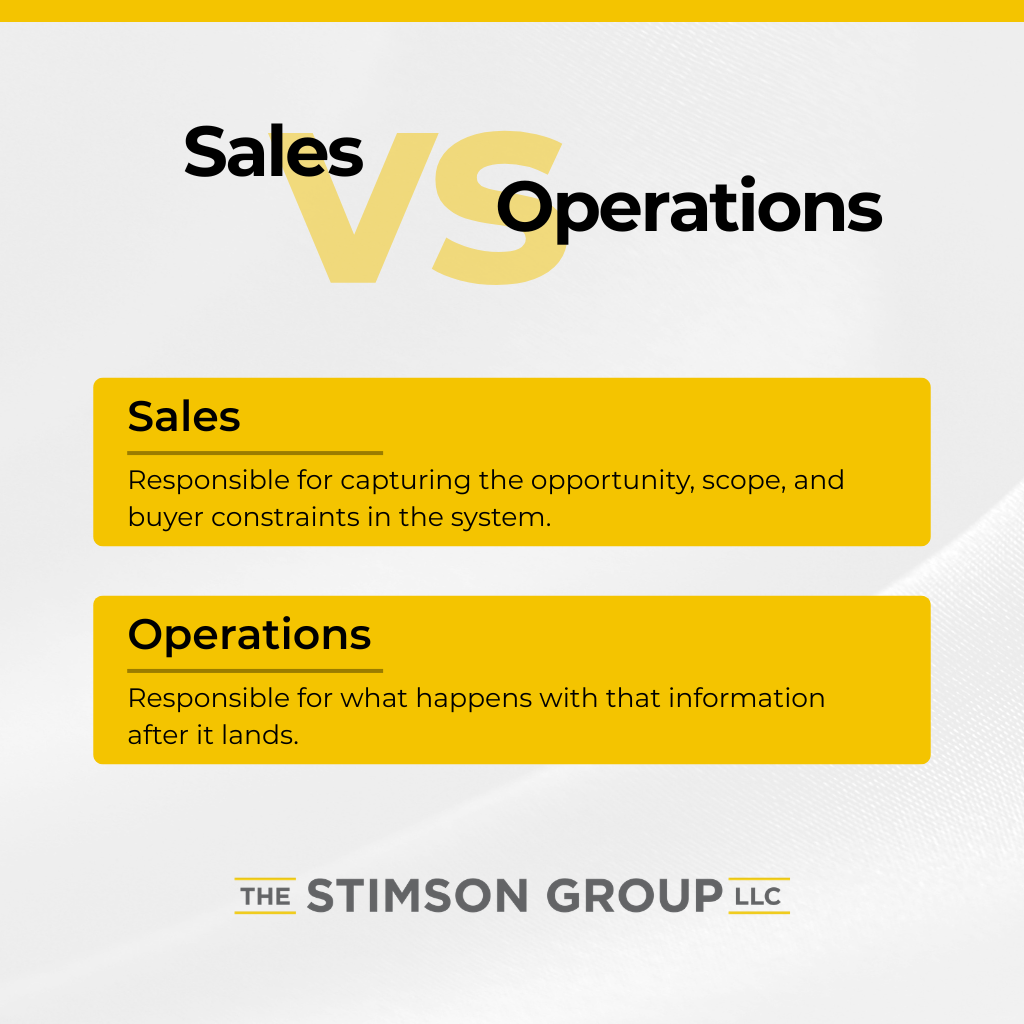
Sales is responsible for capturing the opportunity, scope, and buyer constraints in the system. Operations is responsible for what happens with that information after it lands.
Both sides are accountable for the outcome. Neither side gets to skip the work and blame the other when the show falls apart. Defining roles cleanly is what stops the blame game from running the place.
Operations, Stop Saying It’s Hard
Operations folks, I love you. I’m one of you. I’ve been there.
Your job is hard, and I take it seriously. That’s the last sentence about how hard your job is anybody needs to hear. Your job is to make it easy.
Quit telling us how hard the work is. Quit telling us how busy you are. Quit defaulting to, “Oh my gosh, we’re going to need extra people, we’re going to have to sub-rent.”
Those statements are probably true. They don’t need to be said. They aren’t useful information.
They’re friction wrapped in the language of warning.
The job is to take what comes your way and make it work. The team that says yes first figures out the how on the other side of yes.
Sales, Stop Saying It’s Easy
Sales folks, your turn.
Stop saying the work is easy. Stop trying to placate the other side. Stop trying to avoid the uncomfortable conversation.
Every order you throw on a busy person’s desk is disruptive. Get used to being the disruptor.
You can mitigate the disruption. Give operations enough information so they don’t have to chase you for it. Put the preliminaries in the system the moment you have them.
Quit shielding ops from the customer’s actual ask. Quit shielding the customer from ops’s actual capacity. Building a scalable sales process starts with telling the truth in both directions.
The Order Is the Source of Truth
Verbal communication is helpful as a heads-up. It isn’t helpful as the source of truth.
Here’s the failure mode I see most often. Sales gets an update from the client. Sales walks over to ops and says, “Hey, this changed, we’re switching the breakouts to ballroom B.”
Ops nods, makes the mental note, and keeps working. The order in the system never gets updated.
Three days later, somebody else opens the order, plans the load-in for ballroom A, and the whole show breaks.
Once you’re in order management, the order is the only source that counts. Verbal communication is a courtesy saying, “I’m about to update this, so here’s a heads-up.”
If the update never lands in the system, the verbal communication didn’t happen. The warehouse runs on order discipline.
Show Levels Are the Common Language
Here’s the tool I’ve been building. Ten levels of show. Most companies live in levels three, four, and five. About 90% of the people I work with have never done a level seven show. Many have never seen one.
The level isn’t about quality. The level is about complexity, and complexity drives every operational decision downstream. If sales and ops agree on the level at the point of the inbound call, the rest of the conversation gets easier.
Level one is the bare minimum. Two speakers on a stick. A microphone.
You set it up, turn it on, make sure the customer can use it, and stand by in case they need help. No operator. You might sit in the truck or down the street with your phone on.
Level two is basic attentiveness. Same system with an operator. Somebody behind the console is moving the mic up and down, adjusting levels based on how loud the audience is, giving the presenter confidence that the system is being monitored.
Level three is multiple elements. Speakers on a stick, a microphone on the podium, some lighting, audio playback, maybe a basic video element.
Now we need an AV engineer, not an AV tech. The AV engineer is a technical generalist with customer skills who can help the client think through what they’re actually building. Starting fresh on the language is the cheapest way to fix the sales-ops friction.
Levels Four and Five
Level four is where specialists show up. We’re past the point where a single AV generalist can carry the show.
We need an audio specialist, a lighting specialist, a video specialist, and someone to coordinate among them. That coordinator is a technical director, even when we don’t call them that on the org chart.
A level four show has technical rehearsals. We rehearse for the crew. We make sure the rigging points are shared cleanly, the truss moves the way it needs to, and the lighting cues fire when the video plays.
We’re choreographing the technology to itself.
A level five show adds talent rehearsals. We rehearse for the client. The presentation becomes the star, and we are the tools that help the client deliver.
Level five is also where staff technicians stop being a good idea. You don’t want a level-five technician walking up to set a microphone, and you don’t want a level-two technician trying to call cues. Half the people with twice the expertise start to matter at this level.
Level Six and Beyond
Level six is a level five with a professional show caller. Higher standards. Better crew.
The caller is either someone you hired or someone the client hired, but either way, they’re not the project manager moonlighting between phone calls. They’re a specialist whose only job that week is to call the cues.
That’s when crew quality becomes the difference between a great show and a forgettable one. Anybody can hit the cue if they call it themselves. Hitting the cue every time someone else calls it is a level six result.
Levels seven, eight, and nine push deeper in the same direction. Bigger crews. More choreographed transitions.
Tighter margins on the technical execution. Most of my audience doesn’t live there, and that’s fine.
The growth path from level five to level six is plenty of work for any company. Hire the team that supports the level, and the rest follows.
Lead With the Level
Here’s the move. The next time sales takes an inbound call, the first detail they enter in the CRM after the buyer’s name and date is the level of show.
“I just got off the phone with a client. We’ve got a level three show. I need a general AV engineer to do this job. Two elements. Notes are in the order.”
That sentence does more work than 20 minutes of back-and-forth in the hallway. Operations now knows the complexity, the crew profile, and the rough shape of the order before they open the system. Lead with the level, and the operational decisions start to make themselves.
If sales doesn’t know the level yet, mark it as TBD and start asking the questions that get to the right answer. Don’t sit on the inquiry. Don’t shield ops from the ambiguity.
The roadmap starts with shared language, and the level is the shared language.


Leave a Reply