





Listen instead on your Monday Morning Drive:
I went to a four-hour minimum gig in a coat and tie one day in the ’80s. It turned out to be a teardown, and I was the only technician on the crew wearing a coat and tie. I was also the only technician on that crew who was rehired. Draw your own conclusion.
This blog post is a love letter to freelancers. Some of you are good. Some of you are great.
The gap between the two isn’t technical expertise. The gap is self-awareness, and it appears in the details.
Good freelancers get called once. Great freelancers get the next call.
A note for the hiring side before we go further: If you keep telling me you can’t find good freelancers, check whether you’re a place a great freelancer wants to work. Plenty of you are barely attracting good ones. Read this one from both sides of the table.
Don’t Punch Above Your Weight
Self-awareness starts with knowing what you’re qualified to do. Whatever you think you’re qualified to do, odds are you’re off by a level.
If a dream gig lands in your inbox, A1 for a national corporate event with a live act coming in, and you’ve never done it before, turn the work down. Offer to come in and watch for free. Do not hire yourself for a gig you aren’t ready for.
Punching above your weight is the worst career move a freelancer can make. One bad gig rewrites your reputation faster than 20 good ones can rebuild it.
Disclose Your Limits Before the Show Site
I hired a freelance video guy as the projectionist for a gig where he ran a switcher by himself. He told me straight up, “I don’t run switchers. I’m not a video TD.” I asked if he could hook it up and make a picture come out. He said yes.
He disclosed the limit. I disclosed what the job actually needed and what backup we had.
You earn the right to stretch by telling the truth about your limits. I needed a calm person in a firefight who could talk to a client. That was him. That’s what the employer is buying when they hire you.
Dress Codes and Decorum Still Matter
Ask about the dress code before you show up. AV is a young industry, barely 50 years old, while theatre has millennia of tradition. Corporate events and entertainment tours have different rules, and you need to know which room you’re in.
If they expect you in slacks and a collared shirt for a load-in and you’ve never done that, you’re about to find out whether you fit the gig. Sometimes that’s a career step up. Sometimes you’re walking into a failure.
I worked with a tech who had full sleeve tattoos in the ’90s. I never knew he had them because he always wore long sleeves. Another tech I wanted to work with had face tattoos and a shaved head. There was no corporate event, not even a teardown, where I could place him.
How you present at the door decides the work you get.
People Skills Beat Technical Expertise
Every technician on one of my shows was customer-facing. If a producer or a CEO walked up to a tech on a headset and wanted an answer, every tech on that crew was available to give one. My crews didn’t have room for a technician who needed a buffer between them and the client.
The answer to every question is not, “No, because I’m the expert.” That’s a jerk dressed up as competence. A great freelancer listens, says yes when it’s reasonable, and asks for help without a fight.
Technical experts with no people skills get one gig. The pros who can be in the room with a client get the next five. People skills are the hardest trait to train and the easiest to spot.
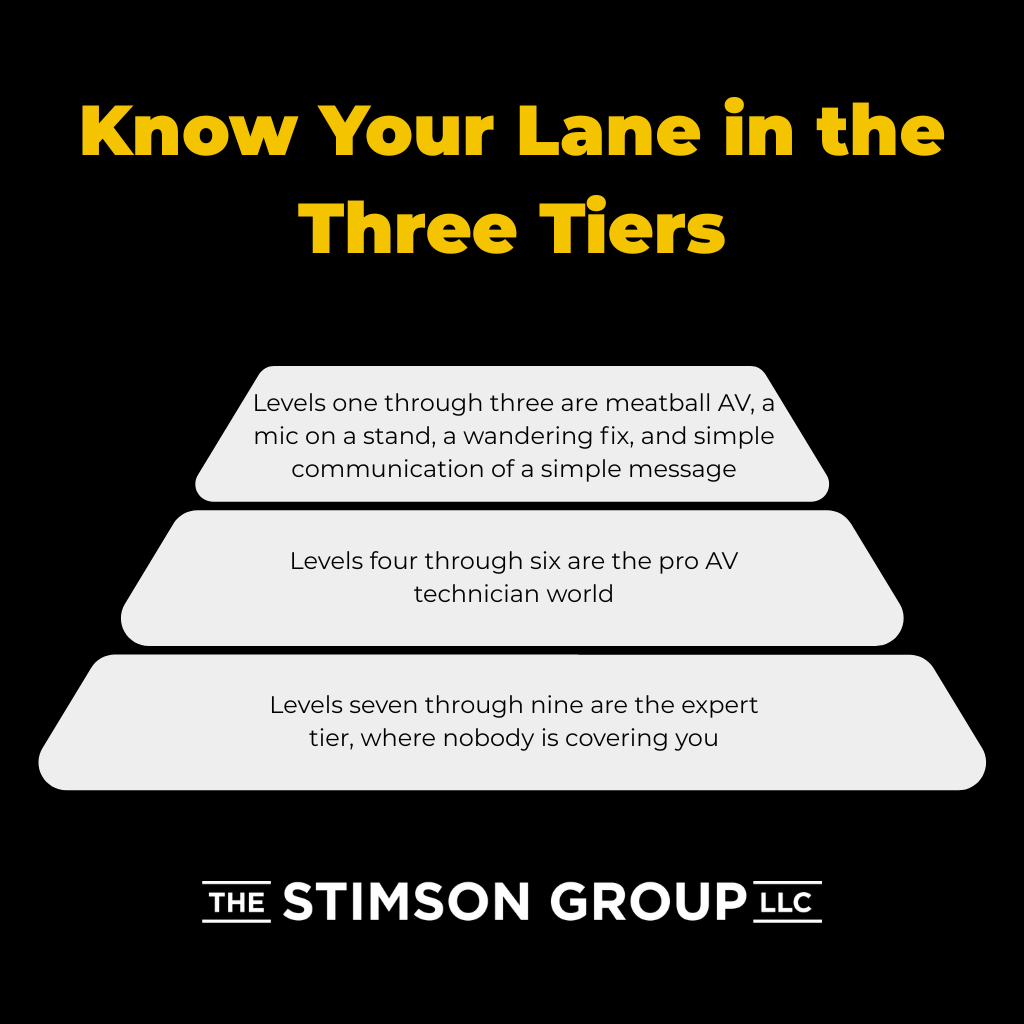
Know Your Lane in the Three Tiers
Shows run across 10 levels, and the middle is where 80% of the freelance work lives:
- Levels one through three are meatball AV, a mic on a stand, a wandering fix, and simple communication of a simple message
- Levels four through six are the pro AV technician world
- Levels seven through nine are the expert tier, where nobody is covering you
A level four show has a production manager calling the shots. A level five needs real coordination, show calling, and professional transitions. A level six is mission-critical, and the show caller has to be better than the crew.
Knowing which level you’re on is how you stop resenting the gigs you’re not getting. A great freelancer owns the level they work at and gets paid reliably to own it.
Pick a Rate. One Rate.
Pros have one rate. It doesn’t matter whether they’re doing the Academy Awards or a pharmaceutical show in a Marriott ballroom. The show is the show, and the rate is the rate.
Mid-level freelancers price like they’re renting out by the role. A1 rate. Camera op rate. Lighting rate.
Stop. When I hire a freelancer, I’m hiring 100% of their brain, and I want all of it on the gig.
One rate sells your whole brain, not parts of it. A consistent rate protects your pricing and prevents the conversation from turning into a negotiation whenever the role flexes.
Do What the Job Needs
Be mindful of where you fit. Embrace the space you’re in. Don’t resent the gigs you’re not getting.
The freelancer who retires well works 150 or 170 days a year on level five shows, doing excellent work every time. That’s a great career by any measure.
The difference between good and great isn’t expertise. It’s aptitude, and aptitude is visible in the details. Show up self-aware, dressed for the room, and ready to take direction.
That’s who gets called back.


Leave a Reply