





Listen instead on your Monday Morning Drive:
I had a lot of jobs before AV, and one of my favorite ones few people can relate to. I spent a summer as an assistant manager at a foreign-car salvage yard in South Dallas in the late 1970s.
The yard handled foreign cars only. American car yards did American cars; foreign car yards did foreign cars, and neither side crossed the aisle.
Each side ran on its own body of knowledge.
The salvage-industry split maps directly onto live events. Corporate people don’t do entertainment, and entertainment people don’t do corporate. The tools are the same; the ethos is different.
The accidental entrepreneur pattern shows up in both worlds.
The first day at the salvage yard, my boss handed me a three-ring notebook and a pencil. His instruction was simple: “When I tell you a price, write it down.”
The salvage-yard notebook taught me more about pricing than any spreadsheet or rental sheet ever did. Here’s what I learned that summer, and what applies to every AV quote you send.
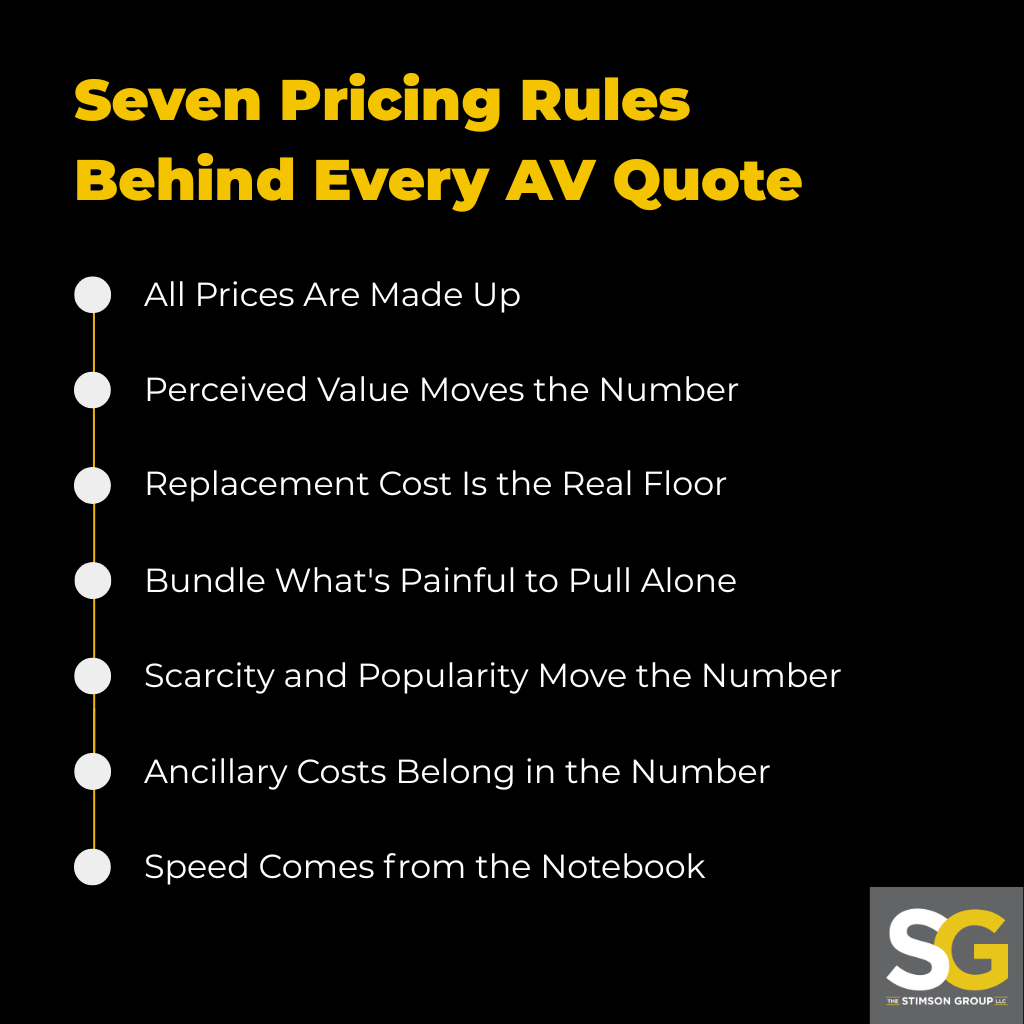
All Prices Are Made Up
Here’s the reality nobody at the salvage yard would say out loud, and nobody in AV wants to admit. All prices are made up.
The rental sheet on your desk right now was somebody’s best guess at what a Shure SM57 rents for. My boss’s price on a 1972 Toyota Corolla left front fender was his best guess at what customers would pay.
Neither number came from a spreadsheet with a formula.
Pricing is a decision, not math. The decision gets written down so you can defend it and repeat it.
Made-up prices aren’t random prices. Great pricing rests on real anchors: replacement cost, what the buyer values, and how hard the part is to source.
The number itself is a call, not a calculation. Pricing at the point of sale is what you’re actually being paid for.

Perceived Value Moves the Number
A left front fender for a 1972 Toyota Corolla sold for $80. The same part for a 1972 Toyota Celica sold for $95.
Same manufacturer. Similar year. Roughly the same effort to pull off the car.
The Celica cost more because Celica owners valued their cars more. The Corolla was the entry-level family car, and the owners paid the minimum to keep it running. The Celica was the sportier upgrade, and the owners spent more to keep it looking nice.
Buyers show you what the number is if you pay attention. A corporate client running a leadership offsite for the C-suite values the same audio system differently than a sales team running a training day at a Holiday Inn Express.
Same gear. Different perceived value. Different prices work for different customers, and both prices can be correct.
Replacement Cost Is the Real Floor
A new Toyota Corolla fender from the dealer cost $220 in 1978. My used one sold for $80. That gap was the whole reason customers called the salvage yard.
The dealer number was the ceiling. The salvage number floated somewhere below it, tied to how easy the part was to source and how much the customer valued the car.
Every quote you send has a ceiling and a floor. The ceiling is whatever your customer would pay somewhere else. The floor is whatever it costs you to source the same result.
Your number lives in between. The updated pricing strategy treats that range as an opportunity, not a constraint.
Bundle What’s Painful to Pull Alone
A single left front fender took a specific amount of work to pull off a car. A full front clip took barely more effort.
The front clip came with the hood, the grille, the headlights, the marker lights, the hinges, and the springs. The front clip on a 1978 Toyota Celica sold for a lot more than the fender alone. But the customer who needed a fender, a hood, and a grille got a much better deal on the front clip.
Bundling makes sense when pulling the parts individually is a pain. The mic without a stand and a cable is a bad experience for the customer. Pulling a single fender that’s bolted to five hidden brackets is a bad experience for the puller.
Both cases price the bundle. Outsourcing the bundled solution is the same logic, one step up.
Scarcity and Popularity Move the Number
A left front fender for a 1978 Honda Accord sold for twice what a Toyota Corolla fender sold for. Same era. Similar segment.
Different math.
Two forces drove that Honda number. Popularity meant demand was high. Scarcity meant supply was low.
Popular parts on hard-to-find cars carry a premium unrelated to the labor cost of pulling them. That premium is real, and it’s where a smart salvage manager made the money that funded the parts that didn’t sell as fast.
The same principle applies in AV. LED wall panels on a Friday in September during peak trade-show season aren’t the same rental rate as LED panels on a Tuesday in July. Managing the seasonal calendar is what turns scarcity math into a price advantage.
Ancillary Costs Belong in the Number
The $80 price on a Toyota fender didn’t include hotshot delivery to the body shop. It didn’t include weekend overtime for the puller. And it didn’t include the $12 in bolts I had to buy because the fender came off with three broken ones.
Those were separate charges, and I learned to write them into the quote before the customer asked.
Replacement cost covers the item, the labor, the freight, and the weekend rates. Take one out, and the number underprices the job.
The $7 microphone price is wrong when full delivery to the show requires $20 of work around it. The right price is $20, because $20 includes the labor, the cable, the stand, and the delivery that make the mic usable. Delivery costs live in the number, or the number is off.
Speed Comes From the Notebook
The whole point of the salvage-yard notebook wasn’t to price fairly. It was to price quickly.
By August of my junkyard summer, I could quote a fender, a bumper, or a rear window in under 30 seconds. Not because I was smart. I had a notebook full of prices my boss had already vetted.
The same notebook trick works for AV. Every time you look up a sub-rental cost, a freelancer’s day rate, or a shipping quote, write the number down. Include the source, the date, and the terms.
Two months of notebook discipline turn a slow quote into a fast one. Six months turn it into muscle memory. Fast quotes build the sales engine that carries the rest of the year.


Leave a Reply