





Listen instead on your Monday Morning Drive:
My first job in this industry was rental manager.
I had the general manager above me and two people in the warehouse below me. I was running operations. The title fit at the time, but seven or eight years later we changed it to “director of sales and operations” because I was signing contracts with national agencies, and the rental-manager title didn’t carry the gravitas the room expected.
The role didn’t change. The title did, because the title is outward-facing and the role is inside work.
That distinction matters more than most owners give it credit for. I sit in too many meetings where a $2 million company has a CEO, a CMO, a COO, and a CFO, and the same person owns the customer relationships, the budgets, the warehouse, and the trucks. The titles came out of a Fortune 1000 org chart that doesn’t fit. Meanwhile, the actual roles inside the company are confused, overlapping, and missing the work that needs to get done.
Building a scalable org chart starts with admitting which roles you have and which ones you’re missing.
The Account Executive
The account executive owns client relationships. A client is a buyer who brings you every opportunity and expects you to figure out how to help them. They aren’t running individual transactions through your shop. They’re running their entire book of business with the assumption that you’ll match your resources to their needs.
That’s a strategic relationship, and it needs a strategic role to maintain it. The account executive doesn’t write every order or hire every technician. The account executive widens and deepens the relationship inside the client’s organization.
Their primary job is to turn the bow tie into a diamond. Most buyer-seller relationships start as one person talking to one person, and that’s the most fragile setup you can run. The AE gets the buyer’s procurement person talking to your project manager, the buyer’s CFO talking to your operations director, and the buyer’s executive sponsor talking to yours.
Knowing your perfect customer is the prerequisite, because you only invest that energy in clients who match.
The Account Manager
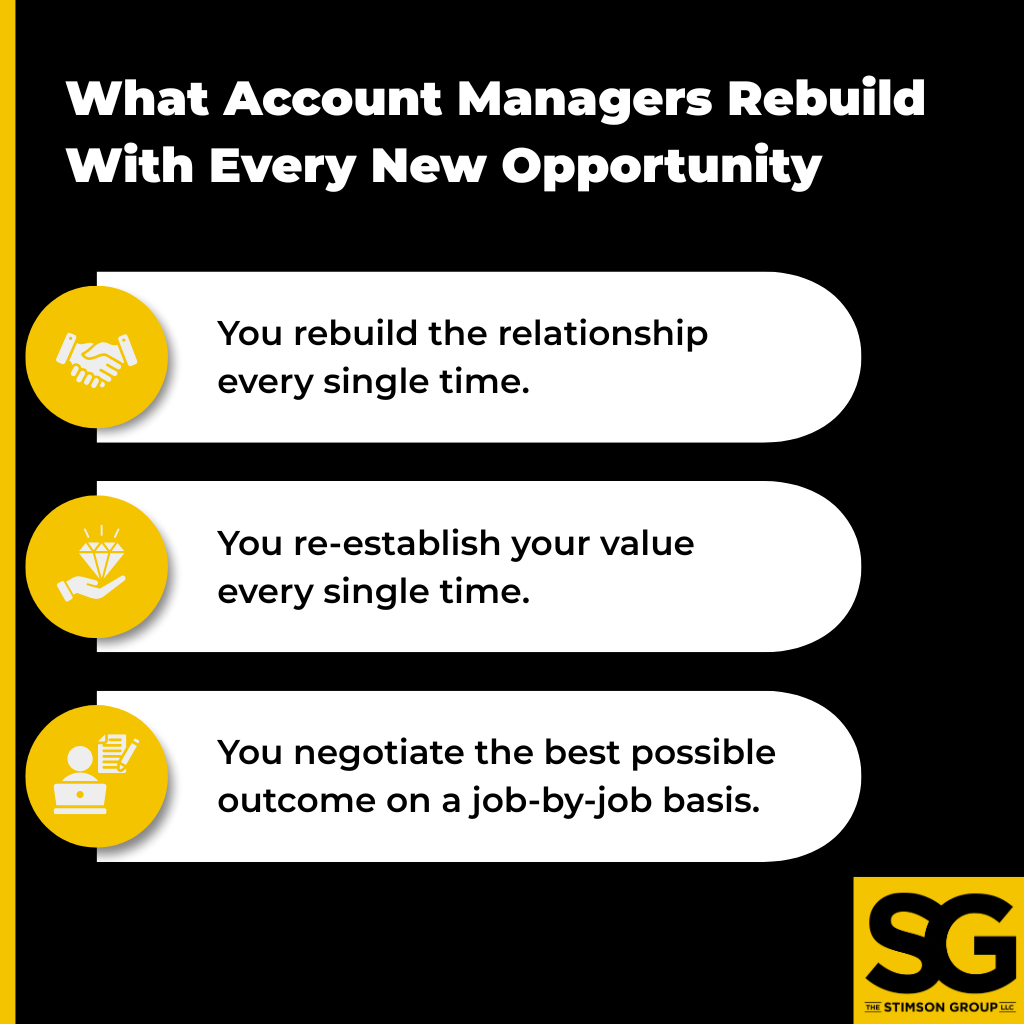
The account manager handles customers, not clients. A customer brings you one opportunity at a time. They develop their own RFPs, they shop the work around, they entertain other vendors, and they push back on price.
That’s a transactional relationship, and it needs a tactical role to handle it. Each opportunity stands alone. You rebuild the relationship every single time. You re-establish your value every single time. You negotiate the best possible outcome on a job-by-job basis.
About 90% of our industry runs on account managers. They’re the most common role on the org chart, and they’re the most interchangeable. If one account manager is too busy, another picks up. If a customer doesn’t click with one, another takes the relationship. That kind of process scales in a way that one-relationship-per-buyer never can.
The Customer Service Rep
The customer service rep is your triage line. Easy orders, packaged services, small events, rentals. The work that doesn’t require a discovery call or a custom proposal. Press conferences. Rental orders. Deliveries with setup.
A customer service rep can’t write a show. If the inbound call turns out to be a major event that just didn’t know how to develop an RFP yet, the customer service rep escalates to an account manager. The triage is the role, and the script is the tool that makes it work.
Here’s the failure mode I see most often. The owner doesn’t trust the customer service reps or the account managers to field inbound calls, so every inquiry routes to the account executive. The account executive gets bogged down taking small orders and returning calls to people who weren’t ever going to buy big.
The fix is counterintuitive: All unqualified calls go to the customer service rep first, with a script to help them qualify or escalate. Filtering at the front door is the whole game.
The Project Coordinator
The project coordinator is an assistant to the sales manager, not to the salespeople.
That distinction matters. As soon as you assign a project coordinator to the salespeople, the salespeople stop doing their own work and dump it on the coordinator. The coordinator drowns. The salespeople drift. Nobody owns the outcome.
Project coordinators liaise with the planning team, liaise with the admin team, and step in to relieve overload on the account executives, account managers, and customer service reps when the sales manager directs them to. It’s a directed role, not a free-for-all. That kind of structure protects the team from the dumping-ground pattern.
The Sales Director
Your first “sales director” is usually the salesperson who was there first. The owner gets tired of managing the other salespeople, picks one of them, and gives them a new title. I’ve watched this for 40 years. It doesn’t work.
The director of sales is not a salesperson. They don’t manage accounts. If you need them to write orders and manage accounts, you don’t have a sales direction problem. You have a sales capacity problem.
The director of sales manages the process and the roles inside sales: the forecast, the metrics, the margins, the training, the coaching. They might show up for the occasional capabilities pitch to shake hands and look impressive, but the day-to-day work is administrative. You only need one once your selling team gets to four or five people. Below that, the owner manages sales.
Hiring the director before you need one creates a layer that doesn’t earn its keep.
Business Development
Business development is the human face of marketing. Most of your marketing is digital: push content, social media, email, search. Marketing softens the beach. It moves leads to prospects. It can’t shake hands, develop a personal relationship, or close the loop with a buyer who’s almost ready.
That’s where business development picks up. The BD role attends conferences, runs the outreach, delivers warm cookies, and puts a human in front of qualified prospects to help them see themselves doing business with you.
Business development doesn’t write orders. They don’t close deals. They don’t go on shows. Their job is to deliver a qualified opportunity to an account executive or an account manager and get out of the way. If they hand off a request for a capabilities pitch, that’s a win. If they hand off a discovery call, that’s a win. If they try to write the proposal themselves, that’s a miss.
Defining the BD role cleanly is how you stop confusing it with sales.
Fix the Roles First
So, what titles do you change?
You can fix the titles later. The titles are outside-facing. They influence how your customers perceive your company, and they need to make sense in the market.
Look at your team first. Do you have one person owning client relationships strategically, or is everybody bouncing between strategic and tactical work? Do you have account managers who can swap a customer back and forth, or is every customer locked to a single salesperson who’s drowning? Do you have a customer service rep filtering the inbound, or is every inquiry hitting your most senior people? Do you have a sales director managing the process, or is your top salesperson trying to coach the team between calls?
If the roles aren’t right, no title change will fix the work. Start with the role chart. Fix the titles in the next round. The roadmap starts with the role chart, not the title board.


Leave a Reply