





Listen instead on your Monday Morning Drive:
The hardest word in business is no.
We don’t like saying it. I can’t say no to revenue. I can’t say no to my employees. I can’t say no to my customers. I can’t say no to my suppliers.
Look at thriving companies in any industry, and what you’ll notice first is that they’re remarkably good at saying no. They do it so effortlessly, you barely notice. They’re great at saying yes, too, but the yeses come from a tight filter that quietly rejects most of what comes through the door.
That filter is what separates a strategically minded company working toward an outcome from a tactically minded company working toward a moment.
Get to No Faster
Years ago, on the consulting circuit, I picked up a little book called “The Positive Power of No.”
I liked the title. I’d already read the much more famous “Getting to Yes,” and I didn’t like that book at all. Didn’t like the techniques. Didn’t like the implication.
What I liked about “The Positive Power of No” was the speed it taught. The faster we get to no, the less time we waste finding out it was always going to be no. And that opens up time for the better yeses.
That’s why I always tell salespeople a job description nobody puts in the offer letter. Your job is not to confirm orders. Your job is to find out as quickly as possible which deals you can stop chasing. The sooner you get to no, the more energy you have to cultivate better yeses.
A scalable sales process is built around speed to no, not speed to yes.
Customers vs. Clients
Thriving companies make a sharp distinction between customers and clients. A customer is a transactional buyer. They show up with a specific ask, well-defined bumpers, and a price point. “I need 10,000 left-handed widgets.” If you make right-handed widgets, you say no, and nobody gets hurt.
A client is an enterprise buyer. They show up with a bigger ask, fewer bumpers, and the expectation that your resources will flex to meet their needs. They want a service. They want a range of services. They want you to figure out the shape of the work for them.
You don’t get to tell clients no. You get to tell them, “Yes, but.” “Yes, but it’ll cost this.” “Yes, but the timeline shifts.” “Yes, but here’s what we won’t do.”
That “but” is a strategic no inside a yes, and knowing your perfect customer is what tells you which conversation you’re in.
No on Investment, Too
The revenue-side no is the obvious one. The investment-side no is the one most companies skip.
Imagine a client asks you to buy $5 million of LED wall for their tour. Six months, six shows, then the wall comes home. A large company looks at that and asks two questions. Is this client a gateway to future business? Will the LED wall stay billable after the tour ends? If both answers are yes, they invest. If either is no, they outsource the wall and absorb a thinner margin on the one job.
A smaller company looks at the same ask, sees the revenue, says yes, and figures out how to pay for the wall later. That’s the investment trap. Outsourcing protects the balance sheet when the math doesn’t pencil out for ownership.
Appropriate Revenue, Measurable Quality, Tight Scope
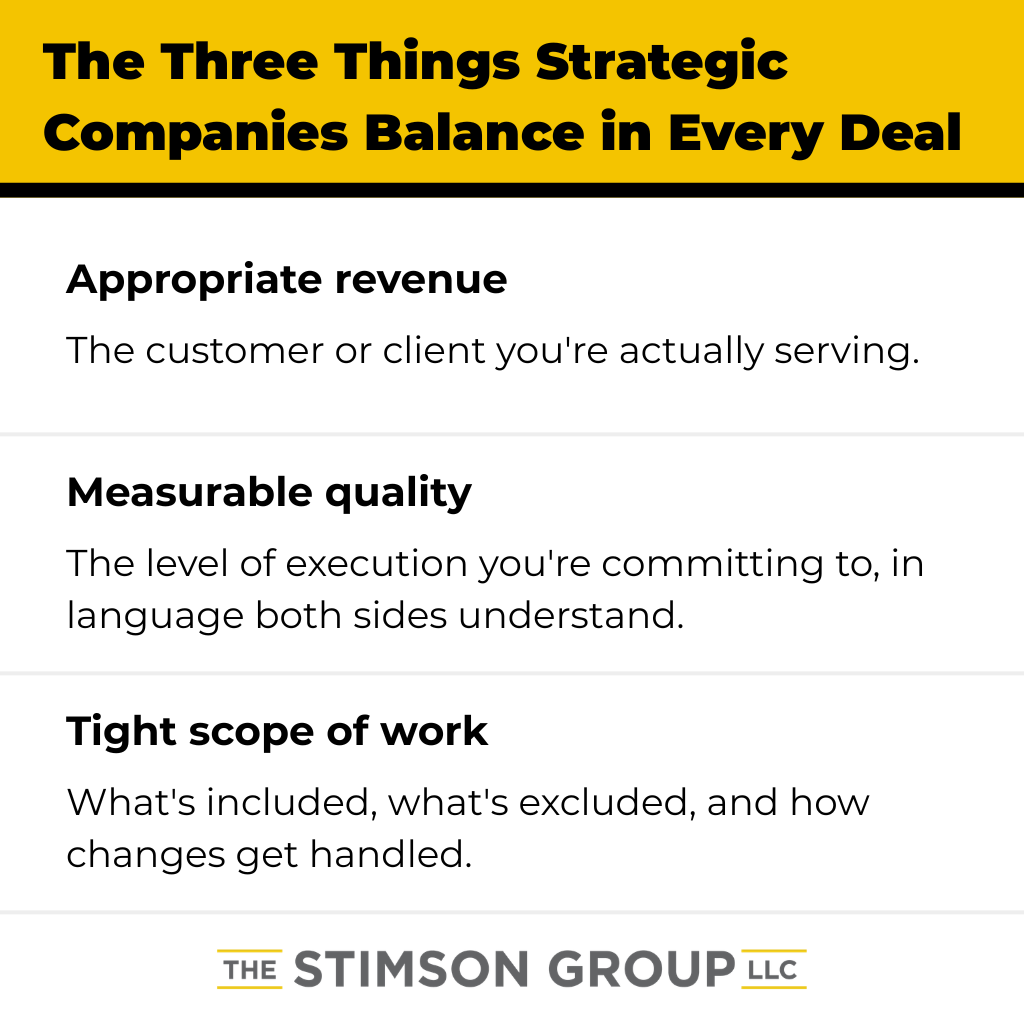
Strategic companies balance three categories at the same time. Appropriate revenue, measurable quality, and a tight scope of work. Get all three right, and the company runs itself. Get any one of them wrong and the other two start to wobble.
Appropriate revenue is the customer or client you’re actually serving. They want what you sell. The price point matches what you charge. You’re not bending your business to make the deal work; the deal already fits.
Measurable quality is the level of execution you’re committing to, in language both sides understand. “We’re great; everybody says so” is not a measurement. Measurable quality is what you discuss at the point of sale, with the buyer, before anybody starts building.
Tight scope of work is what’s included, what’s excluded, and how changes get handled. Without exclusions written down, every later request becomes a yes by default. Pricing at the point of sale lives and dies on the scope.
When One of the Three Is Missing
Three failure modes line up with the three balanced categories. Each one shows up in a different place on the P&L, and each one points back to the no you didn’t say.
The scope-loose case is the classic. Appropriate revenue, measurable quality, but no exclusions written down. The customer pushes for more. The supplier reconciles in the customer’s favor every single time. Margin vaporizes, and feelings get hurt on both sides.
The wrong-revenue case is more subtle. Measurable quality and tight scope, but the buyer doesn’t value what you do. Gross profit shrinks every time you sit down at the table. They push back on price. They look at every line item like they’re shopping for a steakhouse and ordering off the kids’ menu. That’s a pricing fit problem, not a pricing one.
The quality-mismatch case is the noisiest. Appropriate revenue and tight scope, but the technicians know they’re being asked to deliver one level and the client is expecting another. Project managers spend their week reconciling the gap. Stress ensues. Quality mismatch is a warehouse problem before it’s a P&L one.
Start at No, Then Find the Yes
Tactical companies start at yes. They look at the deal, see the revenue, say yes, and figure out the details later. Three weeks in, they realize it was never a yes to begin with.
Strategic companies start at no. They look at the deal, see the revenue, and ask whether their resources, their margins, and their scope match the ask. If they do, they find the version of yes they can keep. If they don’t, they pass.
It sounds harder than the alternative. It isn’t. The default-yes path drowns you in projects that never quite fit. The default-no path makes you pickier, smaller, and more profitable. Saying no is a scalability move.
The Grass Isn’t Greener
The grass is always greener on the other side, as Grandma used to say. It isn’t. Thriving companies look easy because the no work is already done before you arrive. The filter is in place. The categories are balanced. The next yes is going to fit.
For the rest of us, focus on the next decision in front of you. Appropriate revenue? Measurable quality? Tight scope of work? If all three are yes, the project is worth the energy. If any one is no, walk away and find a better yes. The picky companies win the long game.
Get to no faster. Find the yes you can keep.


Leave a Reply