





Listen instead on your Monday Morning Drive:
Overstaffing is one of the biggest quiet problems in our industry.
Most owners don’t see it. They see the payroll number and the schedule, and they tell themselves the two have to match.
Understaffing at least has a fail-safe. If you come up short, you bring in temps. You outsource. You over-hire for a week and then send everyone home. The business bends and recovers.
Overstaffing doesn’t bend. The more people you have, the more work it takes to keep them busy.
Cutting headcount is one of the hardest conversations on the calendar. Lean teams beat big teams at nearly every revenue level, and yet most of us keep adding bodies.

Three lies keep us overstaffed, and they get repeated in management meetings until they sound like gospel. Here’s how to spot them.
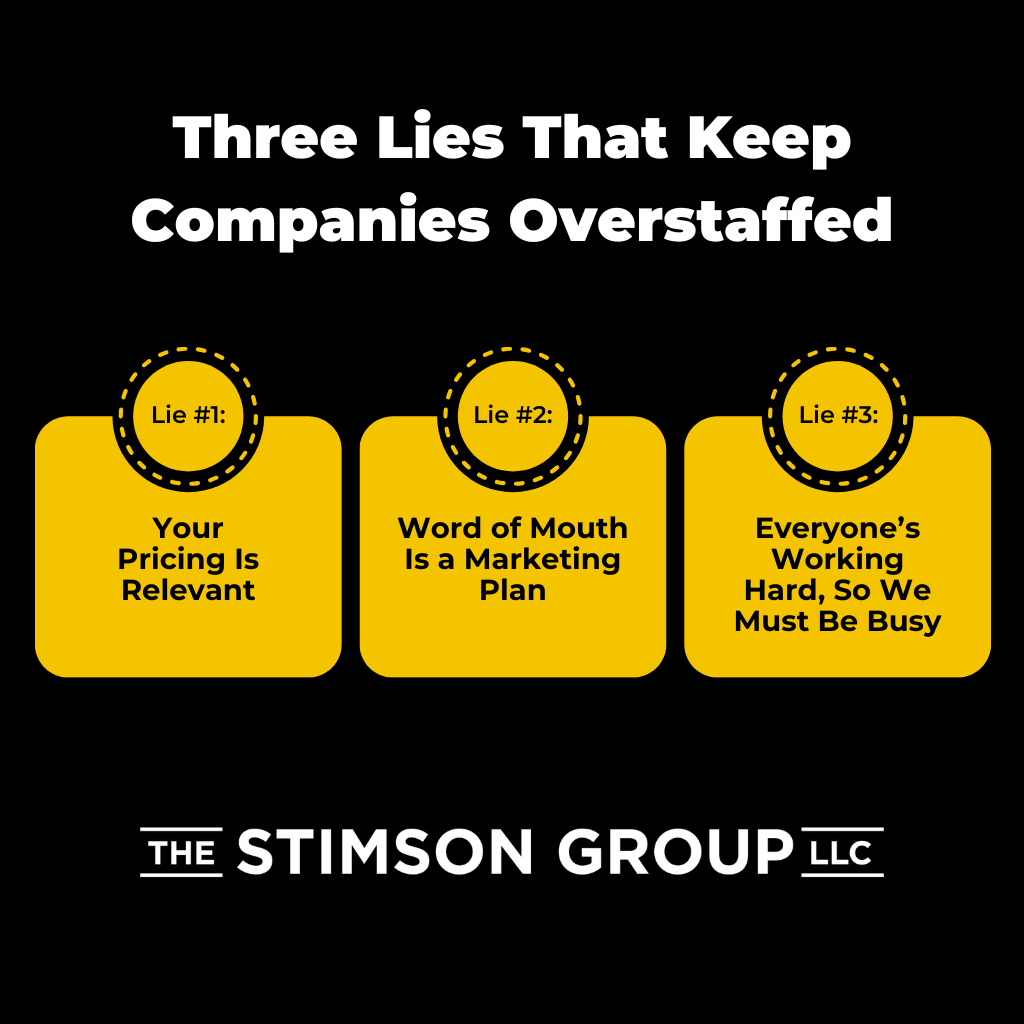
Lie #1: Your Pricing Is Relevant
Very few companies check their pricing with any rigor. “We assume it works because the client didn’t push back on the last one.” “We assume it doesn’t work because the client pushed back on this one.”
That isn’t pricing. That’s self-correction on a hunch.
Most of our pricing failures are team-driven, not market-driven. “We can’t charge for that.” “Why charge more for a projector? The specs didn’t change.” And so the price stays flat while the value we deliver keeps climbing.
Pricing is cost plus value. The cost is what it costs. The value is what the customer extracts from the work, not what you think the work is worth. Value is how much the customer feels they got for the money, and that number is almost always higher than your line item.
Two customers hiring you for the same specification don’t have to pay the same price, because they don’t value it the same way. That’s a hard adjustment for businesses raised on black-and-white rate cards. Ignore it long enough, and you’ll keep hiring people your pricing won’t actually support.
Raising prices is the fastest path out of overstaffing. If your pricing is wrong, every staffing decision downstream is wrong.
Lie #2: Word of Mouth Is a Marketing Plan
Ask most owners for their marketing plan, and they’ll say “word of mouth.” What they mean, if they’re honest, is “dumb luck.”
The phone rings sometimes. One good call saves a slow month. We tell ourselves that’s the plan.
Bad months reinforce the story. A surprise job pays the payroll. The dopamine hits. Word of mouth must work. So we keep relying on it, and we keep staffing for the magical job that may or may not appear.
Word of mouth isn’t intentional. It’s accidental, and it’s not a reason to keep a dozen people on the payroll waiting. If that’s the whole plan, you’re one slow quarter away from a layoff conversation.
If you actually want to know whether marketing is working, look at your numbers. Close rate. Lead time. Margin. Trend lines. Those tell you whether to lower your price, raise your value, or chase different buyers.
Objective numbers beat hopeful stories every time.
Lie #3: Everyone’s Working Hard, So We Must Be Busy
Everybody on your team is working hard. Everybody looks busy. The jobs are big, the schedule is tight, and nobody has bandwidth for more work. Therefore, the company must be fully utilized.
Not exactly.
A lot of what you’re watching is people protecting their jobs. If the company is slow, somebody has to go, and none of them wants it to be them. Pushing the road box a little harder is part of the performance.
“We’re so busy those two weeks in May” is a sentence people use every month of the year.
Parkinson’s law does the rest. Work expands to fill the available time. Some companies take three or four days to prep an order; another company preps in three or four hours.
The task expanded. The clock didn’t. Time is the one input you can actually influence by asking better questions.
Can we add capacity to that week? Can we schedule more people? Can we finish more work earlier? Usually, we can.
The pushback is always the same: “Staff people are cheaper than freelancers.” That isn’t true once you factor in the overstaffing on either side of the job.
Change the Self-Talk
Stop repeating the lies. Start saying the truth out loud.
Pricing is a strategic input, and it needs regular review. Word of mouth isn’t a marketing plan, and a real plan protects you from the slow weeks that overstaff companies out of business. Working hard isn’t the same as working smart, and fewer people working smarter will out-produce more people working harder every time.
We can always do one more job. Say it out loud. Put it on your team. Watch what happens.
Companies with six, eight, or nine people do millions in work while other companies need 20 or 30 on staff to hit the same revenue. The gap isn’t talent. It’s mindset, and it’s the self-talk the owner allows in the meeting.
Look at the lies you’re telling yourself. Then tell yourself the truth.


Leave a Reply