





Listen instead on your Monday Morning Drive:
I was digging through some old notebooks the other day and found a graphic I’d put together a while back. It charted a simple idea: the fewer questions you have answered, the more exclusions you need in your proposal.
In practice, almost nobody runs it that way. When we don’t have enough answers, we over-propose. We include too many line items, send budgets that are too high, and stack on extra scope because we don’t know what we’re targeting and we don’t want to miss a detail.
That over-propose pattern hits hardest when you’re punching above your weight, bidding on a show bigger than yours — or bidding on a show you’d actually be quoting on, which is a different process altogether.
A proposal full of exclusions reads like a proposal full of “no.” Nobody wants to read that. A proposal full of “yes” requires you to know what to say yes to, and the questions are how you get there.
Stop writing proposals without answers. Start asking the questions that earn the proposal.
The Three Questions Before the Proposal
The discovery process most of us run goes like this. A new opportunity lands. We ask the surface questions:
“Tell me about your project. What’s important to you? What would you like to have done?”
The buyer sends us an RFP, and we say, “Great, I’ll take a look at that and get back to you.”
That’s the wrong move.
When the buyer hands you a document, put it on the screen and keep asking questions. The document provides additional information. It isn’t the conversation.
If you say, “I’m sure I’ll have questions about this. Can we schedule time so I can ask?” the answer is always yes. Schedule the time. Take the questions seriously.
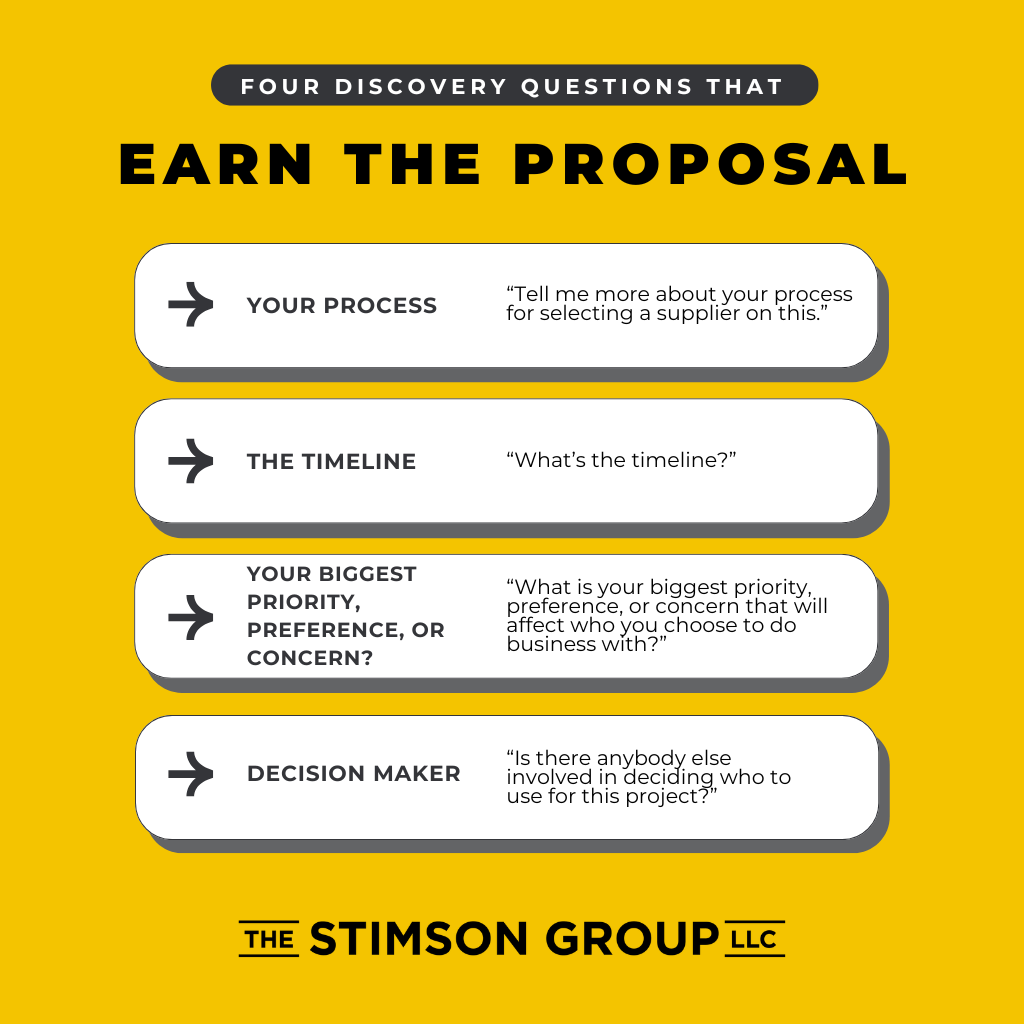
Three questions earn you the right to write a proposal that wins. A fourth question opens up if the first three go well. Without those answers, the best you can do is a quote with a long list of exclusions, and a quote isn’t a proposal.
Question One: Tell Me About Your Process
The first question, almost word for word:
“Tell me more about your process for selecting a supplier on this.”
Then shut up.
That’s the trick. Almost every buyer will fill the silence with more information than you thought to ask for. Why they’re talking to you. Whether somebody did this for them before. How the process works. Where you sit in it. How many other suppliers they’re talking to.
The answers come tumbling out if you stop talking. The less you say at this stage, the more they’ll fill in.
If they’re vague, follow up with another open-ended question. “What does that look like for you?” “How does that usually go?” Quiet curiosity beats clever pitching every time.
Question Two: What’s the Timeline?
Once you know the process, ask about the timeline. Then shut up again.
You’re listening for milestones. When the decision gets made. When the work needs to start. What the next step is. What other dates are driving the conversation.
If they give you a partial answer, ask a follow-up. “What about the timeline for the kickoff?” “What about the timeline for the rehearsal?” The timeline tells you whether you can deliver, when to push the conversation forward, and what level of detail belongs in the proposal. Planning around the calendar is half the battle.
Question Three: What’s Your Biggest Priority, Preference, or Concern?
The third question is a smorgasbord on purpose:
“What is your biggest priority, preference, or concern that will affect who you choose to do business with?”
Buyers fill that prompt with the truth. “My priority is that the person we used to work with retired, and we don’t have a relationship with anybody yet.” “My preference is somebody on site so I can hold them accountable.” “My concern is that our job’s too small to get your full attention.”
That’s gold.
Whatever they tell you is the lens you write the proposal through. Thank them for the information. Take notes. Knowing the customer by name starts with knowing what they’re actually worried about.
Question Four: Who Else Is in This Decision?
If you got clear answers to the first three, you’ve earned the fourth:
“Is there anybody else involved in deciding who to use for this project?”
We all know the answer is yes. They might say no. You can challenge that gently:
“You don’t have a committee? There’s no purchasing department on this one? You’re the only decision maker?”
Sometimes the answer is genuinely yes; agency producers with budget authority, for instance. More often, the buyer downplays the politics because they don’t want to appear unempowered.
If they’re holding back, that reveals a lot about how the relationship will work. Ask the question, listen to the answer, and update your proposal target based on who’s actually going to read it. Selling to the actual decisionmaker beats selling to your contact every time.
Three Priorities Replace “Fast, Cheap, Good”
Once you have your four answers, you can help the buyer prioritize. The old ad-agency motto was, “Fast, cheap, good. Pick two.” Everybody picks all three, so the motto becomes useless.
Instead, rank these three: “Best value for a given set of needs. Best ideas or inspiration from the supplier. Best chances for near-perfect execution.”
Buyers can rank those. “We do care about value, but we’ve had problems with execution, and that’s what we’re focused on. Ideas and inspiration are nice, but we’re a vanilla organization. We don’t need a lot of that.”
Now you know which proposal to write. Your sales metrics live and die on that kind of insight.
Three Proposals for Three Priorities
If best value tops the list, you write a proposal with two budgets:
- Baseline scope: every line item that has to be there to hit near-perfect execution
- Enhancements: the would-be-nice items that improve the show
Your best value lives in the baseline. The enhancements carry higher margin and higher risk, and burying them inside the baseline makes the value look wonky. Separate them, and the buyer can see exactly what they’re paying for.
If best ideas tops the list, stop writing the proposal. You’re quoting the wrong job.
What you propose instead is a creative pitch. Your creative director, executive producer, and best technical interpreter walk the buyer through your capabilities, your prior work, and the process you use to develop ideas.
The proposal isn’t the ideas. The proposal is the pitch. If you don’t have a creative pitch ready, you’re not a player in that space, and that’s worth knowing.
If best execution tops the list, the move is a walk-and-talk in your shop. Their team meets your team, in your space, surrounded by your process. They see how you organize the work, how you store the gear, how the calendar moves through your warehouse.
You can only run that play on your turf. Hire and train the team that supports it, and the rest takes care of itself.
From Bow Tie to Diamond
Most buyer-seller relationships start as a bow tie. One person on their side talks to one person on yours. That’s a fragile setup.
The diamond reverses it. Multiple people from your team talk to multiple people from theirs. Their procurement person talks to your sales lead. Their producer talks to your project manager. Their operations lead talks to yours. The buyer-seller relationship turns from a single thread into a fabric.
You earn your way into the diamond on the full capabilities pitch. Creative pitch, technical pitch, sales pitch, all in your shop, all built around how their team works with your team. If the buyer tells you all three priorities matter equally, head straight to the diamond, because that’s the only way to win that kind of opportunity.
Building a sales engine that runs at this level takes years, not weeks.
Better Questions, Better Proposals
We write proposals to win business. Most of us write more proposals than we win, because we didn’t ask the right questions, didn’t get the right information, didn’t run the correct process, and didn’t write the correct proposal.
Questions asked and answered reduce exclusions. Fewer exclusions mean a proposal somebody actually wants to read. A proposal somebody wants to read is a proposal that wins. That’s the difference between a slow quarter and a healthy one.
Before you start the next one, ask the three. Ask the fourth if you’ve earned it. Help the buyer rank the priorities. Then pick the proposal that matches.
That’s how you write a proposal that wins.


Leave a Reply