





Listen instead on your Monday Morning Drive:
Years ago, I sat across from a buyer who wanted to control every line on the RFP without actually understanding what he was buying. I walked him through how our best customers worked with us. Describe what you need, not what equipment you think you need, and we’ll build you the right solution at the right price.
He hemmed and hawed, then said, “No, my job is to tell you what to bring.” I told him I didn’t think he was ready for us, and I sent him on his way.
“I don’t think you’re ready for us” is a phrase more of you need to start saying.
Activity is picking up. RFPs are rolling in, pipelines look strong through the end of 2026, and the inquiries feel different. Buyers are acting like buyers again, and the ones who reach you first aren’t all going to be good ones.
You have to filter the inquiry before you chase it.
Good Marketing Lowers Your Close Rate
If your marketing is working, your close rate will drop. That’s healthy.
You’re pulling in prospects who don’t fit. Some will pick on price. Some will see your over-delivery as sandbagging. Some just aren’t your customer. A healthy sales pipeline throws off more leads than you close.
Good marketing gives you more chances to say no. The job of marketing is to fill the top of the funnel, not to turn down the volume on price shoppers. That’s your job at the point of sale.
Price Shoppers Are a Good Sign
I’m hearing about more price shoppers right now, and that’s good news. It means your marketing is influencing buyers enough to make them consider switching suppliers. What they’ve been taught by their last supplier is that price is the only lever.
They haven’t seen your quality yet. They haven’t met your better people. All they know how to ask for is the lowest number on the page. That’s a coaching opportunity, not a rejection.
“Shop around some more,” you tell them, “and we can have a different conversation when you’re ready.” Don’t burn the lead. Shape it.
Five Questions Before You Write a Proposal
Windfalls show up, too. A business dev hire lands a $2 million inquiry at a company that does $1 million a year, and everyone wants to chase it. Punching above your weight is a filter problem, too.
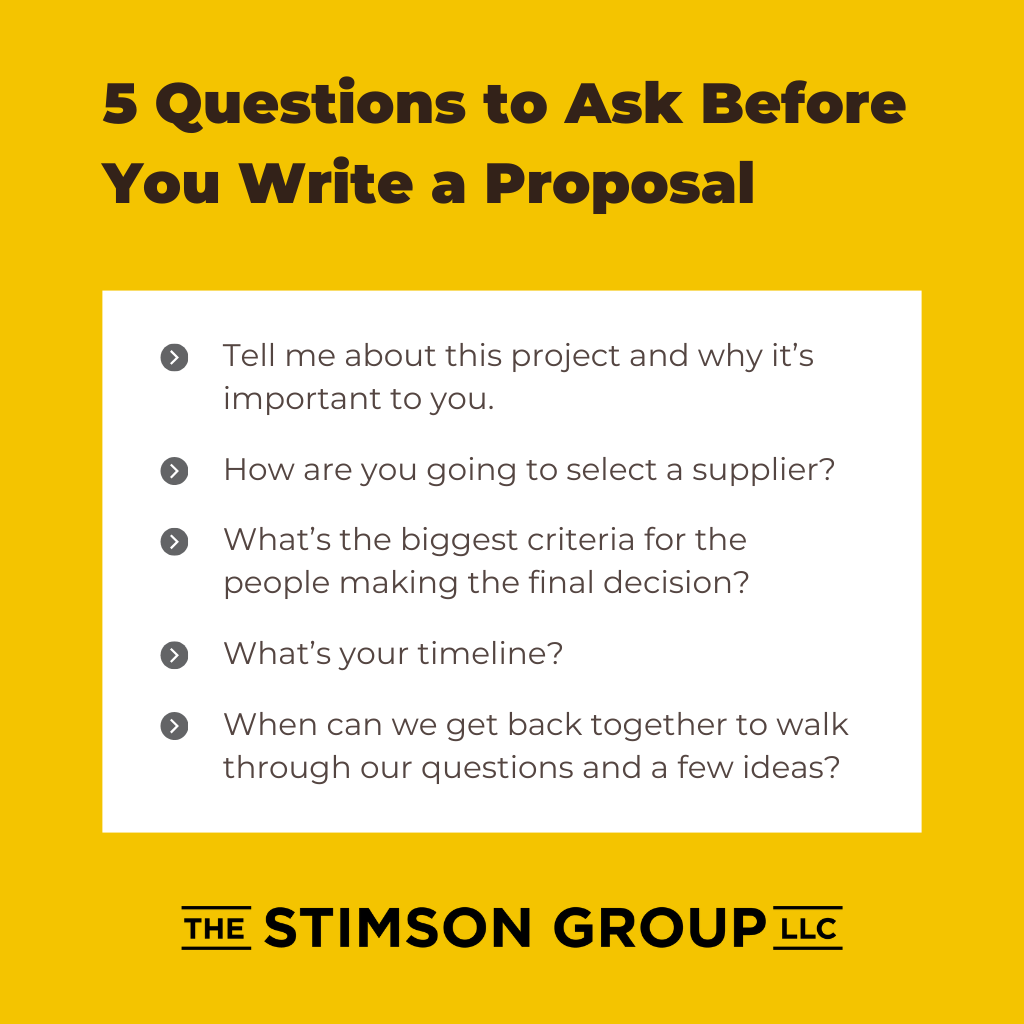
Ask five questions on the first call before you move a step further:
- Tell me about this project and why it’s important to you.
- How are you going to select a supplier?
- What’s the biggest criteria for the people making the final decision?
- What’s your timeline?
- When can we get back together to walk through our questions and a few ideas?
Your job on that first call is to have a 10-minute conversation. Two of those minutes need to be spent scheduling the next one.
If their timeline is impossible, note it. If their committee has 27 people across five companies, note that too. You’re not trying to close. You’re qualifying the buyer against your own criteria before you spend a minute writing.
Don’t Be the Ultimate Expert on the First Call
If the voice answering the phone is the most senior person in the building, you’ve put yourself in a very narrow field of suppliers. The discerning buyer wants a team. They want to feel like the answer comes from more than one person.
Lead with your value proposition. Here’s what we do for our best customers. Here’s how our best customers let us help them. That one sentence does more than any marketing deck.
Then meet the buyer where they are, agnostic, curious, or unhurried. A late timeline gets an “uh-huh.” A committee of 27 gets an “uh-huh.” The most important criteria gets an “uh-huh.”
Every answer is just information, and every piece of information sharpens how you sell on the next call.
Tailor the Proposal Before You Write It
Don’t send the 27-page proposal first. Walk the buyer through what the proposal will look like before you write a word.
“Based on our conversations, our tech director recommends this. The owner weighed in and wants to include that. We’re currently on track for the $70,000–$80,000 range you mentioned, with room for the options you said would improve the project. Do you want to hear about those options?”
Head nods. Buy-in on the approach. Now the three-page proposal lands tomorrow instead of a 27-page guess.
Tailoring the proposal makes the conversation bespoke without forcing you to reinvent the wheel every time.
When the Buyer Only Wants a Price
Some will walk in and say, “I’m looking for the lowest price. Here’s my RFP, and I need line-item detail, especially on labor.”
I give you permission to turn these down. Plenty of you won’t. You need the work.
If you take the job, follow the process anyway. Ask how they’ll compare apples to apples. If they don’t have a way, tell them, “I’m going to quote the lowest common denominator that meets your basic criteria. This isn’t what I’d recommend. It’s what you asked for, and it’s how you find the floor. Price is flexible. Quality is not. Once we establish the floor, we can talk about getting you to the level of quality and value you actually need.”
Keep feeding your marketing team the information about which inquiries fit and which don’t. Every “not ready for us” is a data point. Your marketing gets sharper, your filter tightens, and better inquiries start showing up from better-informed people.
Slow down. Filter. Meet them where they are. Write the proposal last.


Leave a Reply