





Listen instead on your Monday Morning Drive:
The first book I ever put out was called “Do the Math.” That was 20-plus years ago, at the beginning of what would become my consulting career.
The idea that framed the book was simple: Most companies in this industry weren’t running the numbers on what the work actually cost them.
Today’s blog post is about a specific version of that math. Post-event math. Reverse math. The math you do after the show, not before, to see what the job actually made you.
Pricing margins live in the math you do afterward as much as the math you do at the point of sale.
The $35 Delivery That Cost $400
The classic example from Do the Math was the $35 delivery.
Companies were charging $35 or $50 or $75 to deliver a video projector across town, set it up in the boardroom, and come back a few hours later to pick it up.
That was the price. The actual cost was $400 in hard dollars.
Van, fuel, tech loading, tech unloading, tech setup, tech pickup, tech return. Add the middle-of-the-day emergency runs when the customer needed help with a setting.
Add replacement cost of $800 or $900 if you had to send a second van because the first one was tied up.
The $35 delivery fee was subsidized by the equipment rental. That meant the projector needed 20 rentals to pay for itself, instead of the 10 the ROI actually intended.
We couldn’t see the cost because we thought the $200 rental was pure profit. It wasn’t. The updated pricing strategy makes those subsidies visible before the deal gets signed.
Why Bigger Shows Make Smaller Margins
Ask an owner why the gross profit percentage on bigger shows is always lower than on smaller shows. Most owners can’t tell you.
The pattern I see over and over: on a bigger show, the client asks for more equipment. The owner wants to keep the equipment revenue high, so the owner shorts the labor.
Discounting labor to protect equipment revenue is what makes bigger shows less profitable.
The math looks fine on the proposal. The show runs on short labor. Technicians work double shifts and mistakes creep in, and the margins end up lower than they would have been on a small show.
The same pattern happens with logistics. Trucking gets hidden or eaten because “the client won’t want to see it.” The cost is still real. A scalable sales process requires pricing every input at what it actually costs.
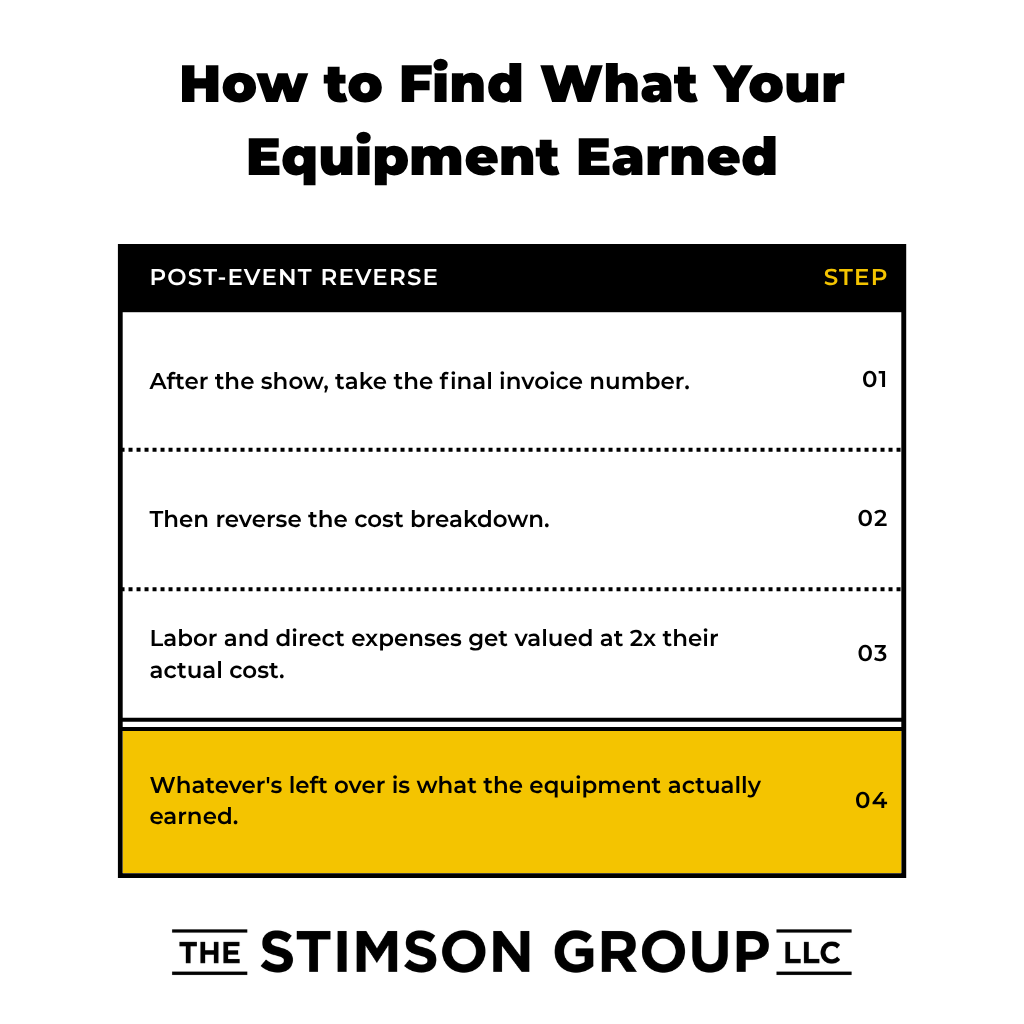
The Post-Event Reverse
Here’s the tool that changes how you look at every job you finish.
After the show, take the final invoice number. Whatever the client actually paid. That’s your top line.
Then reverse the cost breakdown.
Labor and direct expenses get valued at 2x their actual cost. Whatever’s left over is what the equipment actually earned.
The labor multiplier covers the risk of managing people and the reality that talent is what makes the job succeed. The expenses multiplier covers your roles for administering the solution and acting as your customer’s bank.
Whatever falls out at the bottom is what the equipment actually earned after labor and expenses got paid at their real value. The roadmap to balance starts with knowing what each part of the job actually made.
The $100K Example
Let me walk through the math on a $100,000 final invoice.
Talent cost was $25,000 across all the freelancers and crew. Post-event, that labor gets valued at 2x. So $50,000 of the $100,000 was labor revenue.
Direct expenses cost $2,500 for sub-rentals, travel, and specialty items. Post-event, that gets valued at 2x. So $5,000 of the invoice was expense revenue.
That leaves $45,000 for equipment.
Not the $60,000 the proposal had on the equipment line. $45,000, because labor and expenses earned what they were worth first.
That’s the equipment income the job actually produced. Sale metrics track that difference, and the difference is where your business gets stronger or weaker over time.
When Cross Rentals Hit
Say the $100,000 job needed $30,000 in cross rentals because you were busy that week.
Now the math shifts. Labor still costs $25,000. Expenses still cost $2,500.
Cross rentals add another $30,000 in real cost.
Total spend: $57,500. Which means the job actually made $42,500 on a $100,000 invoice. You made $42,500 on that show. You just didn’t make it the way you thought you did.
You made it by charging enough for labor and expenses. The equipment didn’t magically cover its own costs plus profit. Outsourcing done cleanly is what lets the math still work when you have to sub-rent.
Talent Makes the Money
Labor always has a cost. Equipment doesn’t, once you own it.
That reversal is where most owners get pricing wrong. They see the equipment as the profit center and the labor as an expense to control.
Talent makes the money. Equipment is the vehicle that carries it.
That isn’t a case for shorting labor. Under-staff a show and you get overtime, burnout, mistakes, and long-term damage to your reputation.
Whatever labor costs, it’s worth 2x. Believe that multiplier, and the rest of the pricing conversation gets easier. Hire the team that earns the multiplier, and the post-event math takes care of itself.
Do the post-event math on every job you finish this month. The numbers will tell you where the money actually came from. They’ll probably tell you the equipment made less than you thought, and the labor made more.



Leave a Reply