





Listen instead on your Monday Morning Drive:
For years, the rental management system sat at the center of every AV business. Every quote, confirmed order, and piece of gear lived there. It worked.
Projects have changed. A single client engagement can stretch across months of pre-production, creative development, and multiple sub-events before you ever build an order. Your rental management system can’t track any of that.
Your CRM can.
From Order Taking to Project Development
If most of your work comes from RFPs, Customer Relationship Management (CRM) feels like busywork. You get the request, open your rental management system, build the quote, and move on. You already have a record. Why duplicate the effort?
Your rental management system only captures quoted orders and confirmed orders. That’s the bottom sliver of your entire sales funnel. The rest of it (leads, prospects, pitch meetings, client visits, months of back-and-forth) happens before there’s a proposal to sign.
If you’re not tracking that activity, you’re flying blind.
CRM Is a Project Tool
Most people treat CRM as an email log with a probability slider. That’s a waste. A good CRM is a project management platform where a lead becomes a prospect, becomes an opportunity, and ties into a full project with sub-projects, timelines, and milestones.
Your rental management software handles the tactical side: estimating, equipment allocation, purchase orders. That’s an operational tool. CRM handles the strategic side: developing relationships, tracking progress, and projecting revenue. The sales metrics that matter all live here, not in your rental management system.
When companies in my coaching groups made this mental shift, their CRMs stopped collecting dust. They stopped cramming every detail into the rental management system and started using CRM the way it was built to be used.
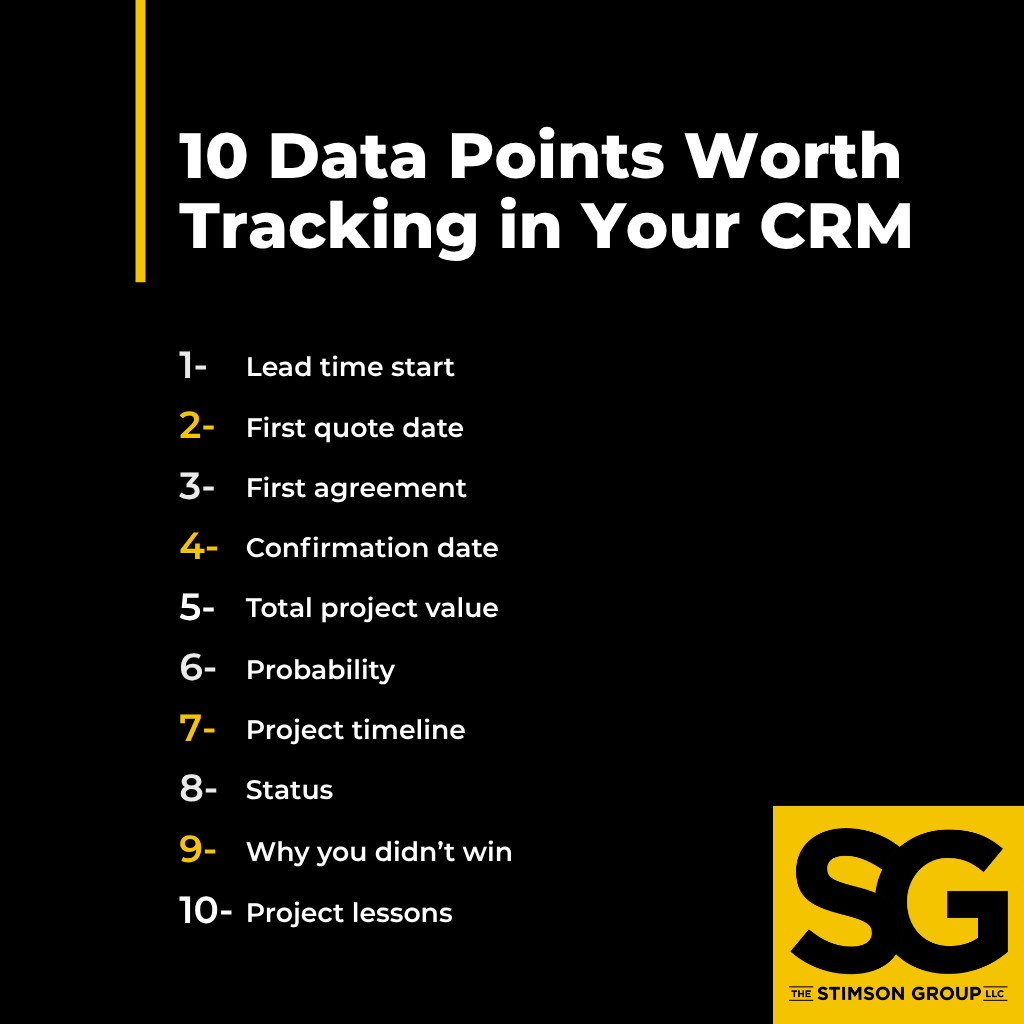
10 Data Points Worth Tracking
These 10 data points make CRM useful for your entire team, not just sales.
1. Lead time start. When did you first learn about this project? For recurring shows, that date is the day the last event ended. Record it. Long lead times strengthen your forecast and your valuation if you sell.
2. First quote date. The first time you put numbers together. Not the final proposal. The first rough estimate.
3. First agreement. Not a signed contract. A working agreement on parameters: “We can do this if we stay under $100,000.” Document it. You’ll reference it later when negotiations shift.
4. Confirmation date. When any element of the project confirms. Creative approval, general session sign-off, whatever comes first.
5. Total project value. This number changes over time, and it can be a range. Knowing a $50,000 sub-project belongs to a $900,000 engagement changes how you optimize revenue from that client.
6. Probability. Below 50%, treat it as zero. If you’re actively engaged and it’s yours to lose, you’re at 70% to 80%. Build a system that communicates useful probability information across your team.
7. Project timeline. When are sub-project quotes due? When do buyer discussions need to happen? When does each confirmation need to land for the project to move forward? If a buyer misses a deadline and nobody follows up, you’ve got a problem.
8. Status. Go beyond “light pencil, heavy pencil, confirmed.” Each sub-project has its own status, and those statuses need to line up with your probabilities. An “inquiry” with 80% probability and a full timeline doesn’t add up. Challenge it.
9. Why you didn’t win. Don’t call it a “lost job.” You can’t lose what you didn’t have. Record the notes: the buyer ghosted, the incumbent dropped their price, they went a different direction. Those notes become your starting point for next year’s conversation.
10. Project lessons. CRM isn’t the salesperson’s tool alone. Production designers, creative teams, and project managers all touch a project. Give them a place to record what worked and what didn’t so next year’s show improves.
CRM Feeds Your Forecast
These 10 data points let you look backwards and project forward. A strong CRM gives you 12 to 18 months of forecast visibility.
No forecast is accurate until it’s passed. But having one lets you make better decisions about pricing, which buyers to pursue, and where to focus your team’s energy. If you’ve ever struggled with slow seasons, your CRM data is where the answers live.
I learned this lesson in 2001. By forecasting six months ahead, we spotted an empty September pipeline in early April. Without that practice, I wouldn’t have noticed until July.
That early warning gave us time to cut spending, pull back on CapEx, and let a few marginal employees go before the recession (and then 9-11) hit. We saw a 30% to 40% drop in revenue the following year, but we were ready for it.
Three Lenses for Forecasting
When I’m working with clients, I look at three areas to gain insight into their business.
Business metrics: pipeline, forecast, and overhead. A healthy pipeline looks like a funnel — more leads than prospects, more prospects than opportunities. If your funnel looks like a cylinder, you’re in trouble. Pay attention to movement, not just volume.
Your forecast (updated constantly) tells you whether you’re spotting trends early or reacting late. And your overhead costs reveal your break-even number: how much revenue you need to cover your fixed expenses in any given period. Those three data points together tell me a lot about how a company will handle any season.
Economic signals. Watch your buyers’ behavior. Are they calling earlier or later than usual? Are RFPs surfacing new concerns about pricing or headcount? Are commitments coming slower? Shorter lead times don’t mean a weak pipeline, but they change how aggressively you need to close.
Your own blind spots. Are you optimistic to a fault? Ignoring the risk of a single major client? Smoking hopium, expecting the numbers to “work themselves out” without a plan? Honest self-assessment is the third lens, and it’s the one most owners skip.
The Shift
Your rental management system is an operational tool. It’s great at what it does. But the single source of truth for your business lives in your CRM. Get the right data in there, and your whole team gets better information, forecasts, and a more scalable sales process.


Leave a Reply