





Listen instead on your Monday Morning Drive:
“Punching above your weight” in this industry usually points to one scenario: You took a show that was too big for your company. It was too big for the crew, too big for the gear list, too big for the budget you priced against.
The show version is worth talking about another day. Today’s blog post is about the version that matters more: punching above your weight when you hire.
The people you hire determine the weight class your company operates in. Hiring the right team is the lever that moves your company up a class or holds it back a level.
I learned this the hard way in the first job I took inside a company.
The Better Pull List Was Never About the Pull List
My first job in AV was rental manager at a growing show company.
The immediate problem was the warehouse. The pull team would take on any request that came in, but they were pulling from a scrap of paper listing gear.
Their standard operating procedure was to load the truck from that scrap, then walk around the warehouse looking for gear that ought to have gone.
I could have solved that problem, delivered a cleaner pull list, and stayed a rental manager forever. A better pull list required better data.
Better data required a better ask from the salespeople. A better ask required a better sell. Fixing the pull list started at the warehouse and ended in how we sold shows.
That chain isn’t what a rental manager gets hired to untangle. The warehouse depends on upstream data, and the upstream data depends on how you sell.
Hire the Third Role
When you hire somebody for a management position, don’t hire them for the role they’re stepping into.
Hire them for the third role they’ll grow into inside your company.
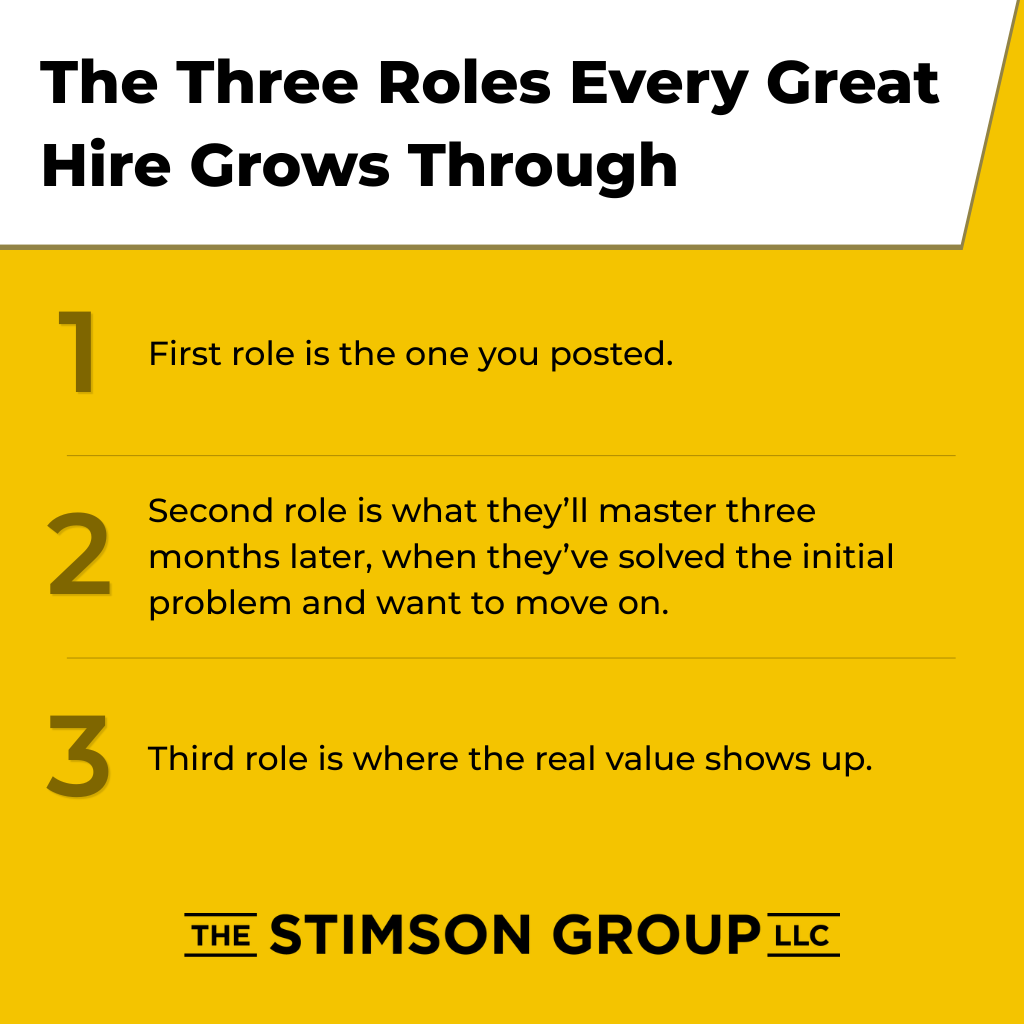
Their first role is the one you posted. Their second role is what they’ll master three months later, when they’ve solved the initial problem and want to move on. Their third role is where the real value shows up.
A person who can only do the first role stops being interesting to your company after six months. Somebody who can grow into the third role stays interesting for years.
That’s the discipline behind punching above your weight when you hire. The scalable org chart works forward, not backward from the problem you’re solving today.
My Dad’s Promotion Formula
My dad had a knack for getting promoted every six to 12 months. Every job he took, the same formula ran.
He’d figure out how the job worked. He’d figure out how to make it work better. Then he’d train his replacement.
By the time he had all three of those steps under his belt, he could walk into his boss’s office and say, “That job is under control. What do you want me working on now?”
I do the same move in reverse. I walk into my boss’s office and say, “That’s under control. Here’s what I’m going to work on now.”
Notice the difference. I’m telling the boss what’s next, not asking.
You’re hiring for that behavior. The person who tells you what they’re going to work on, not the one waiting to be told. Accidental entrepreneurs work that way, and they’re the ones you want inside your company.
Two Kinds of Warehouse Manager
You can hire a warehouse manager one of two ways.
The first kind keeps the shop tidy. Empties the trash cans, sweeps the floors, checks the ceiling, handles the maintenance. The gear on the shelves is theirs to protect.
The second kind manages the processes that live inside the warehouse. The pull team, the check-in flow, the QC procedures, the training pipeline.
The first kind gives you a clean warehouse and a lot of work still on your desk. The second kind gives you a warehouse that gets better every month without you touching it.
The first kind costs the same as the second. Only the second kind gives you a business. Outsourcing the wrong role is what happens when the first-kind manager can’t run a prep, so you end up bringing in expensive show techs to fill the gap.
Owners Won’t Hire Smarter Than Themselves
Here’s the reason most companies plateau: The owner won’t hire somebody smarter than themselves.
It’s a fear response. If somebody smarter walks in, the fear runs: My job’s at risk. My value drops. My longevity shrinks.
None of that is true, and every owner who acts on that fear pays for it. The bosses I’ve worked for who hired above their own weight class kept every one of those people for years. The ones who hired safely watched their best talent leave to work for somebody who wouldn’t.
Every management hire deserves the same test. Would this person outgrow the job in six months?
If yes, hire. If no, keep looking. Growth and scalability both live on this decision.
The People Determine the Weight Class
The show version of punching above your weight is fun to talk about. The hiring version is what actually moves your company.
Hire people who are better than the job you’re putting them in. They’ll get bored with the first role.
They’ll master the second. They’ll start looking for the third.
By the time they’re on the third role, your company is playing at a different weight class than the one you hired at. Bigger projects. Bigger clients. Higher-stakes work.
The obsessively scalable company exists at the top of the ladder those hires climb. You can hire safely. You can hire for the role in front of you. You can hire people who won’t outgrow the job.
If that’s the path you take, your company stays where it is. If you hire for the third role, the company climbs.
Hire the third role.


Leave a Reply