





Listen instead on your Monday Morning Drive:
More than 25 years ago at InfoComm in Orlando, I had dinner with a longtime advisor to my new CEO. The CEO had recommended I take the meeting. The advisor was about to retire and wanted to pass along one piece of advice.
“The CEO can be pretty intimidating,” he told me. “He likes to ask hard questions. He’s more interested in how you handle the question than the actual answer.”
“Always reply with two answers, not one.”
The first answer is the one the CEO already knew. He asks questions like an attorney, expecting the response he can follow up on.
The second answer throws him off. He wasn’t ready for it, so he has no follow-up.
His questions aren’t that deep.
I used that trick more than once, and it worked every time.
The two-answer principle is what stuck with me. Most questions in sales aren’t as deep as they seem.
Most objections in sales aren’t either. Scalable sales starts with knowing that, and it saves a lot of overreacting on the seller’s side.
Sales Needs a Reverse Gear
Cars have reverse gears because sometimes the only way to go forward is to back up first.
Most sales reps run one gear. They pick a direction, hit an objection, and either backpedal into a price cut or dissemble to avoid the tension.
Neither move works. What works is treating the objection as information, addressing it succinctly, and continuing the conversation. Defining the sales conversation starts with recognizing when the buyer just tapped the brakes.
An objection is a question, an exclamation, a protest, a challenge, a complaint, or a correction. Most of these are single-level, meaning one response solves them.
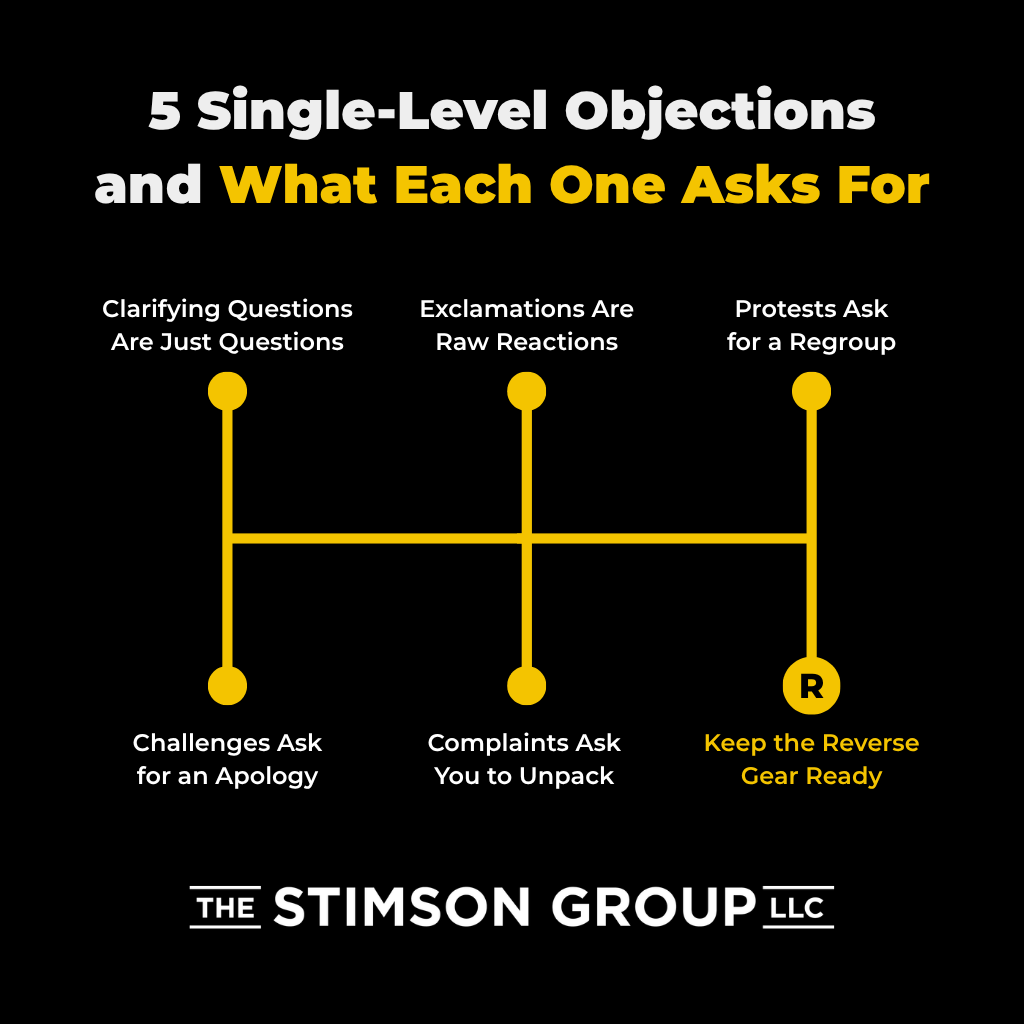
Clarifying Questions Are Just Questions
Sometimes a question is just a question.
A clarifying question sounds like this: “Why did you do it this way?”
The temptation is to hear the question as a challenge. The reality is simpler.
The answer is a plain explanation: “We chose X because of Y, and we’ve found it works better than Z. Does that answer your question?”
Don’t assume every question means you’re on the wrong track. Your customer’s clarifying questions are worth taking at face value.
Exclamations Are Raw Reactions
An exclamation is the buyer processing out loud.
“That’s a lot more money than I was expecting.” “That’s expensive.”
The exclamation is a raw reaction. The buyer isn’t asking for a full explanation. The buyer’s brain blurted out the first reaction that came up.
Your response is a single sentence: “Yes, it is a lot of money, and here’s why it’s at that level.”
Point back to the request, the venue, the timeline, or the choices the buyer already made that drive the number.
Address the exclamation, then continue. Pricing at the point of sale handles the exclamation better when the number was earned in the discovery conversation.
Protests Ask for a Regroup
A protest is an emotion. The buyer is stating a position: “That’s far outside our budget.” “We can’t move forward at that price.”
The buyer is reacting emotionally, and you need to acknowledge the reaction before moving on. A protest asks you to pause and let the buyer regroup.
Two responses work.
“That’s important to know at this stage. Would you like me to keep explaining what we can deliver at this price, or focus on how to work within your budget?”
Or, “We know how to work within budgets. Let me finish the proposal, and then we can talk about how to apply your resources.”
Both responses acknowledge the emotion and hand control back to the buyer. Pushback isn’t a signal to discount, because most protests are just the buyer’s way of pausing.
Challenges Ask for an Apology
A challenge is a clear declaration that you deviated from what the buyer asked for.
“This isn’t what we asked for at all.” “We won’t consider a budget without detailed line items.”
Your proposal introduced an assumption the buyer didn’t sign up for. The buyer feels dismissed and unheard.
A challenge asks for an apology first, and a rebuild second.
“I apologize. That was my mistake. Let me resubmit the proposal with corrections, and we can identify other places I may have misinterpreted your criteria.”
The apology opens the door to rebuilding the relationship. Balance requires occasional course correction, and the challenge is where the correction happens.
Complaints Ask You to Unpack
A complaint is an objection to a specific change or line item.
“I see you raised the shipping price. I know you need to make money, but this increase is unreasonable.”
The complaint has to be unpacked. The best way to handle a complaint is to preempt it.
Call out the change before the buyer notices it.
“You’ll see shipping increased on this event, for two reasons: fuel prices are up in the marketplace, and the venue is further from our base than last year. Here’s what that means for the number.”
The complaint doesn’t happen if you’ve unpacked the change in advance. Updated pricing anticipates the complaint, so the buyer arrives at the conversation already knowing where the number came from.
Agree and Move On
Every single-level objection follows the same four-step response.
Acknowledge the objection. Address the point in one sentence.
Confirm your response registered with the buyer. Move on.
“Does that address it? Can we keep going?”
Most objections are people processing. Overreacting is what gets you deeper into trouble.
Agree and move on. Counter and explain when the buyer is wrong, but stay delicate about it.
At the end of the presentation, come back to the objections that came up. “Earlier you were surprised by the price. Does the number make more sense now?”
That’s how you turn objection handling into relationship building. Sales metrics track objection handling at every proposal, because the pattern of overreaction is what shows up in a slipping close rate.
Two-answer thinking beats one-answer thinking, whether you’re standing across from an intimidating CEO or facing a buyer’s protest at the price on page three.
Keep the reverse gear ready. Most objections are shallower than they look.


Leave a Reply