





Listen instead on your Monday Morning Drive:
When you drive your car into the repair shop, you walk through the glass door to the front desk.
You talk to the person at the counter. That person isn’t the mechanic.
The mechanic is out in the bay with grease on their hands. If you needed to talk to the mechanic, they’d have to stop work, wipe up, and come look at the car.
The shop can’t run its execution team as its intake team.
Same story in AV. Your sales conversation happens with a consultant, and consultation is a function even when the person doing it doesn’t carry the title.
A consultant listens to what the buyer wants and recommends a course of action. If the buyer rejects the advice, the consultant sends them on their way with a polite thank-you.
Building a scalable sales process starts with treating the front-desk conversation as consulting.
Are You a Mechanic or a Consultant?
Every RFP that arrives in your inbox tests this question.
The mechanic in you wants to price every line item and send back a proposal. The consultant in you wants to ask five questions before touching the spec sheet.
The mechanic response gets you to a proposal fast. The consultant response gets you to a “no” fast, which is what you actually want.
That isn’t a typo. The goal is to get to no. The sooner you know the buyer isn’t going to hire you, the more time you have for the buyers who will.
Sell as a consultant first, and the mechanic role stays out in the bay where it belongs.
Every RFP Ping Makes You a Salesperson
Look around your office. How many people talk to the client during a project’s development?
If you have project managers taking direct calls from returning clients, they’re doing sales. Same for production managers running discovery calls, and technical directors advising on scope.
Until the contract is signed, everybody who touches the buyer is in sales.
You don’t get to call yourself a project manager or a technical director on the front end. You get that title after the deal closes.
Rejecting the salesperson label doesn’t help. The buyer is still going to treat you like one. Roles matter more than titles at the front-end conversation.
Priority One: Get to No Faster
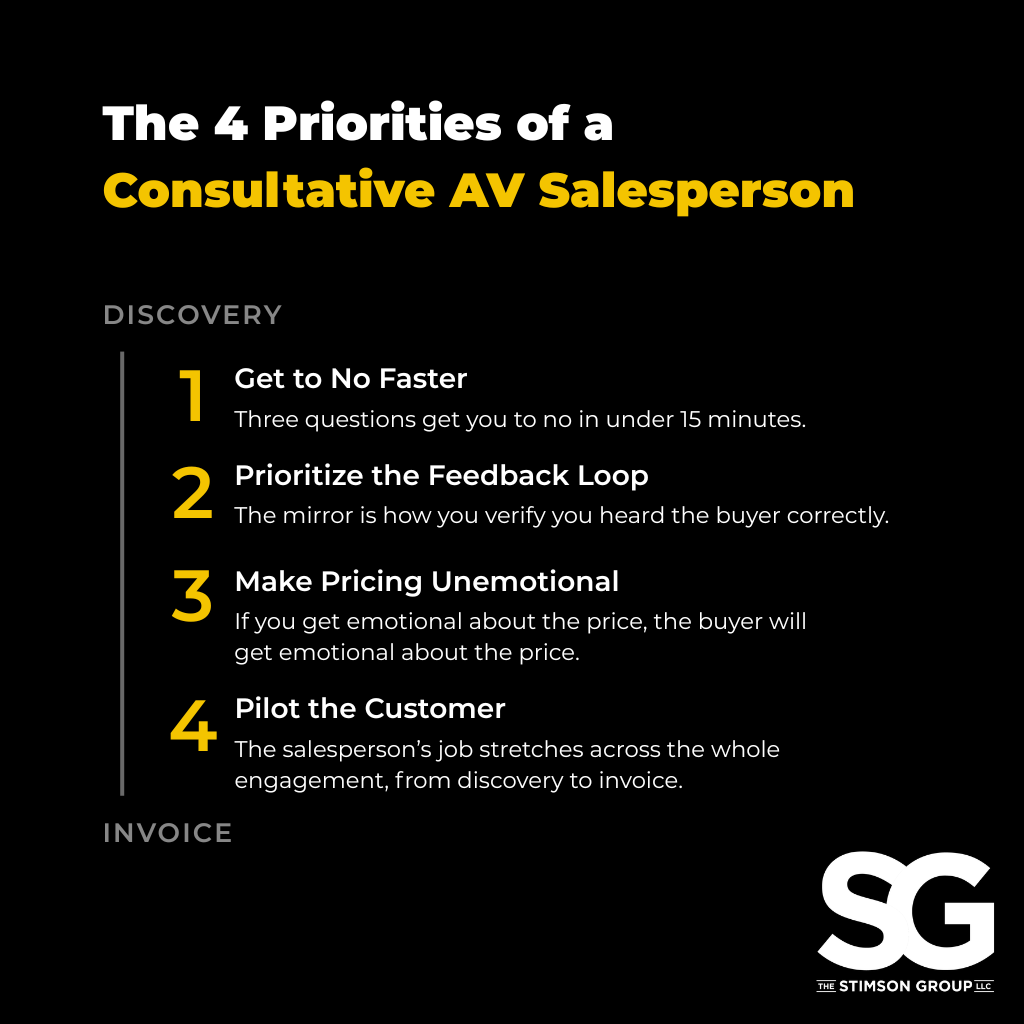
The goal of the front-end conversation is to get to no faster than the buyer expects you to.
That doesn’t mean you don’t want the work. Most inbound RFPs are shopping exercises, and the sooner you know the buyer is shopping instead of buying, the more time you free up.
Three questions get you to no in under 15 minutes.
Where are you in the process? What are your priorities on this? Is the incumbent on the RFP list?
If the buyer can’t answer the first two, they don’t have a decision process yet. That’s a signal to disqualify.
The incumbent question comes with a hard rule attached. If the incumbent is on the list, it’s a hard no.
Nine times out of ten, the incumbent wins. Don’t spend proposal time chasing a decision the buyer already made. Knowing your customer is the whole point of disqualifying fast.
Priority Two: Prioritize the Feedback Loop
The second job is running the feedback loop with the buyer.
Mirror back what the buyer says and reframe it in your own words. Attach a recommendation if the moment calls for one.
The mirror is how you verify you heard the buyer correctly. The recommendation is how you show you can help.
Ask follow-ups on the why. “Tell me more about why this is important.” “Why does this requirement exist?” A lot of RFP requirements exist because one time an event went wrong five years ago.
Sometimes the best advice is to release the buyer from a stale requirement. That’s value creation, and it’s the reason the buyer keeps coming back to the same salesperson show after show.
Sales metrics track feedback quality, and quality shows up in whether the buyer keeps buying.
Priority Three: Make Pricing Unemotional
The third job is stripping emotion out of pricing.
If you get emotional about the price, the buyer will get emotional about the price. If the buyer gets emotional, the deal starts turning on feelings instead of value.
“Your budget is your budget. I respect your budget. I’ll help you use your budget to its highest and best use.”
Say those words out loud. Then walk the buyer through the choices.
If the buyer has $50,000, walk through what $50,000 buys. Another $10,000 gets a stronger version, and $10,000 less means the minimum viable show.
Pricing conversations run on trust and clear priorities. Without both, the deal stalls at the first pushback.
Pricing lives in defensible margin, and defensible margin lives inside a trust-based relationship.
Priority Four: Pilot the Customer
The fourth job is piloting the customer through the whole engagement.
The salesperson stays the customer’s point of contact even after the show moves into production. When the customer starts to feel unheard, they call the salesperson, not the show caller.
The salesperson’s job stretches across the whole engagement, from discovery to invoice.
That’s how retention works. The customer becomes a client when the salesperson stays engaged past the contract.
Hire the team that pilots the customer through every step of the show.
Never Bid Against an Incumbent
The incumbent question deserves its own paragraph.
If the incumbent is on the RFP list, the buyer is going through the motions. The incumbent has the relationship and the history.
Nine times out of ten, the incumbent wins. Don’t spend proposal time trying to displace them.
The right response to an RFP with the incumbent on it is a polite pass.
“Thanks for including us. Sounds like you have a good working relationship with your current vendor. If that changes, please reach out.”
The right customer isn’t the cheapest customer, and an RFP with the incumbent on it usually points at a shopping exercise.
Sales adds value at four moments in the engagement: the consultation, the disqualification, the pricing conversation, and the handoff to production.
Get to no faster, prioritize the feedback, keep the pricing unemotional, and pilot the customer through.
Advice is free.


Leave a Reply