





Listen instead on your Monday Morning Drive:
Words matter. So does planning.
I fell in love with budgeting 25 years ago when I went back to school for my MBA. Before that, budgeting felt like a chore. It didn’t seem important.
Once I understood how it works, budgeting gave me power over my trajectory. A budget is a plan you can change, as opposed to reacting to circumstances without considering all the other factors.
If you react to the moment, you may make a good decision. But if you’re not pulling back to look at the big picture, you’re probably not making a good decision.
Do You Know Where You’ll Land?
Right now, as you read this, do you know within a few percentage points what your final revenue will be? Do you know what your profit for the year will be?
If you don’t, that’s because you don’t have a budget.
With a budget, you’d know. You’d be 99% correct. The 1% you’re wrong doesn’t matter.
You can predict your cash flow. You can predict how much you’ll owe the IRS. You can predict how much cash you have available to buy new equipment. You know whether you need to hire new people.
All of that information is at your fingertips if you have a budget. Let’s get out of this feast-and-famine reactivity and stop using our gut to decide whether to drop a million dollars on an LED wall because we won one job.
The Four Steps of Budgeting
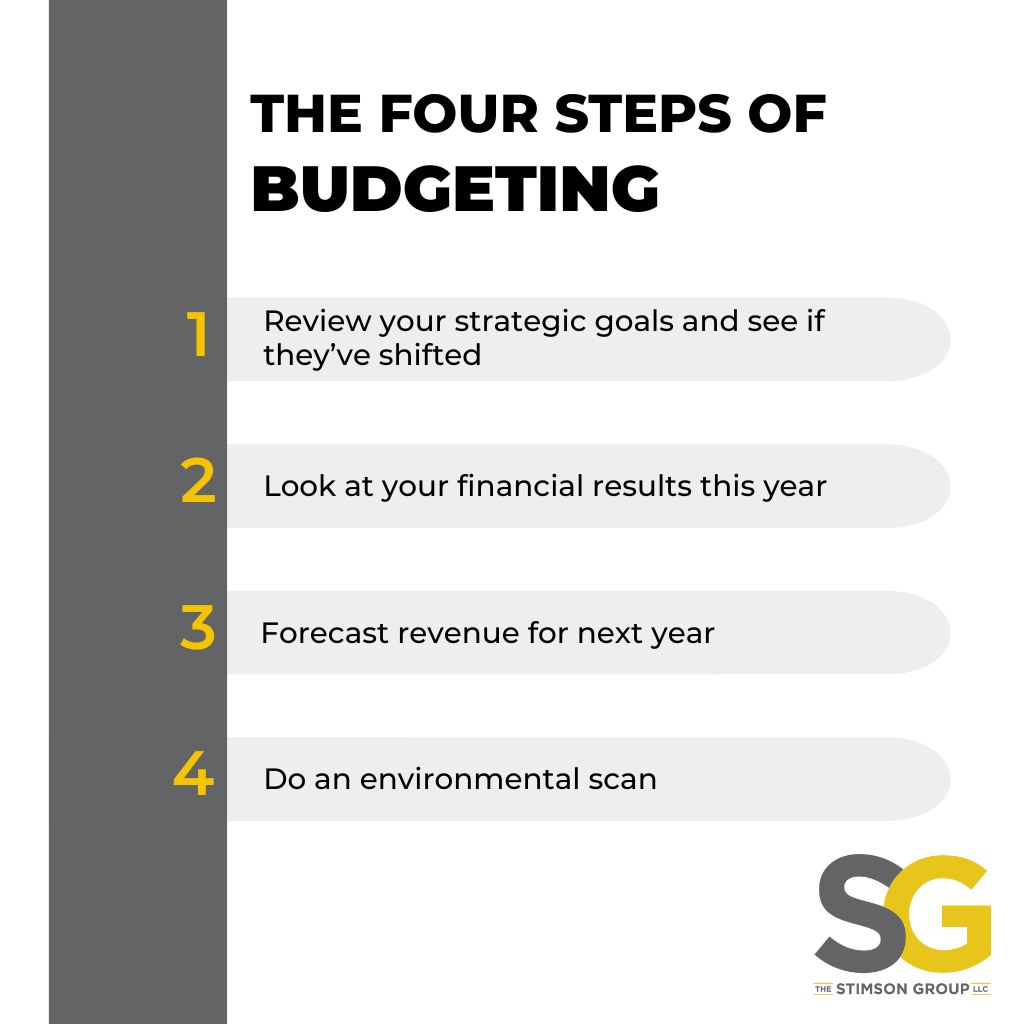
When you sit down to build your budget, complete four tasks:
- Review your strategic goals and see if they’ve shifted.
- Look at your financial results this year.
- Forecast revenue for next year.
- Do an environmental scan.
Don’t budget for next year until you know how well you budgeted for this year. If your budget was off, figure out what you messed up. Every year you budget, you get better at it.
Review Your Goals
What were your goals for this year when you set them 12 months ago? Did you write them down?
Maybe you wanted to grow new accounts. Maybe you wanted to expand into a marketplace. Maybe you wanted to de-emphasize a segment or reduce cost of goods sold. Maybe you had tactical goals, such as adding employee reviews or reorganizing the warehouse.
Did you do it? If you didn’t, was it important?
Did you not do it because you were too busy? That’s good information. Did you not do it because it cost money and you didn’t have it? That’s better information.
My “aha!” moment came when I learned I could budget project expenses during the slow season without affecting that month’s results.
If I’m planning to redo the warehouse in July when we’re slow, I take $5,000 every month and set it aside. By July, I’ll have $30,000 to work with. It’s not coming out of my July budget because I’ve been taking it out along the way.
I won’t skip it because “we’re having a slow month and we need to save money.” I already saved the money. I put it in my budget.
If you have no progress on your goals, what are your next steps? You might need to change the goal’s owner, reset a deadline, delegate the work, outsource the task, or allocate more budget.
Figure out why you didn’t do what was important to you a year ago and fix the problem.
Your Financial Checkup
Review your finances over the past couple of years. Run trailing 12-month reports. Run the past three cycles and look at trends.
Don’t get hung up on the numbers. Look at the trends.
Every spreadsheet has a feature that lets you create a chart and map a trend line. If you map your total sales for the past five years, you might say, “We’re really growing, except that one year.” But then you mark the trend line and find out you’re actually flat. You just had a good year.
Look at trends on your sales, gross profit, total income, and SG&A.
If you’re growing 5% revenue every year, you’re flat. You haven’t achieved real growth. Your revenue will grow 5% simply because some costs go up, and you’ll raise a price every once in a while. You can accidentally grow by 5%, even with less business, just by charging correctly.
Don’t get excited about 5% growth. Get excited about consistent year-on-year 20% growth, or compound annual growth of 20% or 30% over 10 years.
If you back windfall jobs out of a trend, watch what it does. How much are those windfalls sucking the life out of your business? I’m not telling you not to do them, but be more realistic about what they do to your budget.
Use Percentages
If you have a budget, look at your year-to-date budget comparison by month. How well are you hitting your numbers? If you don’t have a budget, compare this year to a prior year and see the trends.
Use percentages. Common-size all your P&L reviews.
If your accountant or bookkeeper gives you reports without percentages on the columns for every line, showing what percentage of revenue each item is, straighten that person out or fire them. That’s bad management accounting.
Costs of goods sold as a percentage of revenue is an extremely important KPI. Never look at the dollar amounts. Who cares if you spent $5,000 on sub-rentals? What was the percentage of revenue? Was it $500,000 in sub-rentals? Who cares? What’s the percentage of revenue? Is it within budget?
Review your P&L at that level, comparing results to plan and history.
Review Your Revenue Quality
Look at your revenue for the past year. Was all of it planned? How much was accidental revenue? How much did you know about coming in?
Some revenue is more valuable than other revenue. Small jobs aren’t good for us, but doing small jobs for big clients is. We can’t say all small jobs are bad, and we can’t say all big jobs are good, either.
Look at revenue and its inherent gross profit for the type of customer, the quality of work, and the quality of the experience. Do you want more of this work?
If you make good money and like doing that work, try to get more of it. If you make okay money but the customer or the work sucks, don’t do it anymore. Get it out of your budget. Put energy toward replacing it.
If your cost of goods sold is going up and your gross profit is going down, chances are your costs went up, and you didn’t change your pricing to keep up. Wouldn’t that be a great discovery now, when you’re figuring out what to do for next year?
Examine Your Expenses
Below the line, are you exercising restraint?
Was your payroll, the biggest number below the line, planned? Did all your people come in at the time of year that made the most sense? Are you right-sized on salaries?
Are all your expenses planned? Did you encounter any surprises?
Hopefully that’s a short exercise.
Review Your Variances
If your gross profit varies by 1% either way, pat yourself on the back. If you budgeted 50% gross profit for the year and you’re between 49% and 51%, you’re well within tolerances. Nobody budgets perfectly.
Your SG&A expenses should be within about 2% of planned spending for the year. If you hired somebody you didn’t expect who was off budget, that’ll affect your planned spending by more than 2%. But once you hired them, your budget changed. You should still be within plan.
The 2% I’m worried about is when your rent goes up and you forgot to put it in the budget. Or utilities went up because you’ve got leaks all over the warehouse. Or your phone bill increased because you forgot to renegotiate your carrier expenses.
A lot of small items add up to 2%. And 2% of expenses is 2% net profit. This isn’t trivial. But you can fix expenses once a year and not think about them again.
If you’re having trouble hitting your target net profit number, look at discretionary expenses. Can you reduce some items? Did you accrue money you don’t need to spend? Do you need to raise some prices before the end of the year?
Forecasting Revenue
How will you forecast revenue for next year?
You have recurring revenue. You have seasonal revenue. You have contracts you know about. You have jobs already sold that fall into next year. You have a lot of data and history.
Do you shoot high or low? What’s the right forecast for your revenue next year?
Don’t declare 10% growth and throw a budget out there if you don’t know how you’re going to grow 10%.
When to Shoot High
Ten years ago, I would’ve encouraged you to shoot high, get ahead of your revenue, hire before it’s too late, and buy equipment before you need it so you can make more money on it.
That’s not the advice I’d give today.
Non-scalable companies have to shoot high. They have to bet on their success to cover overhead, costs, and all the people they need. Non-scalable companies often shoot at a higher budget to justify hiring people and buying equipment to keep costs down. It’s a gamble and a huge risk.
Scalable companies don’t have to shoot high. They can manage far more capacity with the same team and resources.
Scalable companies sacrifice a small amount of gross profit to remain flexible and profitable, but they don’t have to hire ahead of demand. They can handle 10%, 15%, 20%, even 30% more business with the team they have.
A short-term windfall surge doesn’t affect their overhead. They outsource a little more, work a few more hours, get through the busy period, and move on.
Run a lean team in a scalable company. Outsource the help they need to keep them from burning out when you’re busy, but work as far ahead as possible to make everybody’s job easier.
When to Shoot Low
Most scalable companies sandbag revenue a little. They project lower because they don’t want to overspend on expenses or over-anticipate growth.
If you have a high concentration of revenue in certain periods (windfall business, super busy months), factor some of that out. Those months will happen, but even if there’s a 20% increase in your total revenue jammed into one month, don’t change your annual budget.
A windfall is a happy circumstance that doesn’t affect your year-end budget. You had 45% gross profit that month instead of 51% because of concentration in business. You move on.
When factors affecting your forecast are uncertain, shoot lower. If you anticipate adverse market conditions, budget a lower revenue forecast.
Any time your tolerance for risk is compromised (cash flow crunch, major unexpected expense, personal circumstances as a business owner, etc.), budget a lower forecast.
You don’t have to beat your forecast to be successful. Your forecast is successful if it’s profitable. Why set a budget and not give yourself 20% operating profit? The whole reason for doing this is working toward a reasonable profit number.
Use Most Likely Revenue
Scalable companies often target their most likely revenue, erring a little on the low side because there’s no downside to being conservative. It’s easy to scale up if you’re busier. Scaling down is problematic.
If you forecast optimistically and your revenue comes in way down, you’ve got to scale back. That’s painful! Everybody on a small team is critical. You have half as many people as before the pandemic, but they’re twice as good, more expensive, and harder to replace.
We don’t want to scale down if we can avoid it. Be conservative on your forecast. If your forecast is going down, act now. Don’t wait to find out if you’re right.
Smaller Company Considerations
Many smaller companies tell me they don’t have recurring business. They don’t have contracts. They don’t know how much business they’ll do next month, much less next year.
Think about it: You have a consistent track record of what has normally happened. You have indicators about whether customers are buying in advance. High demand periods remain consistent.
Don’t panic. That’s useful information.
Your forecasting will always be uncertain. Always forecast less money. Avoid overbuilding your business and getting caught in a shortfall that forces a downscale. Being a smaller company, be more conservative until you get control over your pipeline and forecast.
Focus on your break-even number. To calculate it, take your last 12 months of overhead expenses and divide by your average gross profit for the past 12 months.
On an annualized basis, it’s one number. Month to month is another. A busy month has a different break-even point than a slow month because costs vary.
When you’re a smaller company, more of your revenue is windfall. The trigger point for a windfall job is much lower. If your average order is $5,000 and you have $50,000 jobs, many of those will be windfall jobs. Celebrate them, take them, do a great job, try to get more, but don’t let that elevate your overhead.
Short-term success (a good month, a new client) is less likely to change your overall trajectory. Concerted, recurring, consistent effort on growing your pipeline will change your trajectory.
Revenue in a smaller company correlates to your outbound sales effort. If you’re not doing outbound sales, you won’t move the needle.
The Environmental Scan
Look at the world. See what’s going on in business and your industry.
Check your supply chain. How busy are your subcontractors? How far out are your favorite freelancers booked? Just ask them. The farther out they book, the better the economy looks, the more positive you can be (or the more concerned you might need to be about your pipeline).
Check your suppliers. Are their costs trending up? Are they announcing price increases for next year? Why? Understand what’s going on because it could affect your business.
Talk to the hotels. Look at the Convention and Visitors Bureau. Are the facilities booked? What’s the activity in venues? You may not work in those venues, but if your city has a lot of business booked into facilities, that’s good information. If they have no business, that’s also good information.
Look at your competitors. Look how hard they’re marketing. Look at the products and services they’re talking about. Some of it may be bluster, but there’s a lot of truth behind marketing. Otherwise, it doesn’t work.
Verify your sources of info. Don’t put third-hand anecdotes into your planning meeting. Dig into it. Talk to more sources. Network with people. Talk to other business owners and customers. Find out how they feel about next year’s budgets.
Are you seeing disparities between what’s happening in the industry and what’s happening with you? Maybe look inward to see if there are any problems to fix. Do you have advantages you can use? Do you see opportunities you can act on strategically?
The Only Real Variables
The only real variables are total revenue and your revenue mix. The rest of your numbers track consistently. You can make adjustments to cost of goods sold, but for the most part, it tracks and moves very little.
You’ll put more money in the bottom line by fixing your revenue and revenue mix than by nickel and diming suppliers in your supply chain.
Use industry observations to adjust your revenue forecasts and, if appropriate, some of your cost projections. Revenue may be down and costs may be up. Now’s the time to think about that and adjust how you sell.
Budgeting is worth your time and energy.


Leave a Reply