





Listen instead on your Monday Morning Drive:
More buyers, not just institutional ones like associations, but corporate clients too, are asking for multi-year agreements.
Why? A few theories, and one of them is worth calling out. We’ve made buying from our industry so painful that repeat customers would rather sign a three-year deal than shop it again.
Complicated pricing, complicated proposals, complicated back-and-forth on every quote. The companies that win keep pricing simple. The companies that lose treat every job like a puzzle the buyer has to solve.
That’s what a multi-year agreement fixes. Planning around the buyer’s cycle is what turns this trend into an opportunity.
Discovery Uncovers the Multi-Year Ask
Multi-year agreements don’t come up in the first five minutes of a discovery call. They come up when the buyer starts describing the recurrence.
“We do this show every year.” “We do this show every two years.” “This event runs four times a year.”
That’s your cue to ask the questions that reveal why, not to pitch the multi-year deal. Why are you talking to me now? What do you like least about the current process?
That last question is the important one. The answer points you at what the multi-year deal actually solves. Knowing the multi-year buyer is how you build the right proposal.
Why Multi-Year Isn’t About Price
Most vendors respond to a multi-year request by offering a discount. The discount misses what the buyer actually asked for.
The buyer wants an escape hatch from the pain of shopping. Reducing the pain of changing vendors, running assessment cycles, and guessing which suppliers to trust.
The buyer is asking for a relationship. The discount conversation is the wrong response.
If you go into the meeting thinking multi-year means big discounts on year one, you’ll price yourself into a corner you can’t hold for years two and three. Multi-year buyers reveal their priorities the minute they open the conversation.
Price What You Own for Three Years
Multi-year pricing works because you can price a big chunk of the budget in advance without knowing next year’s costs.
The equipment you own is the biggest chunk. Sound systems for the room, screens for the back row, control racks, staging, drape, basic lighting.
If you own 95% of the baseline gear list, you can price that baseline for three years and mean it.
Project management is the next chunk. Site surveys, drawings, hotel letters, crew management, vendor coordination.
Project management fees carry 400% margins because you’re using internal resources at internal costs. That isn’t a typo.
If a project management hour costs you $50 in loaded internal cost, you’re charging $200 for it. Multi-year pricing lets you hold that fee for three years without exposure. Pricing lives in defensible margin, and internal work is the easiest margin to defend.
Handle the Variable Costs
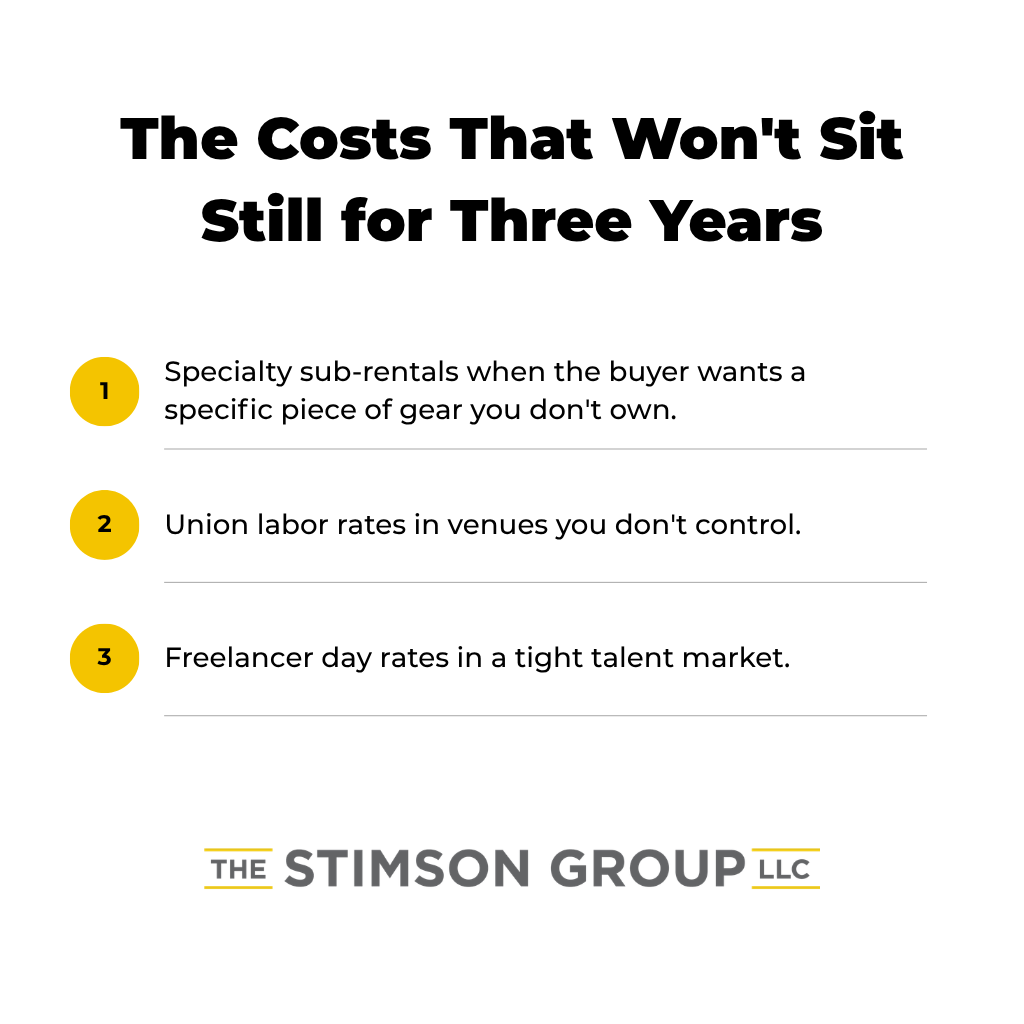
Some costs won’t sit still for three years.
Specialty sub-rentals when the buyer wants a specific piece of gear you don’t own. Union labor rates in venues you don’t control. Freelancer day rates in a tight talent market.
Those get priced as cost plus margin, with the margin set for the term of the agreement.
The customer sees exactly what the cost was, and the customer sees exactly what your markup is on top of it.
Zero hidden costs. No line-by-line negotiation.
When the union rate goes up 15% in year two, the client sees the 15% and understands where the increase came from. Outsourcing done cleanly turns transparency into an asset of the multi-year deal.
Enhancements Get Their Own Baseline Pricing
Enhancements aren’t part of the baseline. Enhancements go on the order when the show calls for them, and come off when the budget doesn’t.
Enhancements get their own baseline pricing inside the multi-year agreement.
The three-camera record package, the LED-wall upgrade, and the awards-moment lighting look each hold one price for the full term.
Each enhancement gets priced once and stays priced for three years. The client picks which enhancements to run each year, and the pricing is settled before the conversation starts. Scalable sales requires structure, and the multi-year enhancement list is the structure that keeps the annual review short.
Cost Plus Margin Plus Handling Fee
The one-off items in year two get their own pricing model.
The client’s chairman wants a custom LED wall for the awards ceremony. It’s a $50,000 item that wasn’t in the baseline.
Here’s the model. Cost plus margin plus handling fee, with the handling fee as guaranteed profit.
Handling fee sits at 8% to 12%. Margin might be 20% to 25%. The client sees three numbers: the cost, the margin, and the handling fee.
Only the margin is negotiable. That’s the whole conversation. The client picks a margin they’re comfortable with, and you close the deal.
Handling fee stays put because handling is non-negotiable. Cost is what it is because you showed the invoice.
The updated pricing strategy turns every specialty ask into a single-variable negotiation.
Multi-year agreements are a discipline play, not a discount play.
Price what you own for three years. Price cleanly on the variable costs. Give the buyer a single negotiating point on the specialty items.
Next time, go for the five-year deal.


Leave a Reply