





Listen instead on your Monday Morning Drive:
Scalability is how I live my life. My whole consulting practice orbits around it: enough resources to do your own work well, plus access to external resources that let you take on extra work when it’s there to take.
A reliable, flat revenue stream isn’t normal for our industry. It never will be. So we chase windfalls: big, one-off jobs that look like manna from heaven on the P&L.
Revenue, though, isn’t the point. Profit is.
Anybody can generate income. Plenty of windfalls sit out there waiting to get bought. The question is whether you take the windfall and stay profitable, or take the windfall and quietly rebuild the business around it.
Every windfall is lying to you about the size of your company. That’s why this matters.
What a Windfall Actually Is
A windfall is a piece of business that might never happen again.
The most common kind is the one-off, a large project that lands in your lap because the moon is rising on a Thursday and this particular client does this particular show once.
The second kind punches above your weight. The skills are there. The institutional depth isn’t. The job takes every resource you have for months at a stretch, and that’s the warning sign.
The third kind is the windfall client, the one who gives you all their business. It’s a great number on the P&L, but they’re always one conversation away from cutting you loose. A single client that big is a structural risk, not a relationship.
The Trophy Job That Almost Ate Our Business
Back in the 90s, our integration side had a shot at a couple million dollars’ worth of work on a campus installation at a local university. It was roughly 25% of what that segment did the prior year in one deal. We had a great team that did high-quality work, and they were ready to chase it.
I was on the management team and stuck my nose in. “How many of your people are tied up on this?” “All of them.” “What happens to the high-end corporate clients who call every week needing a boardroom or a projector tweaked?” “They’ll have to wait.”
My pushback wasn’t framed as scalability at the time, but it was the same idea. If you want this trophy, figure out how to do it with nobody on the inside but a project manager. Outsource the delivery end to end. Win the job, get the prestige, get the bragging rights, keep the revenue, and don’t gut your core business to chase it.
In the end, we passed. Looking back, that was the right call, and it’s the conversation every team needs to have with itself when a trophy job shows up.
The $5 Million Company That’s Really a $2 Million Company
I can think of four clients right now who are living this story. Here’s the version that fits most of them, and it’s why a windfall reshapes the size of your company without anybody noticing.
Five million in revenue. Twelve employees. Inside that $5 million is one $1 million windfall job that’s come back three years in a row, one $2 million windfall client that’s 40% of the book, and roughly $3 million of “normal” business that includes a bunch of small one-offs nobody has categorized correctly.
Lose the windfall job. Lose the windfall client. Now you’re a $2 million business with 12 employees and no momentum.
Seasonality is through the roof. Payroll is the problem. Downsizing is the conversation nobody wants to have.
The math the windfalls were hiding only shows up after they disappear.
The Right Six People Can Do the Work of Twelve
A $2 million core business with regular flow needs four or five people, not 12. If you have the right six, those six can do the work of 12 without the overhead.
That means treating every windfall as an outsourceable project, even if you don’t outsource it. On the $2 million core, your cost of goods sold runs about $750,000 because you’re using internal resources and your own inventory. On the $3 million of windfalls, cost of goods sold runs closer to 60%. Adding employees to run those windfalls cuts job costs a little but blows up overhead a lot.
Recast the numbers with outsourcing and the right six people. Cost of goods sold on the $3 million goes up. Overhead drops. Net profit rises.
Scalable companies have half the employees at a 20% higher per-person cost and come out ahead every quarter.
Three Ways Out When You’re Upside Down
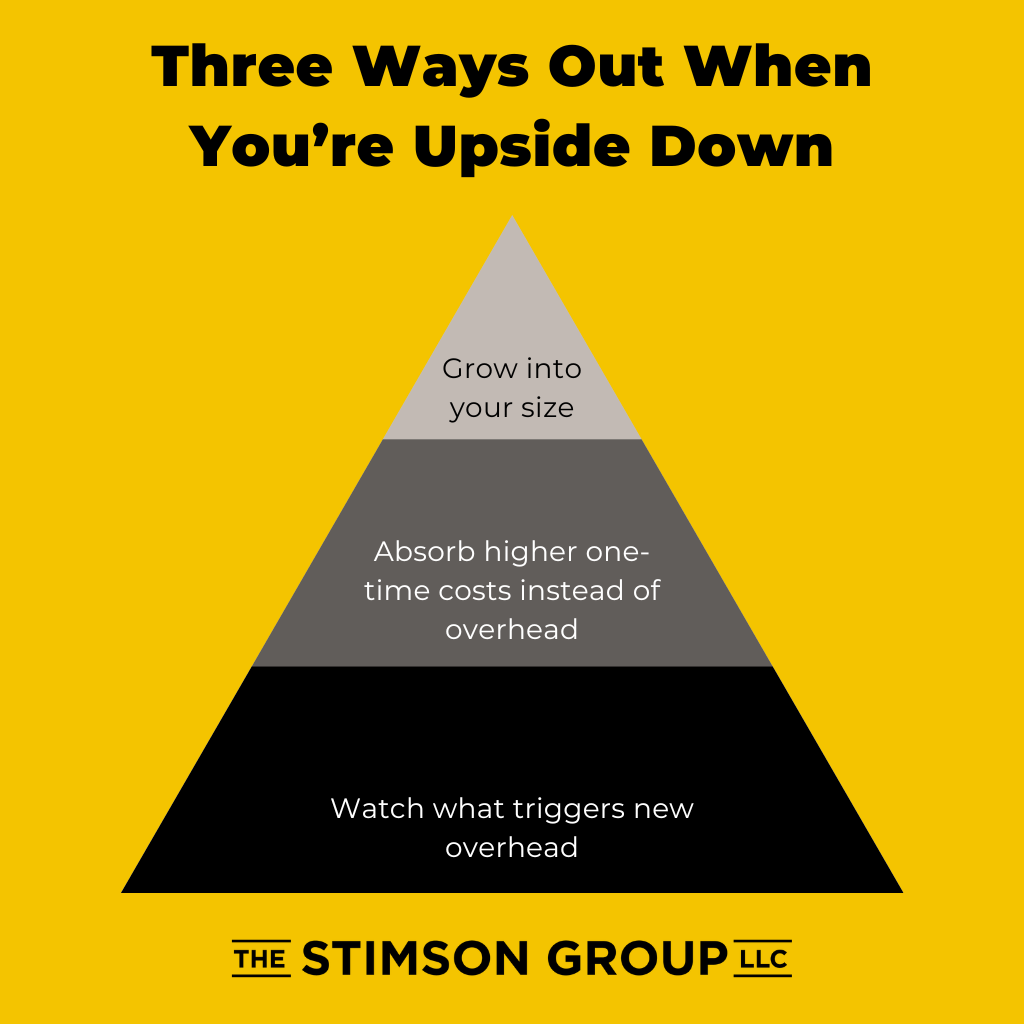
If your business is windfall-heavy and you don’t want to downsize, you have three levers:
- Grow into your size. Take the $2 million core to $4 million of core business and let the overhead catch up. That works. It isn’t easy. Growing core revenue is a sales and marketing problem, not a hiring one.
- Absorb higher one-time costs instead of overhead. A job can cost a little more to deliver without adding permanent headcount. The higher job cost is temporary. The overhead hire is forever.
- Watch what triggers new overhead. Every windfall-chasing company eventually talks itself into more marketing, business development, or salespeople. That raises cost of sales. On the other hand, for every $100,000 of new core revenue you bring in, about $60,000 lands as profit. Marketing pays for itself quickly when the core grows. It pays for itself slowly when two-thirds of your revenue is a windfall.
Invest in Better People, Not More People
If you outsource a non-core project at 70% of cost of goods sold, which is a lot, then a $1 million windfall costs you $700,000 to deliver. You still make $300,000 on it. Do that reliably, and occasional windfalls are good for you.
Take that profit and spend it on better people, better inventory, and better marketing, not more. Building the right team is how you protect the profit when the next windfall disappears.
Punch above your weight if you want to. Take the trophy job if you want to. Have a favorite client if you want to.
Build the company that makes money even when those projects disappear.


Leave a Reply