


Listen instead on your Monday Morning Drive:
I’ve watched dozens of AV companies fumble through staffing the same way. They get by. They make do. Then, a big job lands, and suddenly, they’re scrambling with no crew and no backup plan.
Here’s what happens next: Your sales team loses confidence. They start checking before they sell. The question “Can we even staff this?” kills deals before they start.
When sales loses confidence, you stop winning jobs. You start selling on price. You hire cheaper people. You use the same crew over and over since they’ll work for what you’re paying. Now you’ve got mismatched talent, stagnant thinking, and a shrinking pool of available techs.
Any time one of your regulars moves on, your bench gets smaller. And it keeps getting smaller until you can’t grow anymore.
Finding the right people to work in your business and on your events is your most important task. The rest is easy by comparison.
The Workflow of People
Evaluate talent all the time. Always be hiring.
If you have a six-person company and someone with real talent walks through your door, hire them. I don’t care what they do. You’ll figure it out.
Good people are rare. When you find them, act. The bigger you are, the easier this gets.
You also need to jettison talent that isn’t working out. This is especially true in your freelance pool. Always look for the upgrade path.
Once you find good talent, track their availability. If you’re not tracking availability, they’re not part of your team, and you’re not part of their future. You’ll call them out of the blue, and they’ll think, ‘Oh, those guys. They never hire me,’ and turn you down.
Good freelancers share their availability. They don’t want to waste time responding to requests for dates they can’t work. Keep track of it.
Book further ahead than you think you need to. If you haven’t booked crew for your standing shows for the second half of next year, you’re already behind.
And most importantly, ask your freelancers to recommend others.
You’ll always run out of people, and you need a steady stream of referrals to keep building your bench. One-hundred percent of great talent comes through referrals. Great people aren’t looking for work. They don’t need to find you.
You need good people to refer you to other good people.
Always ask, “Who should I work with? Who else should we talk to? Hey, I’m sorry you’re not available. Who do you recommend I call?”
Screen Fast, Decide Faster
When someone gets referred to you, do your homework.
Ask for a resume. Look at their LinkedIn. Have a conversation. Find out who else they’ve worked with and make a call.
Be quick to decline. If the screening isn’t going well, say, “No, thank you.” Don’t string people along. Don’t make them think they’re on your list when you’ll never hire them. That wrecks your reputation.
Once you decide to hire someone, figure out how to evaluate them. Bring them into the shop. Add them as an extra person on a show. Have a department head talk to them.
Provide onboarding information before you engage them: “Here’s how we work. Here’s how we pay you. Here’s how we succeed together.”
If you’re recruiting for a show next week, you still have time to complete these steps. The process just moves faster.
Track Your Talent
When you interview someone great, look at your schedule and find a job to put them on immediately.
When a highly recommended tech reaches out and says, “Bob told me to check in with you guys. I have some open dates in January,” find a job in January. Bump somebody else if you have to. Kick a staff person off, or move a regular to another gig.
You need tracking tools. Software can help, but I like spreadsheets, Gantt charts, and lists. I want a visual system that shows the person’s name, the positions they can fill, the jobs we haven’t booked them for, and the dates they’re unavailable.
When you talk to a freelancer, ask, “Is my schedule up to date? I show you’re not available on these dates. Has that changed?” The people who send you weekly updates are the people you book first.
Skills Profiles Matter
Not everybody does what they think they do. Not everybody’s as good as they think they are. Sometimes people are way better than they realize.
Figure out the skill profiles you’re booking. Not everyone is an A1, and there are multiple types of A1s. A lead audio person for a general AV gig is not the same as someone who does entertainment or large general sessions.
Book appropriate people for appropriate work.
Don’t use skill classifications to vent a grudge. I see it all the time: Someone didn’t like working with a particular tech, so they trash them. That’s their prerogative. Don’t work those people together, but remove grudges from your classification system.
If someone can’t be objective, maybe you shouldn’t ask them.
The Crewing Meeting
I like transparent crewing meetings where the team comes together to review upcoming jobs and decide who to book. Bring your owner, GM, director of production, operations lead, project managers, salespeople, and department heads.
Feather new talent in the appropriate places. Treat every job equally. You can’t make one job great by making another job bad, and the last outcome you need when a big job is running is for a small job to go south.
On a big job, if you’re worried about the depth of the team, throw an extra person on there. It’s a good investment.
Salespeople, project managers, and department heads shouldn’t decide who to send on shows. They all have biases. They go to the same people every time and wreck your bench.
As management, you have to challenge everybody to use new people, find better people, and use people more appropriately. Don’t set yourself up for failure, but don’t hamstring your ability to grow.
Slow periods are a great time to try out new people. You can pair them with your best available folks. Always have new people on your jobs. That’s the crewing meeting’s goal.
Respect Rates
“This guy’s more expensive, so we can’t book him. This guy’s less expensive, so let’s put him on a job.”
That’s the wrong conversation.
Book the best person available. Respect their rates and don’t offer inappropriate work. If someone is priced for high-end jobs, don’t offer them low-end work and expect them to drop their rate. They’ll block your number.
Hire the best person at the rate that’s appropriate for that job.
Manage Your Freelancers
Have written policies and practices. Give freelancers great paperwork. Use purchase orders and written agreements.
Define travel and expenses clearly. Staff and freelancers should operate under the same rules.
Don’t expect freelancers to make compromises you wouldn’t ask of staff. I know companies that throw lead techs in a truck with a driver to save on airfare. Don’t do this. You’re hiring experts, so treat them like experts.
If you have to replace someone on a job, do all you can to make up the lost work for them. It happens. Make the effort.
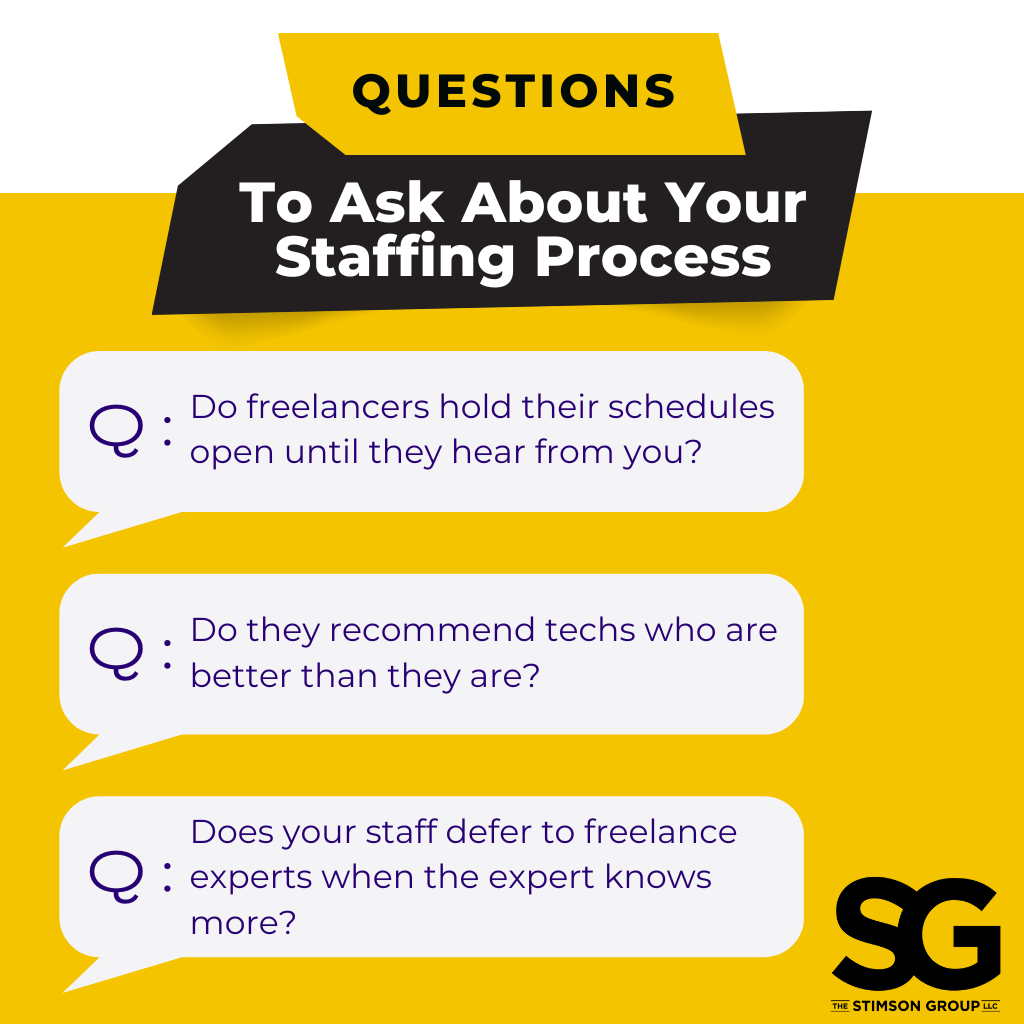
Is Your Staffing Process Working?
Ask yourself these questions:
- Do freelancers hold their schedules open until they hear from you? That’s a great sign.
- Do they recommend techs who are better than they are? That’s a great sign.
- Does your staff defer to freelance experts when the expert knows more? Again, that’s a great sign.
If freelancers cancel on you or back out at the last minute, it doesn’t reflect well on them, but it means you’re doing wrong by them, too. Either you’re hiring the wrong people, or you’re the wrong company to work for.
Figure out which one it is and fix it.
Your best freelancers and staff will almost always come from referrals. You want to be a company that good techs refer other good techs to. If your freelancers refer poor people to you, that says a lot about them and just as much about you.
And don’t try to hire a great freelancer and make them staff so you can control their lives. Great freelancers make lousy staff people. Great staff people make lousy freelancers. Put people in the role they’re suited for.
People are the most important part of your business. Stop winging it.


Leave a Reply