





Listen instead on your Monday Morning Drive:
Q1 is almost over, and you’re still leaving money on the table.
Before we get into the fun stuff you can try throughout the rest of the year, let’s talk about the non-negotiables. These practices belong in your business right now. If you haven’t committed to them already, they’ll change how you sell, how you price, and how much you keep.
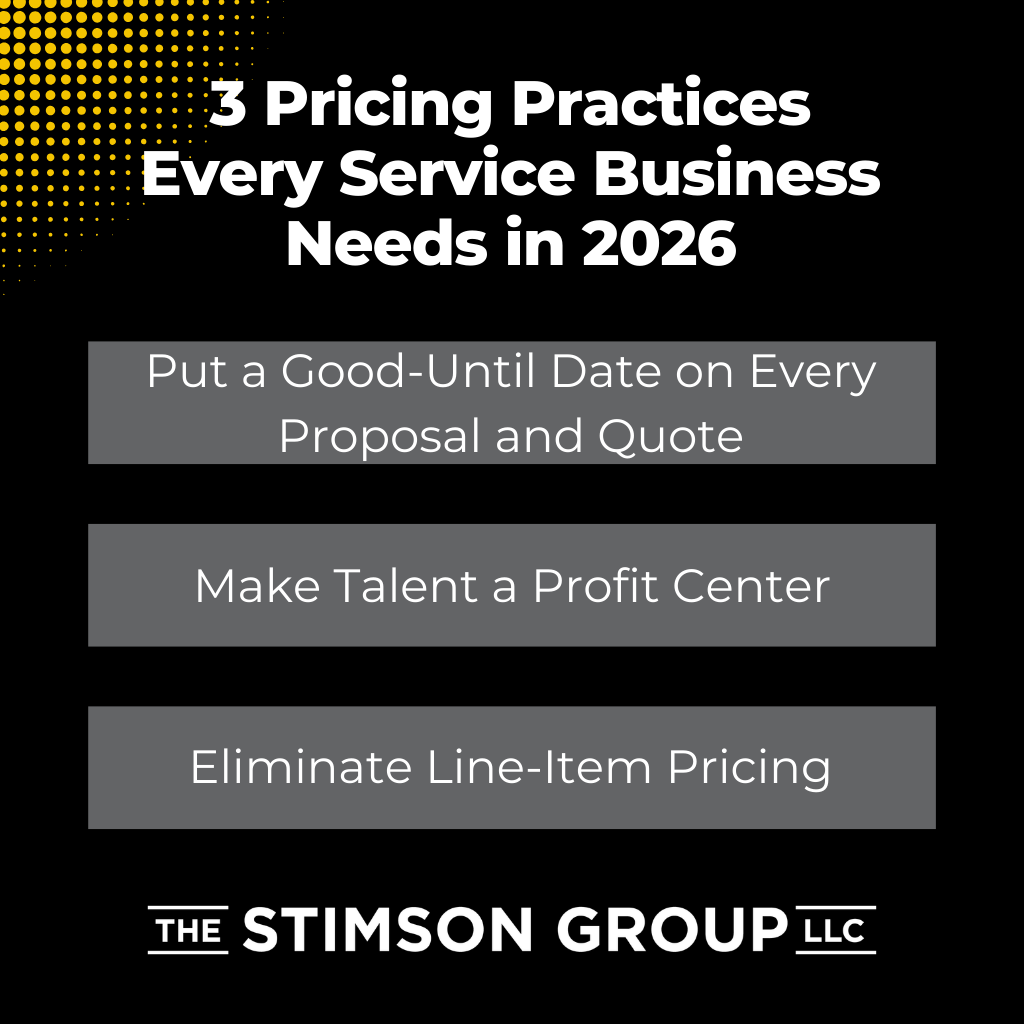
Three Practices You Should Already Be Doing
1. Put a Good-Until Date on Every Proposal and Quote
Every proposal or quote you send needs an expiration date. No exceptions.
If you’re sending a proposal, your good-until date can be a little further out. Ask the buyer about their decision timeline, agree on it, and put it in writing: “This proposal is good until this date.”
If you’re sending a quote (not a full proposal, just ballpark numbers), your good-until date is almost nonexistent. “If we can schedule a call next week, we can start with these numbers. If you’re still shopping around, these numbers won’t be valid after our conversation.”
Your price isn’t good forever. Your circumstances will change, and buyers don’t understand that on their own. You have to explain it to them.
You can’t guarantee what an airline ticket or a hotel room will cost next year. You can’t guarantee what dinner at your favorite restaurant will cost next year. The same is true for your services.
When a buyer signs an agreement, you’ll live by it. A good-until date gets you there.
2. Make Talent a Profit Center
Raising your labor prices isn’t the finish line. Higher prices help you pay the workforce what they deserve, which means you can recruit better-qualified people. That’s a good start, but it’s not enough.
When you commit to making talent a profit center, you’re saying every talent transaction has to generate gross profit. If people aren’t the most important part of what you provide, why are you in this business?
It’s not the gear that makes you good. It’s the people. And people aren’t scalable unless they’re a profit center.
When you add crew to a big show, your profit margin drops if talent margins are lower than equipment margins. The profit margin on talent shouldn’t be zero. Your team deserves it.
Your clients will get better work out of you once you stop complaining about how much people cost. Flying someone in and paying a premium for the right technician are normal costs of doing business.
Price your talent accordingly. If the buyer pushes back on the new number, negotiate somewhere else. Commit to making talent a source of income.
3. Eliminate Line-Item Pricing
It’s 2026. Line-item pricing needs to go.
I know you’ve got buyers who ask for it. So change the lines. Package pricing works.
“Here’s what this package costs.” If they ask what happens when they remove a piece, your answer is simple: “You can’t remove it. It’s a package. This comes with that.”
Think about buying a car. You want the beige leather seats, the navigation system, and the right color. You’re stuck with the moonroof whether you want it or not.
That’s how packages work. Manufacturing does it to keep production efficient. You’re a service company, and you can approach your buyers the same way.
Don’t shortchange your team by removing tools from their toolbox to save a buyer a few dollars. “Here’s the package. Here’s the price.”
Some of you have B2B buyers, and B2B works a bit differently. You’ll need system pricing and kit pricing for those accounts. But that’s a small part of your business.
Don’t let the B2B mindset undermine your approach to buyers who are purchasing a service.
Four Practices to Try
1. Start Selling Packages
When I say “packages,” I don’t mean a two-camera switch package or a sound system package. You sell shows. You get shows done for your buyers, and you know what those shows are worth.
Tell buyers, “We work in that ballroom all the time. Here’s the baseline package we put in there. Here’s what it costs.”
Then add, “Here are the enhancements you can add. I can’t take pieces away to make it cheaper.”
You always have a starting point, and you can negotiate on the upgrades. When you embrace packages, you’re embracing the concept of a baseline show.
If a show needs displays so the audience can see, sound so they can hear, wireless mics so presenters can move around, and lights so we can see the stage, sell it that way. One package. One price.
Packages will change your life. Start with one or two this year. If you need help building your first package, don’t hesitate to reach out.
2. Try Cost Plus Margin
I know you’re used to building quotes on retail pricing handed down from old-timers (including me). Stop. Those prices were made up.
The people after us made up prices. Then companies compared each other’s made-up prices and called it a market. It was all fiction from the start.
Cost plus margin is the real price. And it’ll vary.
You’re a service business. Your costs change with the time of year, your available inventory, and your team’s capabilities. That’s okay. It means you might not be the best value when you’re punching above your weight, and that keeps you from punching too far.
Here’s how to test it. Build a proposal the way you normally would: retail pricing, your standard discount, and the number you’d present to the buyer. Then go back and calculate your actual costs. Freelancers, travel, trucking, subrentals, expendables, drawing hours. Add all of it up.
Now ask yourself, “If I’m spending $5,000 to get this show done, what do I deserve to make?” Compare that number to your old-fashioned quote. You’ll be surprised.
Once you start selling this way, negotiations get simple. Your cost is $5,000, and you quote $12,500. The buyer says their budget is $11,000.
You say yes. You’ve still got a strong margin. No more pretending to shuffle equipment discounts or swapping technicians to shave a few dollars.
Know your costs. Add your margin. Negotiate to the margin you’re willing to live with.
The math gets easier. You’ll make more money. And you’ll spend less time inventing stories about why the price is what it is.
3. Use Good-Until Dates to Kill Dead Deals
If you’re already putting good-until dates on your proposals (as covered earlier), take it a step further. Use them to close out stale opportunities.
A good-until date means you finally get to say, “This job is dead.” That’s all your operations team wants to hear. They don’t care about your optimism.
If the buyer doesn’t respond by the deadline and you’ve made your best effort, operations can move on. “Thanks for trying. This isn’t going to happen.”
No is as good as a yes in sales. If you get to a no, you stop wasting time chasing a yes that’s never going to come. You can focus on better opportunities and bigger wins.
Good-until dates earn respect. Buyers will take you more seriously when your time has a limit.
4. Write a One-Page Proposal
You can do this. I promise.
Build your order however you normally would. Use line items internally, use cost plus margin, do whatever works for your process. Then write one short paragraph.
“We’ll provide sound, two large screens, stage lighting, wireless mics, downstage monitors, and speaker timers so your presenters feel confident and comfortable. We’ll handle all of it on your event date. The price is $15,000.”
That’s it. One page. Good until next Friday.
A one-page proposal tells the buyer you know what you’re doing. It signals that you’ve done this before and communicates confidence in a way a 12-page line-item breakdown never will.
Final Thoughts
These are small lifts. Start stretching your wings. Many of your competitors are already making these changes. Your buyers may be seeing it from you for the first time, but they’re not seeing it from anyone for the first time.
Make 2026 the year you start running your business with common sense.


Leave a Reply