





Listen instead on your Monday Morning Drive:
Many years ago, a company owner called me in a panic. His team was burned out after eight straight weeks on show sites. They were ready to walk.
This wasn’t a small operation. It was a sizable company where 80% of employees could end up on a single show site.
The owner needed to stop selling for a while to let his people recover. The problem was that he could only hold out for about three days. He loved to sell. He loved being needed.
So, how did they get into this mess? They didn’t know how to forecast.
They chased all revenue equally, filled their calendar with unprofitable work, and turned down good jobs because they were “too busy” with bad ones. When the busy period ended, there were no jobs on the books, and the cycle began again.
The information they needed to prevent this was available to them. They just never used it.
Your Business Isn’t One Business
When I ask clients to tell me their lines of business, I’m usually met with dead air.
“We do events,” they say. “That’s our business.”
I push back: “Do you sell equipment?”
“Oh, yeah. We sell LED walls. We install them in churches three or four times a year.”
That’s a separate line of business. It makes money differently from your event production work.
Imagine a restaurant with a bar. You sit down, order a drink, pay your bar tab, then move to your table and start a new tab. You’re dealing with two different revenue streams, two different margins, and two different teams.
A bar makes money differently than table service. That’s why they run separate tabs.
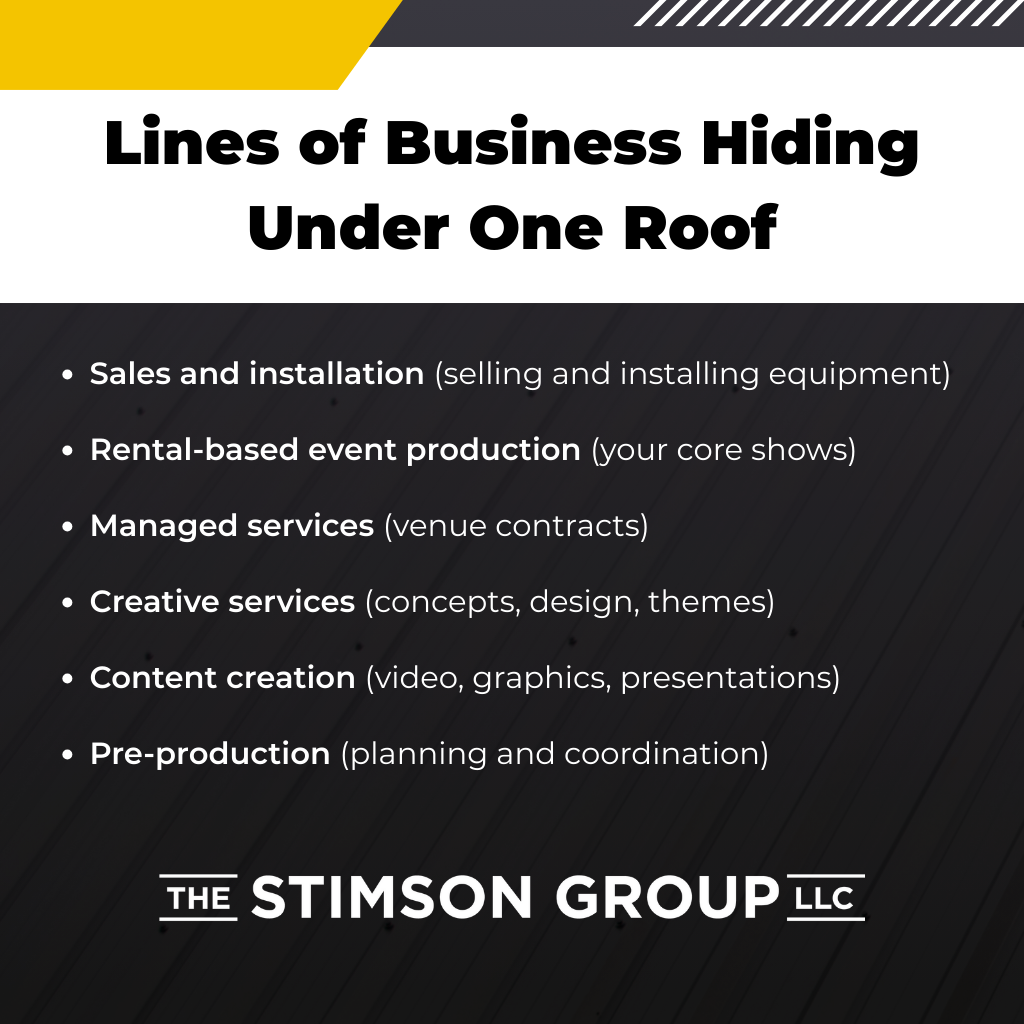
Your company likely has several lines of business hiding under one roof:
- Sales and installation (selling and installing equipment)
- Rental-based event production (your core shows)
- Managed services (venue contracts)
- Creative services (concepts, design, themes)
- Content creation (video, graphics, presentations)
- Pre-production (planning and coordination)
Creative services sell intellectual property on a different timeline than your rentals. Content creation has different costs from event production.
You can combine these into a full-service show, but they’re not the same. You can’t look at all revenue equally. Each line of business generates a unique gross profit with specific costs the other areas don’t have.
You have to understand your lines of business before you can forecast.
Not All Customers Are Created Equal
Once you’ve sorted your lines of business, look at your customers. Don’t sort by vertical (associations, corporations) or channel (marketing managers, executive offices). Sort by their relationship with you:
- Clients give you all their business. For the services you provide, they expect you to handle everything. You have an implied right of first refusal.
- Customers decide whether to use you or someone else every single time. They put the work out to bid.
You might argue that a three-year association contract makes someone a client. It doesn’t. They’re a customer with a three-year agreement. If you make them unhappy, they’ll move on.
They want the convenience of not having to switch suppliers annually. That’s not loyalty; it’s efficiency.
Within customers, you have subcategories:
- Recurring customers do their show with you every year, but it’s not guaranteed. Maybe they’re on year three of a three-year deal.
- Pickup customers are customers you don’t see coming. Maybe their event is in your town. Maybe they discovered you online. Maybe another company handled their last event, and now they’re testing you out. This is business that finds you.
- Windfall customers are the big one-time jobs, maybe a recurring job you got lucky on once. If a customer accounts for more than 25% of your business, it’s a windfall. If they don’t use all your services, if you’re not the primary contractor, if you’re punching above your weight, it’s a windfall.
Windfall work isn’t bad, but you have to recognize it for what it is.
Say you did $8 million last year but only $6 million this year because you “lost” a $2 million job. Let’s unpack that phrasing.
You had a $2 million windfall. It happened once. You were never doing it again. You didn’t become an $8 million company. You were a $6 million company with $8 million in revenue. Now you’re a $6 million company again.
Worse, you probably quit selling while you were busy with the windfall.
Finally, there’s B2B work, courtesy work for commercial partners. It’s good revenue to fill idle equipment and resources. But if B2B is your primary focus, those are your customers, and you’re running a different model entirely.
How to Actually Forecast
Now that you’ve looked at your customers, you can build a forecast.
Each line of business has revenue streams. Sales and installation might include product sales, installation labor, and service/repairs, which means you have three streams within one line of business.
A client who does event production with you might also hire you for occasional installation work. But if you don’t know they’re opening a new office next year, it doesn’t go on your forecast.
Clients are easy. They give you their schedule. You know the size of their projects.
ABC Insurance Company does five medium shows, one big show, and 10 small projects annually. Within each event is creative, content creation, pre-production, and event production. You can break them all out and forecast them accurately.
Customers are trickier. They’re not all loyal, but a subset are, and you know when their events happen because they’re published.
Maybe you work with an event producer who hires you whenever she gets a new show. She’s buying $1 million in events from you annually, though not always with the same end clients. You can probably count on $800,000 from her.
Put that in your forecast. If her pipeline shrinks, shrink your forecast. If it grows, wait and see.
For agencies, you’re working on market share. How much of their business comes to you because you’re regional? Ask them how many jobs they’ll have in your market next year. Or, figure out how to become a preferred provider so geography doesn’t matter.
If you can’t forecast a customer’s revenue and they have a lot of it, make yourself more valuable and become part of their planning.
Pickup business is seasonal. May is always busy with graduations and corporate work. If you can answer the phone and support those buyers, you’ll pick up business.
Don’t forecast pickup revenue as a percentage of total revenue. Forecast based on how much demand exists in each month.
July might be dead for corporate work, so no pickup goes on your July forecast. If you get pickup work in July, that’s a bonus, but you can’t bank on it.
May has two busy weeks and two weeks with capacity. Demand is higher, so work more aggressively to win jobs that fit the less-busy weeks.
The Real Goal of Forecasting
The goal isn’t to forecast a huge number so you can throw a pre-success parade. It’s to understand how many resources you need to fill the gaps. How much selling do you need to do? When do you need to do it?
Back to my burned-out client. They needed to reorganize their warehouse, fix their pricing, do marketing, hold team meetings, and complete personnel reviews. This work keeps a business healthy.
They kept putting it off because they were feast-or-famine on revenue. No work meant no money, so they wouldn’t spend money on maintenance tasks.
Then, eight weeks of busy revenue kept them from selling. When the push ended, no new work was on their books.
Pickup business saved them. Known buyers, agencies, and recurring customers came through with work that they would’ve known was predictable if they’d been paying attention.
If they’d done a proper forecast, they would’ve known they couldn’t afford to put the entire team on show sites for eight weeks while abandoning the rest of the business.
You Already Have the Information You Need
Examine your lines of business. Then, examine your customer types and the services and products they buy within each line of business. Use that information to build your forecast for next year.
Without a forecast, how do you know when and how to allocate resources to grow while servicing the customers you have?
Have fun. Make money. Why else are we in business?


Leave a Reply