





Listen instead on your Monday Morning Drive:
You need to understand the difference between a customer and a client and never treat one like the other.
I was working with a large organization making the transition to being more client-focused. Business development was doing its job, bringing in opportunities. Then came a chance to add a major university to their portfolio through a small event.
They walked away from it because they felt they were too busy.
I came unglued on them.
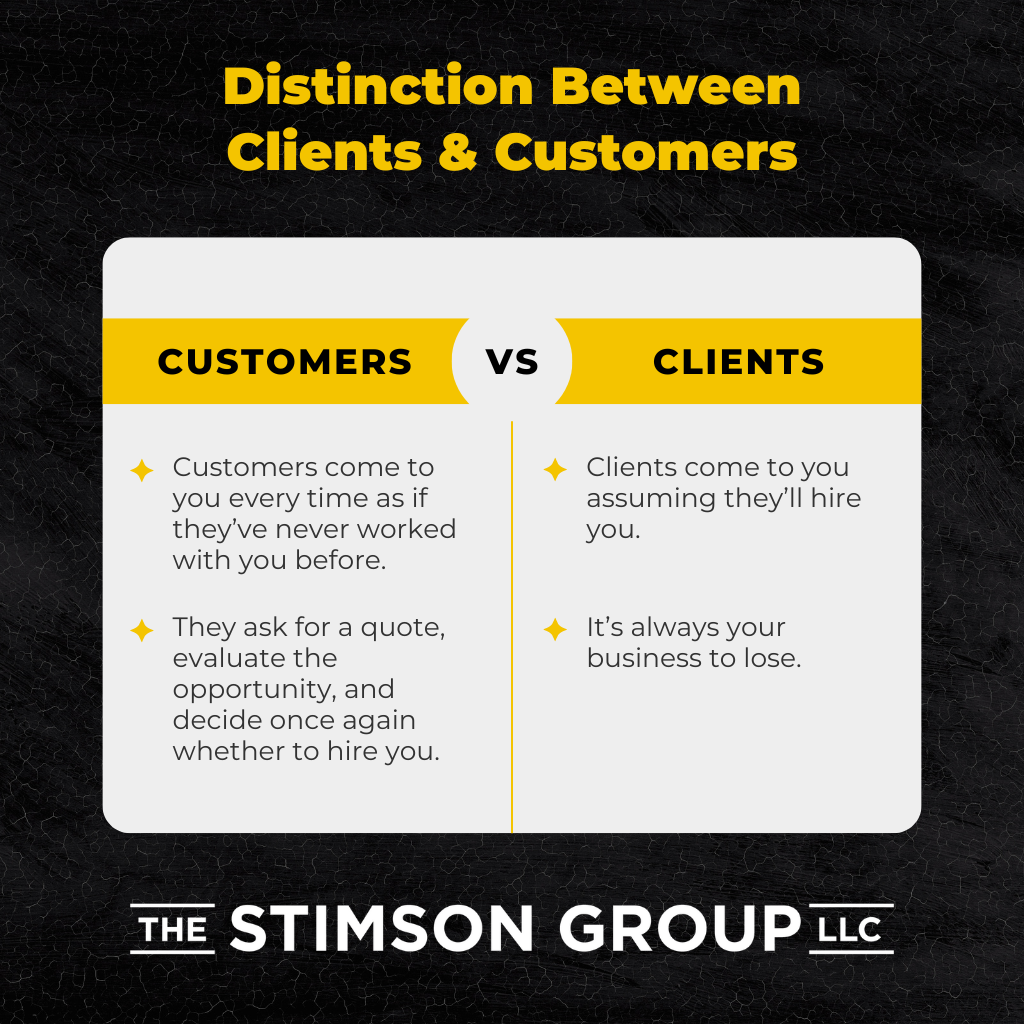
Clients vs. Customers: The Distinction
Customers come to you every time as if they’ve never worked with you before. They ask for a quote, evaluate the opportunity, and decide once again whether to hire you.
Clients come to you assuming they’ll hire you. It’s always your business to lose.
Retaining clients is easier than finding customers. Clients don’t want to change vendors. Nobody loves mistakes, but clients are more likely to tolerate them. In fact, they often expect them, and that’s factored into the relationship. They’ll give you another chance. They’ll let you know when you’re not doing well.
Attracting clients is the goal for most of us. We want nurtured relationships. But clients require a different level of work and commitment than customers.
How Buyers Actually Behave
Look at your buyers. Are they typically customers or clients?
Back in my sales career, I sold primarily to agencies. Most agencies are customers, but they call themselves clients, they like to be thought of as clients, and they think of their customers as clients.
But most agencies are living on the edge of being fired at any given moment on any given day, which means you are, too.
A good agency buyer may like working with you, come to you all the time, and be extremely loyal. In that case, you might treat them as a client instead of a customer. They may have earned that respect, and you’ll take on their jobs that have a low margin or aren’t ideal.
But if you sell into the agency world, you just won’t want to do a lot of projects.
When my agency customer came to me with 80 breakout rooms, I told him we don’t do breakout rooms. “Well, you need to do this for me,” he said.
“No, I don’t,” I replied. “I’ll help you. I’ll give you the RFP. I’ll send you to a company that can do that for you. But I’m not that company.”
Customer relationships are different. You can turn down a customer just like they’re about to turn you down.
The Warehouse Problem
Many times I’ve been out in the warehouse with my clients, talking to the warehouse manager, seeing the salesperson run out with a last-minute order for “the most important customer in the world.”
The salesperson thinks that customer is a client. What they actually have is a customer being opportunistic, taking advantage of the fact that the salesperson will go outside the bounds of normal business.
They bend over backward for a buyer who isn’t worthy of client-level services.
And on any given day, if the answer is, “I need $1,500 for this,” and they say, “I’ll give you $1,000,” and you hold firm on the price, they’ll move on.
Audit Your Account List
When you see your sales team getting behind a buyer who doesn’t seem to deserve it, examine who your customers and clients actually are. Print out your top 25 accounts by volume. Better yet, print them all out.
This is the 80/20 rule. Roughly 80% of your revenue comes from 20% of your accounts. When you start getting down into the smaller numbers, you’ll find a lot of people who are a pain in the butt: people who ask you to jump through hoops even though they may have been with you for a long time.
You’ll often find people you’re treating like a client who you should treat like a customer.
Raise your prices for these accounts. Be more selective about what you’re willing to do for them. Push back against their demands so you have more resources to cater to your clients.
If your top 10 is full of customers, they’ll get in the way of your client business.
The Busy Week Test
Don’t say no to clients on the busiest week of the year. When a customer calls during a busy period, it’s okay to say, “We’re too busy; we can’t help you.”
When a client calls, say, “We can help you. Here’s what I have to do to accommodate you. Your regular team isn’t available, but I’ve got suppliers that can get me the equipment we need. I’ll personally attend to your job to make sure it’s handled properly. We’ve got some great freelancers I can put on this project.”
It may not be their normal team, and the gear may not have your name on it, but that’s why they’re calling you. They know you’ll take care of it.
You can say, “This is a little late, and I’ve got to move resources around, but here’s what I can do for you.”
Don’t turn clients down. That’s how you earn, keep, and retain loyalty.
The Other Side of the Deal
In exchange for never turning clients down, we expect them to call us for every project, and we get to call them on it when they don’t.
“Hey, I see you’re putting the graduation out for bid this year. Let’s sit down and talk about this. What’s going on?
“If you were ready to put this out to bid, I should’ve been your first call. What happened to our relationship? What’s changed? Do you need better numbers? Do you have a new boss? Is there a new person in procurement?”
If there’s a new influencer in their organization, ask to do your capabilities presentation so they can learn the value of your partnership.
Customer-Based Business Is Valid
Not every business owner wants clients. There’s no shame in being an RFP- and project-based business.
If you work for agencies or for local corporations that might have a national organization that buys from a different provider but buys from you locally, every project is an opportunity to win or lose.
These are customers. If they keep coming back, great. But we can’t assume we’ll win their next job just because we did the same job last year. We have to prove ourselves every time.
Listen to how their needs have changed. See what’s happening in the organization. Are they more price sensitive this year? Are they more finish sensitive? As personnel change, are the presenters different?
Customers need to see you paying attention to those changes. They need to know you’re engaging with each project like it’s new and that you’re not taking any part of that relationship for granted.
Nobody will get fired for hiring you, because they’re doing their due diligence. Always make them look good by being diligent about your response.
Two Models, Different Goals
If you want the million-dollar project but don’t want the $50,000 projects that trail behind it, look for customers.
If you want a steady stream of long-term revenue from a handful of businesses, and you want to work for fewer companies that give you more work, pursue clients.
You can look for both, but you need to use the appropriate process for each.
The Negotiation Difference
For a loyal client, make their budget go as far as you can. Never question their budget.
With customers, you tell them what their budget will buy, and that ends the conversation.
There’s a limit on what you’ll do for a customer. There are very few limits on what you’ll do for a client.
If a client continually over-asks for their budget, you can push back and reframe it. If they want to maintain their relationship with you, they’ve got to give a little, too.
Customers that don’t like your position will go buy from another vendor. But on any given day, you might be the most effective seller for that particular project.
Customers and clients are both fantastic. Never treat them the same way.


Leave a Reply