




Turning Referrals into Great Marketing
To answer the eternal question of “how can I grow my business?” To grow organically – that is, without a new product, new territory, or an acquisition – there are three primary sources of new business:
- More sales from existing customers through either expanded product offerings (going wider) or working with more buyers within one company (going deeper).
- Finding new customers through marketing, advertising, and business development efforts.
- Leveraging existing contacts through sales networking.
If you are a service company, then the least expensive and lowest risk of these is number three, sales networking. I find that the most valuable sales networking technique in terms of immediate returns is Asking for Referrals. It’s an ideal method for marketing-averse companies or anyone that feels that “salespeople” are the key to growth. Asking for referrals is part of an overall sales plan that has the added benefit of ensuring ongoing customer engagement without making another “sales” call.
If your business success comes from word of mouth, then asking for referrals is a natural complement.
The process is not as simple as asking if the client ‘knows someone else’ that you can call on. Instead, asking for referrals is a smorgasbord of simple requests that will allow the happy customer to contribute to your efforts in a way that means something to them.
Opportunities within a Referral Conversation
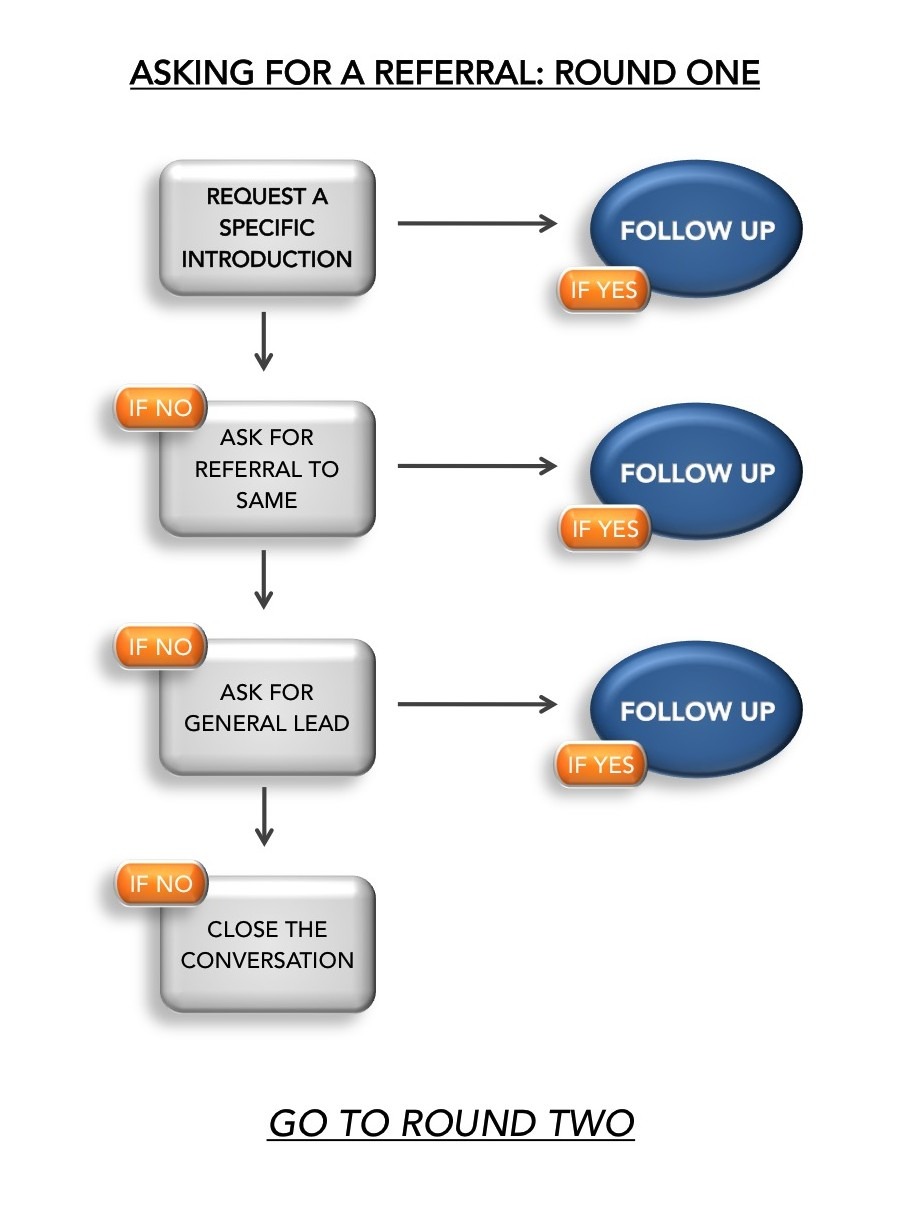
The referral conversation requires preparation on your part. The goal is to get the target to agree to an action that furthers your goal, which is a referral, a lead, an endorsement, advice, or the agreement to a future interaction. You need one ‘Yes’, but you are allowed only two ‘Noes’.
The typical referral conversation will touch on topic #1 plus no more than one or two additional points. You can decide which points to try depending on the how the conversation goes.
- Introduction (to a lead, networker, or prospect)
- Referral (to a known buyer)
- Testimonial or Endorsement (written, video, or ??)
- Advice (on a specialty topic)
- Offer for deeper engagement such as an updated capabilities pitch, product demo, intro to your new key employee; Offer your client an introduction that might help their career (not just yours); Ask if they will allow you to use them as a reference and take a call from a prospect of yours.
I will go into each of these in more detail, but clearly a little preparation on your part will ensure that you come away with something of value.
The Introduction
Requirement: Identify a specific person that you would like to meet. It could be your client’s co-worker, peer, or other acquaintance.
Having an opening request is key to getting an introduction from your contact. A clear, succinct petition ensures that the call will be an efficient use of your customer’s time and allows you to quickly focus on an achievable outcome.
“Hi Carol, this is Tom. Thanks for taking my call. I have identified a buyer in your company named Bob Smith. I believe he is the VP of Sales for your Western Division? Is that correct and do you know him?…Wonderful, I am hoping for a simple email introduction. Would you be comfortable making a small endorsement of my company and sharing my contact information?”
Note that this question has a binary outcome, but you have more than one path to success. If the target says, “No, I don’t know them well enough to do that,” then you shift to, “Can I tell them you suggested I call?” – This creates a referral, which is an acceptable outcome for this conversation and the end of the call. Thank them and move on. (See ‘The Referral’)
Ask for the introduction, but embrace the referral.
If ask nicely and your client appreciates your work, you will probably earn that introduction Most professionals have received an introduction email before, but here’s what one looks like:
Hi Bob,
Great to see you at the Executive retreat. I want to introduce you to one of my trusted suppliers. Tom Jones is with XYZ Corp and they handle all of my printing for the Eastern Division. As you know we shopped a lot of suppliers and getting a better price was not as difficult as finding someone that would do a good job, on time. XYZ has consistently delivered.
I ask that you take a few minutes and let Tom introduce himself to you. If you were to shift your printing to XYZ, I bet we could both get great service and an even better price!
Thanks,
Carol
Cc: Tom Jones, XYZ Company
Now, your job as the beneficiary is to immediately follow-up with a message or phone call to the lead or prospect. Not all recipients welcome these introductions, so step lightly. This is a marathon, not a sprint. If you do earn an introduction, be sure to thank your contact and let them know how the lead pans out.
The Referral
A direct introduction by your client to someone of interest (“Bob, I’d like you to meet Tom with XYZ”) is more likely to result in a high-value conversation than a blind call or second-hand referral (“Bob, my name is Tom and Carol suggested I contact you”). Let your client know how the direct introduction greatly improves the potential for an actual connection. If the answer is still no, then shift to a more open question:
“Is there a person in your organization or professional network that you would be comfortable introducing me to?”
If still no, then thank them for their time and ask if you might contact them again if you identify another prospect they might know. The math here is simple: If you get two ‘no’ responses in one phone call, thank them and move on. If you get your yes, wrap up the call. Don’t get greedy. You don’t want to sour your client by asking too much.
Management note: Customers that refuse to engage at this level are often dissatisfied or simply do not like the person who is doing the asking. Review the conversation with the salesperson and if necessary, transfer this contact to a higher level in your organization to review customer service.
Testimonial or Endorsement
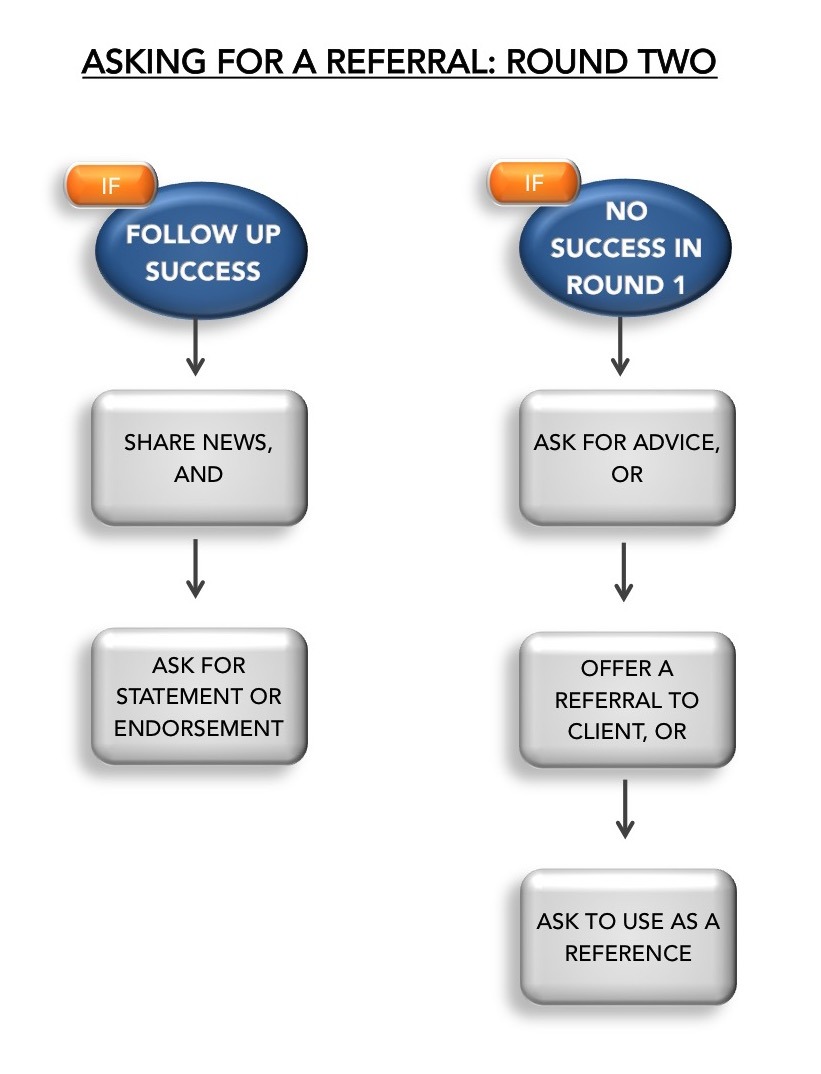
Notice what is in the introduction letter above, an endorsement! “…we shopped a lot of suppliers and getting a better price was not as difficult as finding someone that would do a good job, on time. XYZ has consistently delivered.” This is gold, provided your contact will allow their name, title, and company to appear with it. All you need to do is ask.
“Hi Carol, this is Tom again. Thanks for the referral to Bob Smith. We are still trying to connect, and I think your endorsement is what will make that happen. Speaking of that, my Director of Marketing loved your turn of phrase in your introduction email and wanted me to ask if you would give us permission to use it?…Thank-you, can we attribute it to you? We’d love to include your photo. Do you have one you can share with us or we can use that great one of you from our customer appreciation day?”
Sometimes a good endorsement will pop up in conversation or unsolicited emails. Learn to spot them and quickly ask for permission to share. Send a final version to the provider for their approval. And, do let your endorser know when you realize success attributed to that quote.
Thankful clients actually want to help you. They will be honored that you asked.
Websites, print, and social media are productive fields for sharing endorsements from clients. You can use them in email signatures or presentations. Be creative!
Video endorsements are currently the most powerful medium for today’s video-obsessed, fast-paced audience. They serve two purposes: One, they can help your company by serving as a highly credible marketing tool. Second, they deepen your client’s engagement with your company. Asking a client over to the office to sit for a short video shoot is an exciting honor for most folks.
Advice
Asking for advice is the last tier in a referral conversation. It’s somewhat of a face-saving question for both you and your target. The time to pull it out is when you have that first No, but sense that the second No is already tee’d up in the customer’s mind. Or, you perhaps sense that the target lacks the confidence to see herself as a valuable reference. Sometimes customers are not in a position to make an introduction or public endorsements. Not to fear, most folks want to help and that’s why you need to have an advice question ready.
Let’s say that our customer, Carol, has just explained that her company is going through a re-organization and she is not comfortable making an introduction or endorsement at this time. That caution indicates that it’s not the right time to ask for a favor, so instead – ask a question she can answer.
“I completely understand. Can I ask you for a bit of advice? In your position, what is a good way for a supplier to break the ice or get your attention in a positive way?”
This question gives the helpful customer a chance to be of service without embarrassment. You will probably learn something from them that will help on your next cold call. If they have no advice, that tells you something as well and we have exhausted this lead. Move on.
Summary
This system works, but you need to do your homework and go in prepared. Have your opening request prepared in advance. Know specific names of people you would like to ask about. And, have your safety “advice” question prepared (and a follow-up question in case the target is chatty).
Stay “in the moment”, which means listen for clues about where to go next. A referral request may be a non-starter if the customer doesn’t know you well enough, but that is a great lead-in for deeper engagement options. A tentative response might mean you need to re-ask the question or maybe, move on. Listen for the “no”. Make the call short – don’t linger. You called with a purpose.
Finally, do not try to accomplish all your goals in one call. Get the referral and then call back for another time for the endorsement. Later, ask if you can include them on a reference list. If you need an excuse to call, use the advice question you’ve been saving.
Referrals are a tool for growing your business, but not getting a referral doesn’t have to mean failure. Use the reputation you have earned through good customer service to deepen the relationship with the client. Endorsements and Advice are two more ways we can engage happy customers and reinforce the goodwill until the next sale.


Leave a Reply