





Listen instead on your Monday Morning Drive:
Last week, I wrote about the tipping points, the phrases you hear around the office right before an owner loses control of the business. “We’re too busy.” “We need one big project.” “We tried that once.” “We just need more revenue.” “We need the slow months to be busier.”
Thanks to everybody who wrote in about that one. This week is the follow-up.
Those phrases are symptoms, and every one of them is treatable. The roadmap to balance runs through the treatment, so here it is, one symptom at a time.
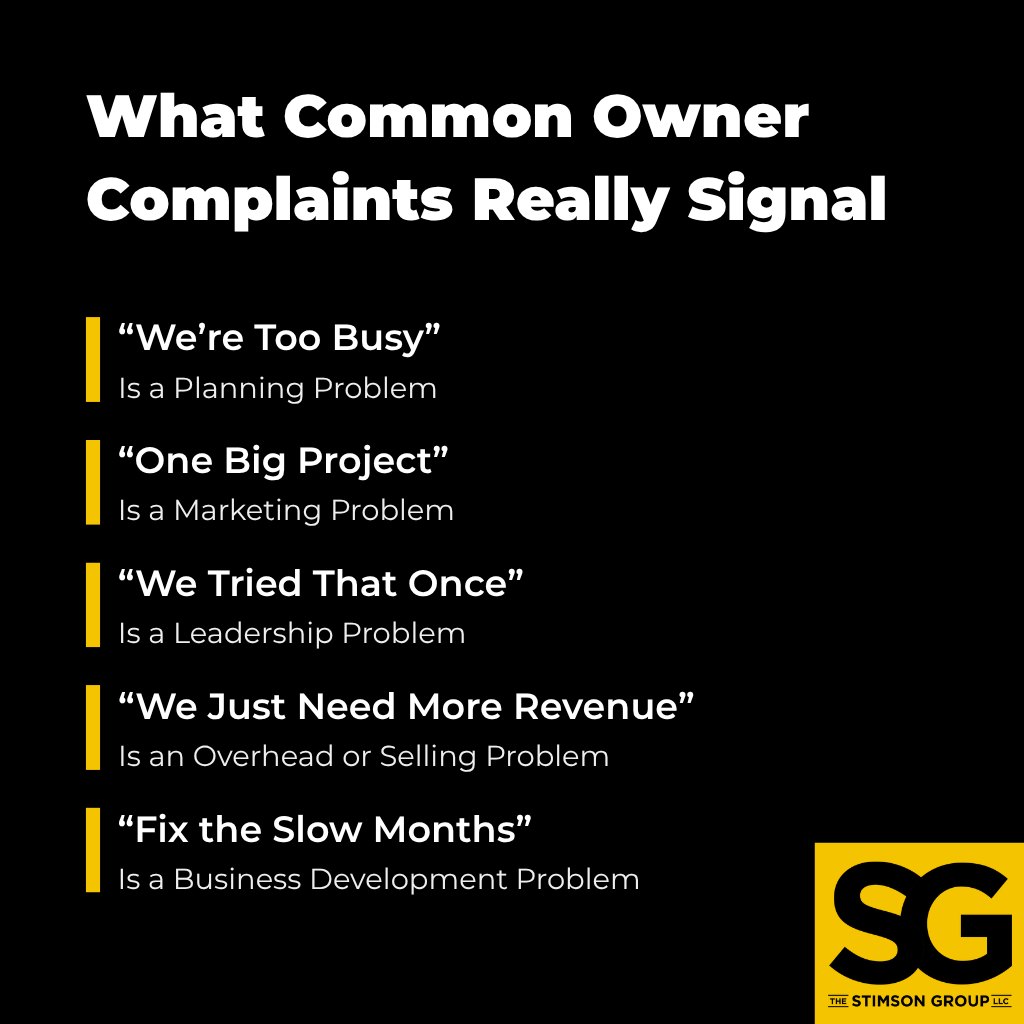
“We’re Too Busy” Is a Planning Problem
When a team tells me they’re too busy for October, I ask one question. If your best customer called with one more job, would you do it?
“Oh, absolutely.”
Then you’re not too busy. In 15 years inside a production company, I can count on one hand the times we truly had to turn work away, and in each case, we still took care of a top customer who needed us.
The feeling of being too busy comes from a lack of concrete planning. Every new order and every late change turns into a crisis when nobody is looking far enough ahead.
The fix is a complete planning team that stays in planning. If your production manager sells the job, plans the job, and runs the job on site, nobody is planning on the busiest day of the year. That person is out on a show.
A good planning team treats capacity as its point of pride. The team is always hunting for new freelancers and new resources, busy season or slow.
It’s fall, and you have shows confirmed for next year. Are the crews hired, the lifts ordered, the trucks lined up, and the known sub-rentals secured?
Why your team is always too busy comes down to whether planning gets protected or gets pulled onto show sites.
“One Big Project” Is a Marketing Problem
The big project promises to put you on the map and cover last year’s lost revenue. It also gives you pictures that make the company look bigger.
That’s the irony. What you need is to look good at what you already do.
Yearning for a job you’re not built for is a sign that marketing isn’t doing its job. If you had the 10 smaller customers you ought to have, you wouldn’t need the one big one to make the numbers work.
Marketing builds demand for the work you already do well. Sometimes, when you put real energy into it, you learn the big-job buyer was never looking for you anyway.
What you do well is already apparent. Marketing is the fuel that explains it to the buyers who would hire you if they knew you existed.
“We Tried That Once” Is a Leadership Problem
This one shows up most in hiring. The sales hire, the account executive, the business development person, the senior production manager. Plenty of companies have tried. Few have gotten it right the first time.
A failed hire doesn’t prove the role was wrong. Maybe you did the due diligence and bad luck bit you. Maybe you skipped the hard questions, or hired a business development person when you needed a salesperson.
“They worked for us for 12 months and didn’t sell a dime.” Business development doesn’t sell. It develops the business.
Giving up after one attempt always starts at the top of the org chart, so the fix starts there, too. Ask what the first attempt taught you and get advice from colleagues or advisors. Then try again with better questions.
Hire fast and fire faster. If you’re not seeing the results you want in the first 90 days, stop and review. Did we hire the right person for the right job, and did we give them the right support?
Ideas don’t come fully baked. You bake them while you apply them. Hiring fast and firing faster keeps a bad first bake from killing a good recipe.
“We Just Need More Revenue” Is an Overhead or Selling Problem
We all want more revenue. But if revenue alone would make you profitable, the math points to overhead. It costs you too much to sit idle, so the downtime eats the profit before the work starts.
If overhead isn’t the issue, selling is. Or, to use the scientific term, there’s suckage in the selling process.
Then I look at your margins, your process, your customer experience, your marketing, and your selling team. I want to find where you’re losing business.
The top of your funnel has to be bigger than the bottom. You ought to be turning down opportunities, because you’re specific about how good a job has to be before it earns your time.
How companies in this industry make money has been changing since the pandemic, and costs are moving again. Pricing and margins have to keep pace with the market you’re selling into.
“Fix the Slow Months” Is a Business Development Problem
I’ve been in this industry for 40 years, and fixing seasonality has always been the top question.
The secret: you can’t fix it. Seasonal demand exists for a reason.
You can, however, be busy in months that are normally slow.
Corporate events happen 12 months a year. Walk into a hotel the day after Christmas, and you’ll find one. It just isn’t yours.
Your slow months are untapped business development opportunities. A corporate AV company can pick up institutional work, nonprofits, universities, and graduations in the second and third quarters without touching the entertainment side.
The same holds for entertainment. Entertainment isn’t slow in the winter. The entertainment you do is slow in the winter.
My most successful clients make a profit every month of the year. When they miss, it’s one month out of 12, every other year.
Get the outreach right, and you end up turning down work in the busy months because better work is already on the books. The slow season is a sales problem, and the buyers who work year-round are out there.
The Structure That Treats All Five
Every one of these treatments comes from the same organizational model. The first step is to ditch your organization chart and replace it with Role Spheres. Start with Selling, which includes marketing, business development, and the design interface.
Then comes Planning, which organizes execution, and Administration, which supports the people doing the work.
From there we can define execution, the output sphere. Execution can be 100% outsourced. Whether to outsource yours is a company-by-company decision, but too many people in execution recreates the overhead and seasonality problems you’re trying to solve.
The classic top-down org chart takes twice as many people to do the same work. Well-defined spheres remove the obstacles to growth by focusing on the series of outcomes you are trying to achieve.
Building the scalable org chart is how you stop caving under the weight of these five phrases. The fixes exist. Keep looking for them.


Leave a Reply