





Listen instead on your Monday Morning Drive:
The most common title in live event production is project manager. A company with one salesperson typically has two project managers. A company with four salespeople might have six or eight.
Every job needs a project manager because the whole system is built around it. Small jobs and large jobs both get one. The industry treats the ratio as a given.
Project managers look at one job at a time. That’s the design flaw, and it’s what keeps this industry from scaling past a certain revenue level.
The information for each job lives inside one person’s head. When that person is on a show, they’re unreachable for the six other jobs on their desk. When they leave the company, half the institutional knowledge walks out with them.
Building the scalable org chart starts with recognizing what the project manager model actually costs.
Every Job Deserves the Same Attention
The principle I built my consulting practice around is simple: No job is small.
The budgets get small. The jobs matter equally to the client on the other side of the transaction.
Every project matters as much to that project owner as any other project you’re running. The pricing changes across the calendar. The satisfaction expectation does not.
The project manager model breaks that principle every time. The bigger jobs get the stronger project managers.
The smaller jobs get shuffled to a salesperson, a technician, or the operations manager filling in on a Tuesday. Same company, different levels of attention.
That’s what a client feels when the smaller job is treated like a smaller job. Knowing your customer means giving every event the same treatment, no matter the budget.
Selling, Planning, Admin, Execution
The old model has four silos: sales, operations, finance, and field.
The better model has four functions: selling, planning, administration, and execution.
The words look similar. The difference is that project managers span all four silos in the old model, which is why they’re always overloaded.
In the new model, each function has its own specialists, and project managers stay focused on execution.
Selling gets the qualified proposal out. Planning allocates the resources across every active job.
Administration handles the money and the paperwork. Execution runs the show on site.
The roadmap starts with role clarity, and role clarity requires giving each function its own owner.
Planning Looks at All Jobs at Once
Here’s the shift. The project manager looks at one job. The planning team looks at every job on the calendar, all the time.
You can’t allocate the truck without knowing what every other job needs from the truck. You can’t book the crew without knowing where every other job is drawing its crew from.
You can’t source the sub-rental without knowing whether the same gear is already committed somewhere else.
The planning team lives inside the constraint of every resource being shared across every job.
The head of planning has enough production experience to look at a proposal and know what the job needs.
They don’t have to do the operational work themselves. They divide the work up and give direction to project coordinators.
Managing across the calendar is what portfolio planning actually feels like.
Enter the Project Coordinator
A project coordinator does the operational subset of a project manager’s job.
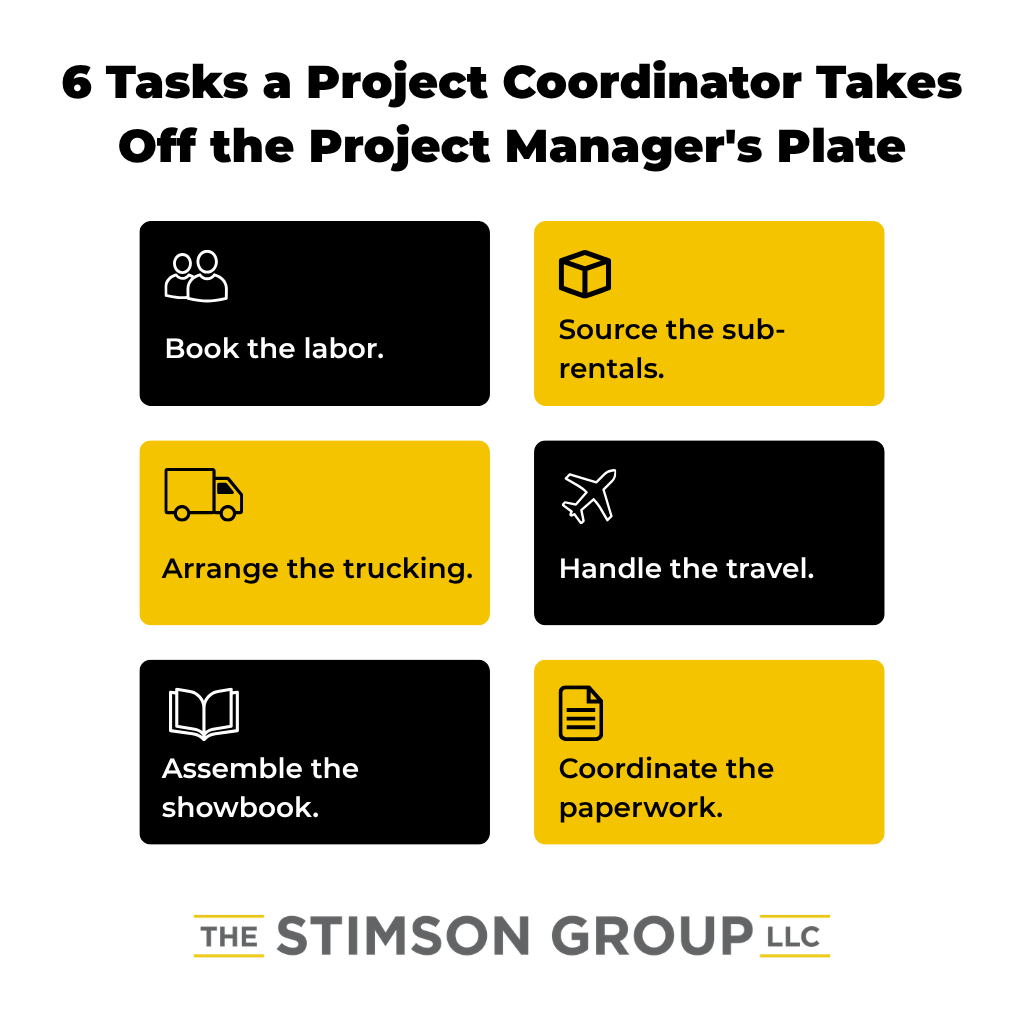
Book the labor. Source the sub-rentals. Arrange the trucking.
Handle the travel. Assemble the showbook. Coordinate the paperwork.
These are the tasks that used to sit on the project manager’s plate and pull them out of the strategic work.
Move those tasks to a project coordinator, and the project manager works at the level the client actually pays for.
The project coordinator runs the operational plumbing. The project manager runs the client relationship, the outcome, and the show. Defining the coordinator role cleanly is what makes the split work.
Coordinators Are Interchangeable, Not Pigeonholed
Most companies make the same mistake when they hire for this role. They hire a labor coordinator.
Six months later, the owner asks the labor coordinator to help with logistics on a busy week. The labor coordinator refuses.
“That isn’t my job. I’m the labor coordinator.”
Well, yes. The title said “labor coordinator,” so labor is what they coordinate.
Hire project coordinators, not labor coordinators.
Each coordinator can develop a specialty inside the role. The title stays broad.
They handle labor and logistics. Sub-rentals fit inside the same role.
They can flex between selling and planning, and cross into field work when the company needs the coverage. A team of three project coordinators moves across the whole business. A team of three specialists can only do their three specialties.
Hiring for flexibility is what allows a small planning team to run a big calendar.
Start with One Coordinator
A $5 million company doesn’t need three project coordinators. It needs one.
The first hire is usually a warehouse manager. The second is a project coordinator.
The third might be another salesperson. The fourth is a second project coordinator.
By the time the company hits $20 or $30 million, the planning team has multiple coordinators. Some sit on the selling side helping with proposals and change orders. Some sit on the planning side handling labor and logistics.
A few land on the largest jobs as on-site business managers, handling change orders and vendor check-ins so the project manager stays with the client.
The coordinator role scales with the company. The project manager role does not.
Coordinators scale, project managers don’t, and that’s the whole reason to fix the ratio before you scale past $10 million in revenue.
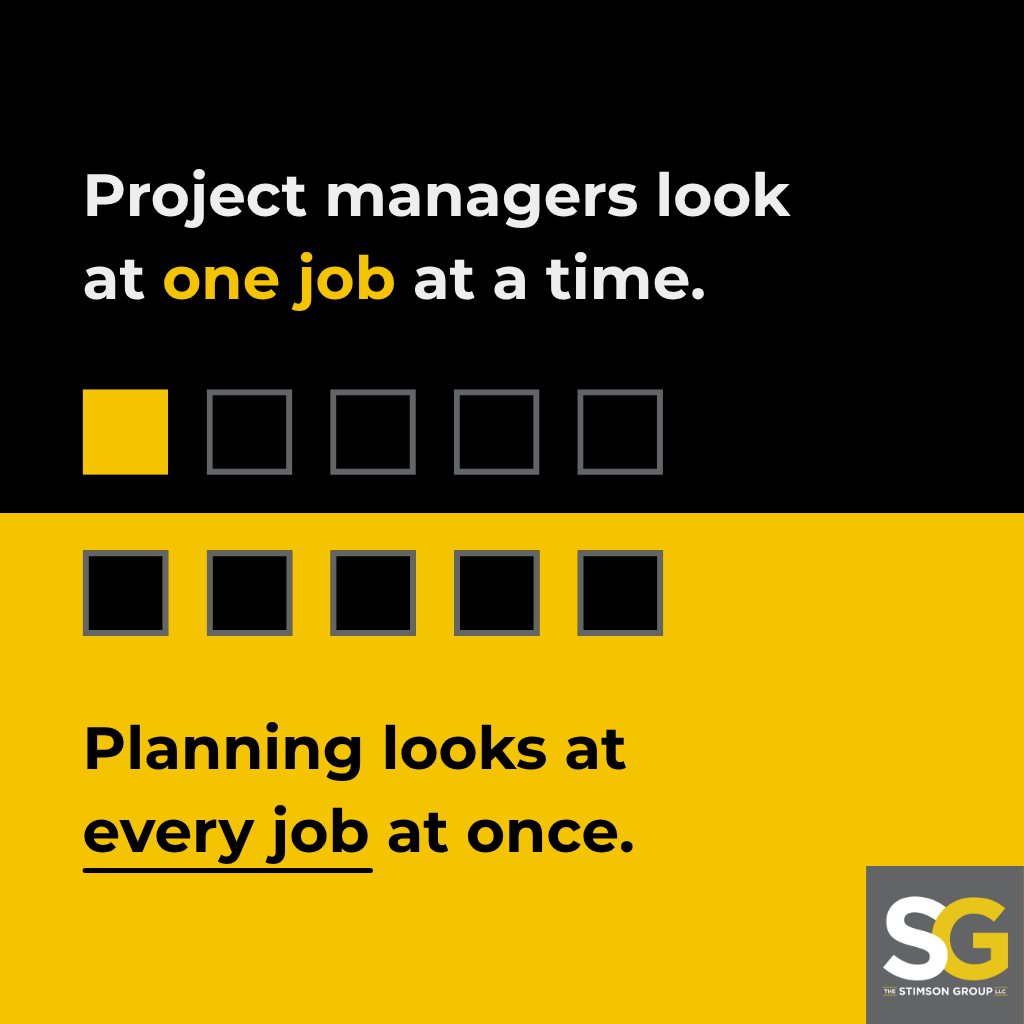
Project managers look at one job at a time. Planning looks at every job at once.
Hire the coordinator, and the planning team gets to look at the whole calendar without one person becoming the bottleneck.


Leave a Reply