





Listen instead on your Monday Morning Drive:
Last week, I wrote about my first job as a rental manager. Half of that job was spent in the warehouse. The other half was spent taking orders on the phone, one item at a time.
Here’s how the phone calls went. Customer says, “I need a screen.” Great. Front projection or rear? On legs or hanging? What size? Dress kit? Scenic surround? What’s behind it?
We’d spend 10 minutes reconciling every question about a single line item before hearing what the customer was actually building.
Then we’d move to the next item and repeat. And repeat.
The whole time, we were pricing pieces instead of listening to the show.
Most of those calls, the customer had a scenic company doing the surrounds. Or a production company that was going to bring the stage. Or a lighting outfit that already had the lectern.
We could have sold this in a completely different way, and much more efficiently, if we’d shut up for those 10 minutes and let the customer describe the whole show. The scalable sales process starts with the shutting-up part.
Why I Hate the Word Upsell
Somebody at Jumpstart in Las Vegas asked me how to upsell. I struggled to answer. The word “upsell” carries baggage I can’t shake.
“Upsell” sounds like the used-car pitch clients dread. Tack on the rustproofing, the extended warranty, and the mud flaps for another $800. Commission-driven, unsolicited, out of context, and always in the seller’s favor.
That’s the connotation. The reality of “upselling” in AV is usually less predatory, but the word still carries mistrust.
A cleaner way to think about the same sales move starts with the language. The framework has three tiers: needs, enhancements, and options. Selling inside a defined framework fixes the connotation problem for good.
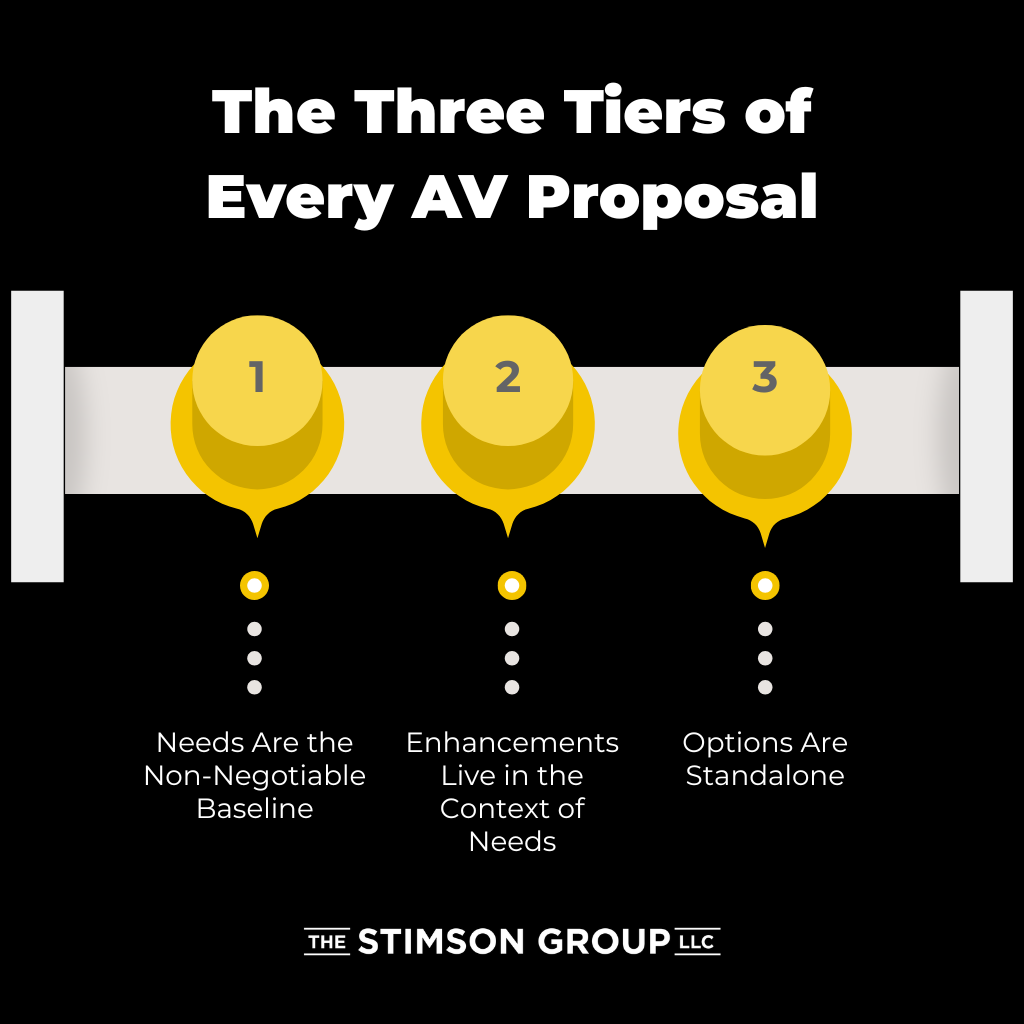
Needs Are the Non-Negotiable Baseline
Every event has a set of baseline needs. Everyone in the room can hear. Everyone can see.
Speakers stay comfortable on stage. Every piece hung stays hung. Every piece on the ground stays put.
Those needs drive the baseline gear list. A sound system rated for the room and the audience size. A screen that reads from the back row.
Enough source inputs. Enough lighting for the stage.
The baseline defines the show. Cutting the baseline cancels the show.
Pricing has to protect the baseline because the tiers above the baseline are negotiable, and cutting into the baseline breaks the show.
Enhancements Live in the Context of Needs
Enhancements add to the baseline.
Enhancements come out of the discovery conversation, not out of your inventory. The client mentions they want to record the keynote. That’s an enhancement.
You now propose a camera package that covers recording, streaming, and image magnification. The camera is the tool. The enhancement is the outcome, not the equipment.
If the client says they want to add excitement to the awards moment, you propose two moving lights, a music cue, and a lighting look for the reveal. That’s an enhancement.
The client asked, you responded, and the enhancement fits the outcome the client described. Enhancements make the customer feel understood because the enhancement came out of the customer’s own words.
Options Are Standalone
Options are the third tier. Options are standalone.
An option can go on the order or come off it without changing the rest of the show. An option lives outside the scope of the baseline, but you introduce it because you think the customer would use it.
The client didn’t ask for a second camera. You suggest one anyway, because a second angle would improve the recording quality. That’s an option, not an enhancement.
The distinction matters when the budget shifts. Enhancements reinforce the show. Options are extras.
If the client cuts the budget, options are the first place to look. The updated pricing strategy treats options as separable line items so the customer sees each choice on its own.
What Separates an Upsell From an Enhancement
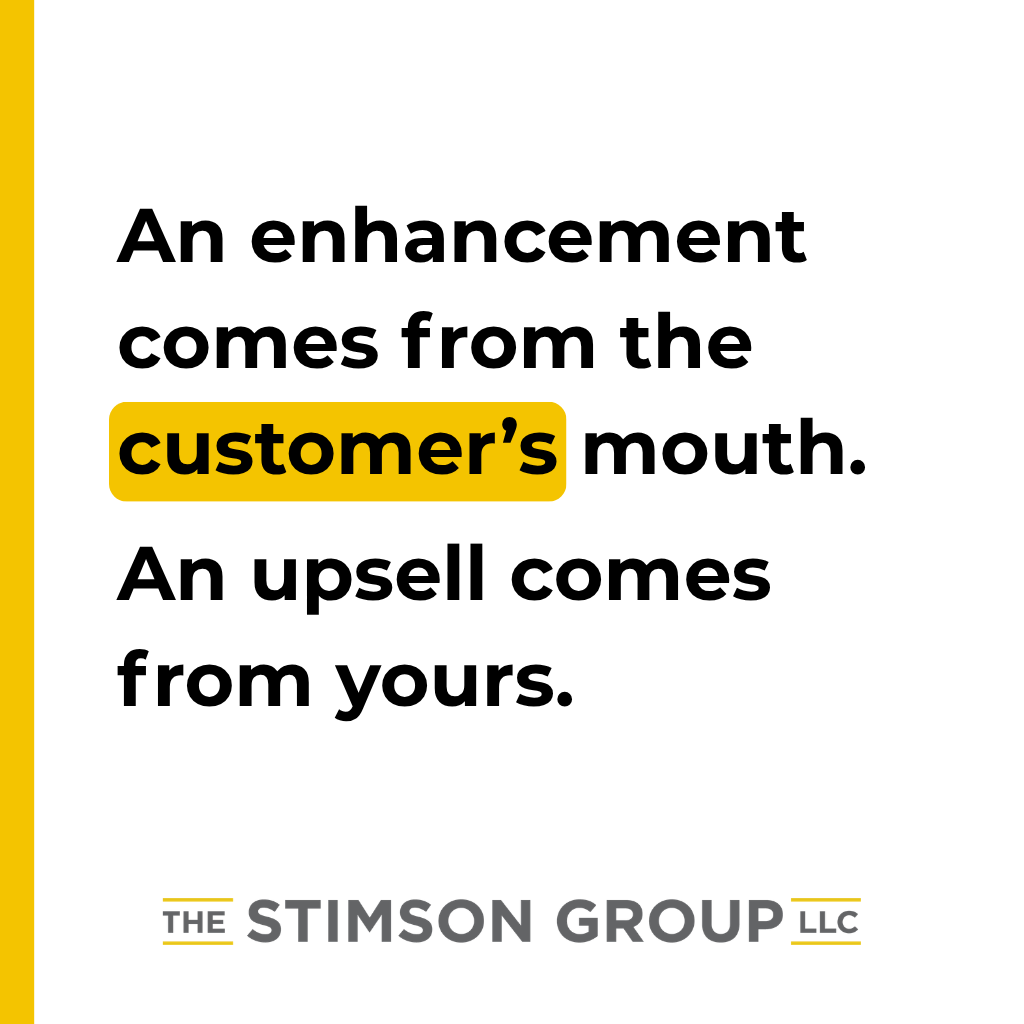
An enhancement comes from the customer’s mouth. An upsell comes from yours.
An enhancement reinforces context. An upsell lacks it. The customer described the outcome, and the enhancement answers the outcome. The upsell arrives out of nowhere, and the customer feels the pitch before hearing the value.
That’s the whole test. Did the customer describe the outcome your idea reinforces? If yes, it’s an enhancement. If no, it’s an upsell.
Every proposal you build lives or dies on that distinction. Enhancements protect your pricing because they came out of the customer’s own words.
The Budget-Cut Call Tests the Framework
Two weeks before the show, the customer calls and says, “We need to cut 20% off the budget.”
Every seasoned salesperson has taken this call. The framework decides how the call goes.
You can’t cut the baseline. Cutting the baseline cancels the show. The customer knows this if you positioned the baseline as the baseline from day one.
You can cut options. Options are the first place to look. Options come off, and the show still works.
You can cut enhancements. Some enhancements will be easier to lose than others. The customer picks which enhancements go based on what matters most.
If the customer sees the baseline, the enhancements, and the options as three separate tiers on the proposal, the budget-cut call becomes a 15-minute conversation instead of a two-hour emergency. Sales metrics run on that clarity.
Upselling is the wrong word for what actually happens in a good sales conversation. The good version is baseline, enhancements, options.
Kill the word. Keep the customer.


Leave a Reply