





Listen instead on your Monday Morning Drive:
I sit in a lot of management meetings. Sometimes in person, more often on Zoom. Most of the time, the team talks about business, and I don’t have much to add. Then somebody says the line that makes me unmute.
“We just got an invoice from a freelancer, and he’s charging us for airport parking. We don’t pay for airport parking, do we?”
The next half hour is gone. The meeting isn’t about the business anymore. It’s about a rule.
The same pattern plays out with vacation requests. Somebody wants off the second week of May. Don’t we have a rule about that? Well, no. Do we need a rule? Maybe? And now we’re writing a rule nobody asked for, based on one invoice from one freelancer for one airport.
Rule-making like this is how management meetings get hijacked. Rules are what happen when a team doesn’t know how to have an adult conversation.
Rules Are Binary. Policies Are Human.
A rule is black and white. You’re either inside the rule or outside of it.
When the rule can’t bend, the rule gets broken. When the rule gets broken, you’re stuck arguing about the rule instead of the business.
A policy allows for exceptions. It gives you room to consider the circumstances and make a reasonable call. The framework holds, and the humans in it get to stay human.
“We don’t pay for airport parking” is a fine statement. As a rule, it’s fragile. Every time you direct somebody to drive straight from one job to the airport, you break the rule and create a rewrite.
As a policy, it works. We don’t pay for airport parking unless we’ve directed you to drive there. A clear policy saves you the rewrite because the exception is built in.
The Squeaky Wheel Problem
I worked with a company whose handbook stated that employees had to request their own compensation review. They had to schedule it with their supervisor.
The squeaky wheels got them. The quiet employees didn’t, year after year.
That’s what happens when you codify a rule without thinking about who it serves. The employees who most need coaching don’t ask for it. The employees who least need a raise negotiate one. Your best people quietly drift toward the door because nobody made the time to talk to them.
A policy fixes it: “Compensation and performance reviews happen every August. Both parties are responsible for finding time to meet.” Building reviews into the calendar keeps the whole team growing, and it gives you an obvious lever when someone can’t make August work.
Policies state when work happens. Rules state whether it happens at all. You almost always want the first one.
Vacation Requests in a Busy Month
Every owner has the same headache: somebody wants a vacation during the busiest two weeks of the year.
A rule says “no vacation requests in May.” What happens when the request comes in anyway?
A policy says we consider the request. If your daughter is getting married, you’re getting time off. That’s a reasonable exception. If you’re trying to save a few bucks on a cheaper flight, the answer is no. You’ll make more money that week, and your June vacation is already cheaper than your May one.
You can apply a policy like that without feeling like a tyrant. You can enforce a rule like that without sounding like one. How you handle this kind of friction tells the team plenty about the culture you’re building.
The Truck Loading Example
Here’s one everyone in AV has heard: “Heavy stuff goes to the front of the truck box.”
As a rule, it’s common sense. Balanced loads. Safe trucks. Hard to argue with.
Until you realize you also want the heavy cable and power distros on the tail so the tie-in crew can get to them first. Now the rule is broken every load.
Try it as a policy instead. The rule is that the truck goes out safely. The policy is that we load heavy cases on the front first. The practice is to make exceptions when motor gear and distros need to come off the tail.
Rule holds. Policy adapts. Nobody argues. A written practice keeps the crew aligned without a rulebook fight.
Policies People Don’t Fight
People fight rules. They don’t fight policies.
A rule forces a binary answer. Yes or no. In or out. The person on the receiving end has two choices: comply with a rule that doesn’t fit their situation, or push back hard enough to break it. Neither is a good outcome.
A policy says, “Here’s what we do, here’s what the exceptions look like, and here’s what I need to hear from you to make an exception.” The person on the other side says, “Thank you for considering this.” They appreciate the space. They come back next time with a better ask, not a better workaround.
If you send your folks to the Ritz-Carlton and there’s no free parking within 15 minutes of the hotel, that’s when the policy gets tested. “I know the policy is you don’t pay for parking, but the hotel has no free option. Can we make an exception for this trip?”
That’s an adult conversation, and you get to have it instead of an argument.
Write Fewer Rules
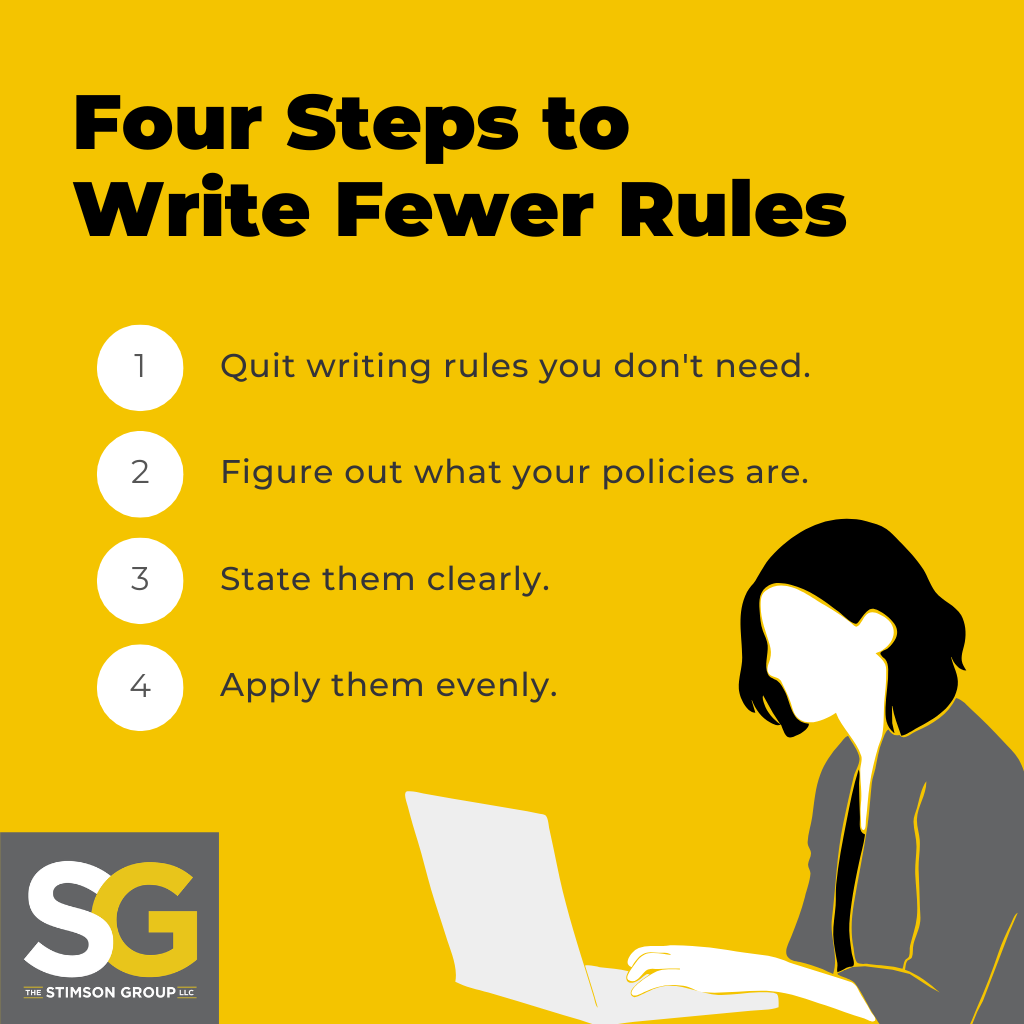
Quit writing rules you don’t need. Figure out what your policies are. State them clearly. Apply them evenly.
You’ll find a lot less resistance on your team. You’ll find more harmony in the decisions you do have to make. Your management meetings will run shorter, and the hour you used to spend debating a parking line item will go to the work that actually moves the business.
That’s my policy.


Leave a Reply