





Listen instead on your Monday Morning Drive:
You’ve heard it a thousand times: A rising tide lifts all boats. It’s a comforting idea. But it’s a lie.
An improving economy doesn’t help everyone. It helps the people who are prepared.
Picture a boat sitting on top of a reef. It appears to be above water, but it has a hole in the bottom. When the tide rises, the boat fills with water and sinks.
In business terms, the reef is a subsidy. If your business model has holes and the only reason you can’t see them is a calm economy, a rising tide won’t lift your boat. It’ll show everyone your boat doesn’t float.
The Economic Outlook Is Good (For Some)
Economists are predicting steady but modest growth through at least 2029, even with erratic monetary policy. The propping mechanisms behind the U.S. economy won’t break over the next three to four years — according to some experts.
Government spending continues to flow into the economy, and money is still doing work. That’s the good news.
The bad news is that an aging workforce, a rising cost of living, and skyrocketing healthcare expenses are squeezing the labor market from every angle. Fewer entry-level workers are available, and fewer people want sub-$20-an-hour work when they can earn $30 an hour doing piecework.
Your biggest cost, people, is going up. The question is whether you’ll ride the wave or get swamped on the reef.
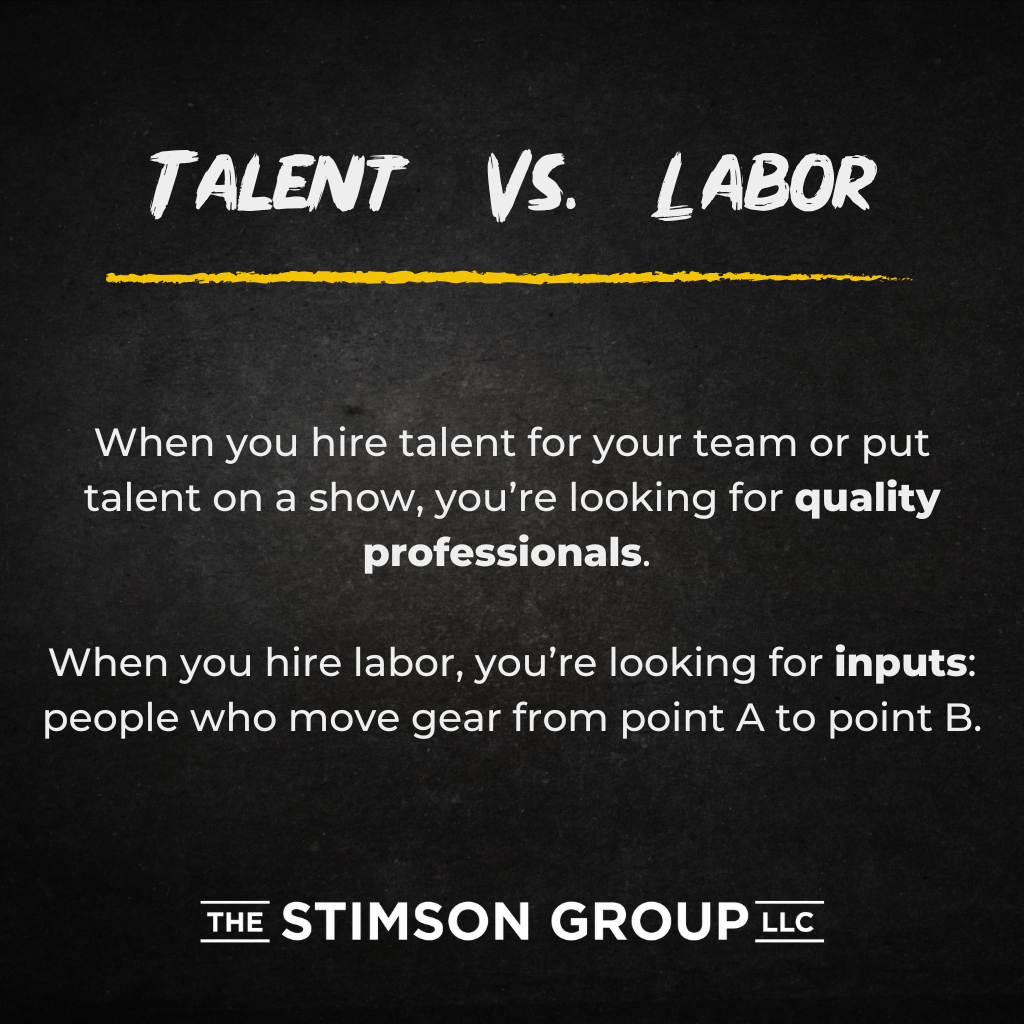
Talent Versus Labor
Talent is about quality. Labor is about quantity.
When you hire talent for your team or put talent on a show, you’re looking for quality professionals. When you hire labor, you’re looking for inputs: people who move gear from point A to point B.
Inputs require skills, a strong work ethic, and trainability. But talent will always be more valuable.
Here’s where it gets expensive. Many companies add labor to compensate for a lack of talent.
A post-pandemic company with only one or two talented people on the team solves every problem by throwing more bodies at it. They end up with 15 people working in their warehouse when they only need four — all to avoid mistakes and keep people from complaining about how hard the work is.
A shortage of talent increases labor demand. The more talent you have, the less labor you need. Talented people are smarter and more efficient.
The Talent War Is Already Here
We’re facing a talent shortage during an economic upturn. The battle for quality people will be fierce.
This is especially true in our industry as companies move toward scalable business models. You need fewer people, but they need to be twice as good. You’re pulling from the same talent pool as everyone else.
You’re replacing average talent with better talent (at least, you’d better be if you want to remain scalable and keep growing).
The value of talent is increasing. The value of labor is increasing as well. Fewer workers are available for those roles, and their cost of living is higher.
Think about minimum wage for a second. It was set over 40 years ago. A high school student can’t pay for gas to get to work on minimum wage. It stopped being a useful benchmark a long time ago.
So, when a warehouse worker asks for $30 an hour, ask yourself: What does it cost to live in your community? That’s a $60,000-a-year employee. Companies paying those rates in Southern California are still profitable. They monitor their pricing, margins, and productivity.
Pricing Strategy: The Reef Below Your Boat
If the tide rises and everyone else raises their prices but you hold yours steady, telling yourself, “My customers won’t pay for that,” here’s what happens.
Your workforce and supply chain costs rise. Your margins shrink. You sell more business to make the same money.
You take your average team and work them twice as hard to do twice the revenue for half the profit. That’s the death spiral. You can only survive it for so long.
Pricing strategy and margins go hand in hand. Revenue growth is worthless if profit doesn’t grow with it.
Stop obsessing over top-line revenue and start watching your margins. Over the next three to five years, the only number that matters is profit.
Automation Is Your Friend
Automation doesn’t mean running shows with fewer people by making everyone wear more hats. It means streamlining operations that consume your team’s capacity.
Selling, marketing, customer service — so much of this can be automated. Before you recoil at the idea of a computer talking to your customers, consider the experience you already love as a consumer.
When you order glasses online, you get updates at every stage: order received, optician review, build started, packaging, shipment. That’s automation. That’s great customer service.
When the repair company tells you your technician will arrive in seven minutes instead of “sometime between noon and 5 p.m.,” that’s automation, too.
Your customers welcome this. They don’t want weekly production meetings that review the same information. They don’t need constant reassurance when your talent is competent and your systems are reliable. Provide automated touchpoints and free your team to focus on higher-value work.
Retention Is Cheaper Than Replacement
As the cost of high-quality talent increases, focus on keeping the good people you already have. Pay market rate.
If it would cost you 50% more to replace your best person, you’re gambling every day you underpay them. All it takes is one competitor walking up to your star employee and saying, “You only make $90K? I’ll pay you $150K and you’ll work less.”
Balanced, scalable businesses need half as many people to do day-to-day work, but those people need to be twice as good. You may have to pay 50% more than what you’ve been paying, but you need half as many people. Your net cost for talent drops when you have the right people in place.
Hire Overqualified People
Stop telling yourself a candidate is “overqualified.” You’re saying they cost more than you wanted to spend.
Overqualified people take work off your plate. They make the job look easy.
If your reaction to someone making the job look easy is “I’m paying them too much to sit around,” reconsider. They’re that good.
When you hire, hire people who are better than you at the job you’re filling. Too many owners hire a controller who knows as much about accounting as they do. They don’t want to feel outmatched.
If you need a controller, hire a great one. Don’t hire a bookkeeper and call them a controller. Don’t hire a controller and call them a CFO. If you need a CFO, hire one and reap the benefits.
Create a better work environment. Give talented people room to develop and use their abilities. Take responsibility away from yourself for the work you’re not good at and let the people who are better at it handle it.
Leadership Makes or Breaks This
All of this (pricing strategy, margins, productivity, automation, retention) comes down to one factor: your leadership.
If you don’t know how to look around the corner and plan for what’s coming, surround yourself with people who do. Hire them. Outsource them. Don’t sit on the reef and pretend the tide won’t rise.
Economists are handing you a three-to-five-year window of modest growth. Strategy is engineering what you want to happen based on what you expect will happen. If you understand the economy is growing and you sit still as your competitors act, you’ll lose.
Pay attention. Read up. Look ahead. Win the talent war.


Leave a Reply