





Listen instead on your Monday Morning Drive:
I started my AV career as a freelance technician. I came from theatre, knew how to thread a 16mm projector, and could hit five cues in succession without breaking a sweat. I was good at doing shows.
But doing shows isn’t the same as planning them.
In 1991, Tom Alford, founder of Alford Media, pulled me off the road and gave me the title of “rental manager.” He didn’t know exactly what I’d do. He just knew I’d bring value to the party. What I brought was an obsession with systematizing chaos.
Here’s how planning evolved from those early days and why the model still applies, whether you have eight employees or 800.
The First Lesson: Train Your Replacement
Before I get into the mechanics, I need to share the mindset behind every system I built.
My dad taught me this during his corporate career. Every time he got a new job, he’d assess how the operation worked, delegate responsibilities to the team, and work himself out of that job. Then he’d approach his boss and say, “You no longer need a manager in this area. This area runs itself.”
They’d promote him and put him somewhere else.
I applied the same thinking at Alford Media. Every job the company depended on me to do also depended on me to teach somebody else how to do it. If I couldn’t train my replacement, I’d have to do that job forever, and everybody would suffer.
Starting With the Pull Sheet
The first task Tom handed me was a pull sheet: a sheet of paper listing all the equipment we owned with room to write in more. I’d fill it out, hand it to the warehouse manager, and he’d start prepping.
The scrubbing process back then was primitive. I once told the warehouse crew to grab a cardboard box full of cables and put the whole box on the truck.
We didn’t have cable lists or cable cases. We just sent all the cable we had and brought back whatever was left over.
But we got the work done. And from that starting point, I learned how to scrub orders properly. I learned to look at a job and say, “Here’s what I know we need.”
The Iteration Cycle
Once you learn how to scrub an order, you start noticing patterns.
We always sent the same gear out, so we started packaging it together. Then, our cardboard boxes wore out, so we bought cases and trunks. Then, we had delicate gear that needed specialized casing, so we bought more cases.
Each improvement changed what our pull sheet looked like. The pull sheet got fancier.
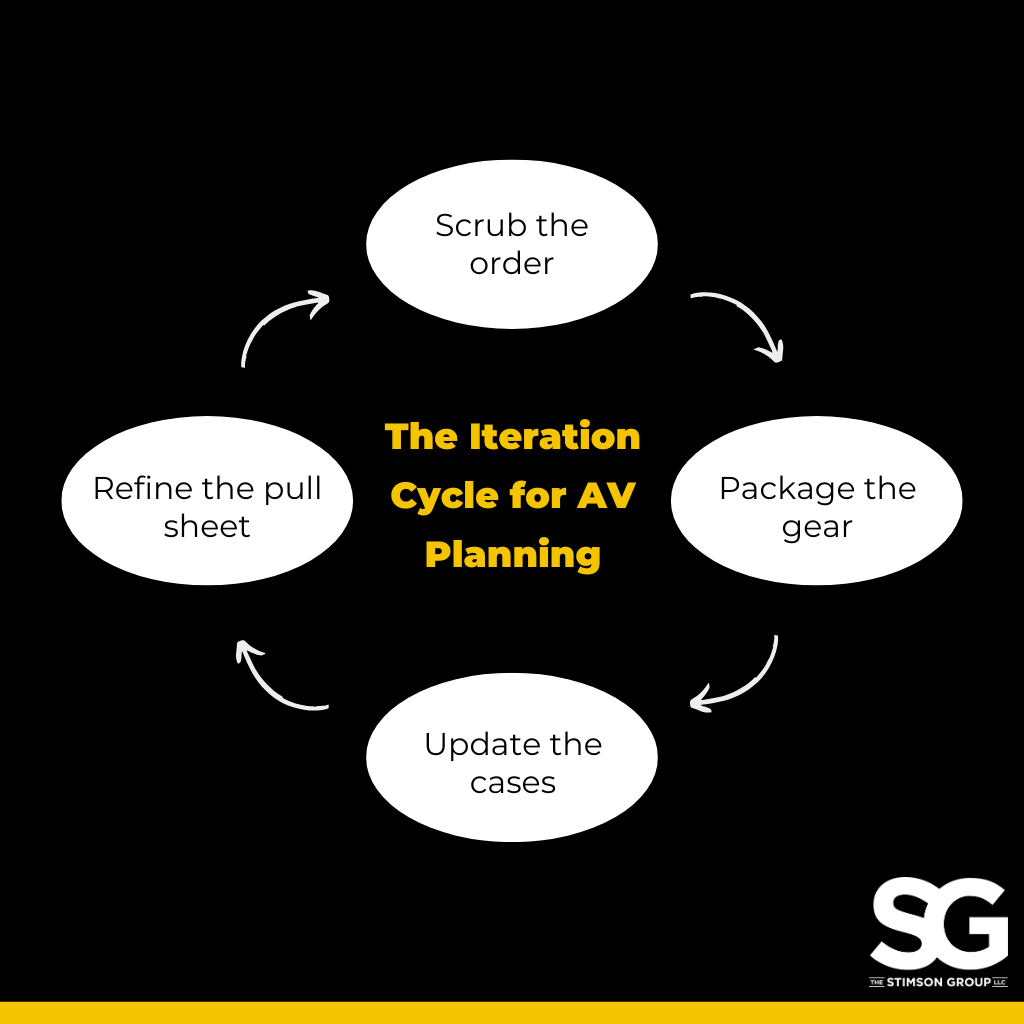
The cycle was always the same: scrub the order, package the gear, update the cases, refine the pull sheet. Go through that cycle 50 times and see where you end up.
Systems and Kits
The real breakthrough came when we started asking better questions. “Why do we keep leaving this piece behind?” “Because it wasn’t on the list.” “But it’s always supposed to go with that switcher!”
So, we created the purple book.
It was a three-ring binder (it happened to be purple) in which we documented every system we regularly used. If this switcher goes out, here are all the components that automatically go with it.
Eventually, the purple book included cables and accessories, but at first, it just listed the core components: switcher case, router case, three basic monitors, plus another monitor for every source.
Systems were made up of kits. Sometimes a kit fulfilled a system. Sometimes a kit was standalone. We could double-duty our gear.
Building systems and kits improved our pull sheets. It made prep simpler and made scrubbing an order much simpler.
Soon, the warehouse manager scrubbed simple orders himself. He’d bring them to me, show me what he did, I’d coach him, and off he’d go. Over the years, it got better and better until I no longer scrubbed orders at all.
The Crew Scheduling Evolution
Booking crew followed a similar path.
At first, Tom and I both booked crew. We’d confirm a show, tell people where to go, book freelancers, and put names into the system. Then, we had to arrange travel.
Our travel agent would book flights and send airline tickets and rental car reservations to the shop. (This was the early ’90s. We had actual paper documents.)
The complexity and level of detail led to constant questions. So, Tom hired an assistant whose responsibility it was to schedule crew, inform them where they were working, and book their travel. That was a huge load off both of us.
This led to the Tuesday morning meeting. Every Tuesday, we’d schedule freelancers and staff as far out as we could. We’d look at the schedule to see if we needed more freelancers, if we had a weak position to fill, or if a crew was overcast with too many good people and needed to be balanced.
The person booking travel and informing freelancers wasn’t making decisions about who would do the work. She was fulfilling the decisions made in that Tuesday morning meeting.
Documentation and Support
As planning matured, documentation became critical.
We started labeling what was in cases and putting inventory lists inside. On a gang box, we’d attach a list to the top: “Here’s what goes in this trunk. Here’s where to find it.”
The final piece was support. The better you are at planning, the less extra support you need to provide. But the support you do provide becomes more important.
We ran logistics on additions and changes. The client added gear? We need to get it there.
What’s the drop dead time? “As soon as possible” isn’t an appropriate answer. If they have it by four o’clock, they can set it up in time. Therefore, I’ll have it there by three.
What Planning Actually Is
Planning is operations management led by a knowledgeable production person. It serves one goal: meeting all the needs of execution in advance.
Planning isn’t about going out and doing the show for your crew, and it isn’t about supervising them. It’s about trusting them to do the work.
Put the right people on the show, give them the right tools, and get back to your desk to plan the next one or the next 10.
The outcome of good planning is the show crew has what they need. They know where gear is coming from, when it will arrive, who’s involved, and how to reach everyone. They have all the client information, agendas, and floor plans.
You receive minimal questions because you’ve provided for as many circumstances as you expect to happen. They know how many extras they have tucked away. They know how many times they can say yes before they have to call the shop.
The Key to Growing Your Business
People who do shows for a living do shows. People who plan shows for a living keep planning shows while other shows are going on.
That’s the key to growing your business.
None of my planning team ever went out and did a show. It wasn’t in their job description. While execution happened in the field, planning happened in the office for the next job.
The model still applies today. Whether you’re running a small company or a large one, planning is how you scale.
Systematize your processes. Document your systems. Train your replacement. Then do it again.


Leave a Reply