





Listen instead on your Monday Morning Drive:
Your best employees are out on shows while your office sits empty. You’re chasing rental revenue to cover overhead.
You’re in the wrong business.
Recently, I received a call from a client who does high-level events. He was burned out and trapped, and his business wasn’t growing. Why?
He was doing shows instead of getting shows done.
The Death Spiral of Doing Shows
When you’re in the business of doing shows, you create a predictable trap. You need the revenue to cover overhead, so you take every opportunity that comes along. You take rental jobs, field tire-kicker phone calls, write courtesy proposals, and serve non-ideal customers.
On your busiest day, everyone’s out doing shows, and the office is empty. Nobody’s working on future projects, fixing processes, or improving systems.
Then, the slow months hit. You still have high overhead, so you chase harder.
My client was living this reality every day. When someone called in sick, he’d jump on the show himself. When someone needed equipment, he’d rent it to them. His pricing was based on rental rates with labor as a pass-through.
The Epiphany That Changes Your Business Model
After listening to my podcast and reading my blog and books, this client realized his job wasn’t to do shows but to get shows done.
That mindset shift changed his entire business model.
He stopped booking himself on shows completely. He eliminated rentals because, as a show company, he had no place for them. He rebuilt his pricing structure around his value, not his rental rates.
Most importantly, he started outsourcing major equipment pieces instead of force-fitting every show with what he owned.
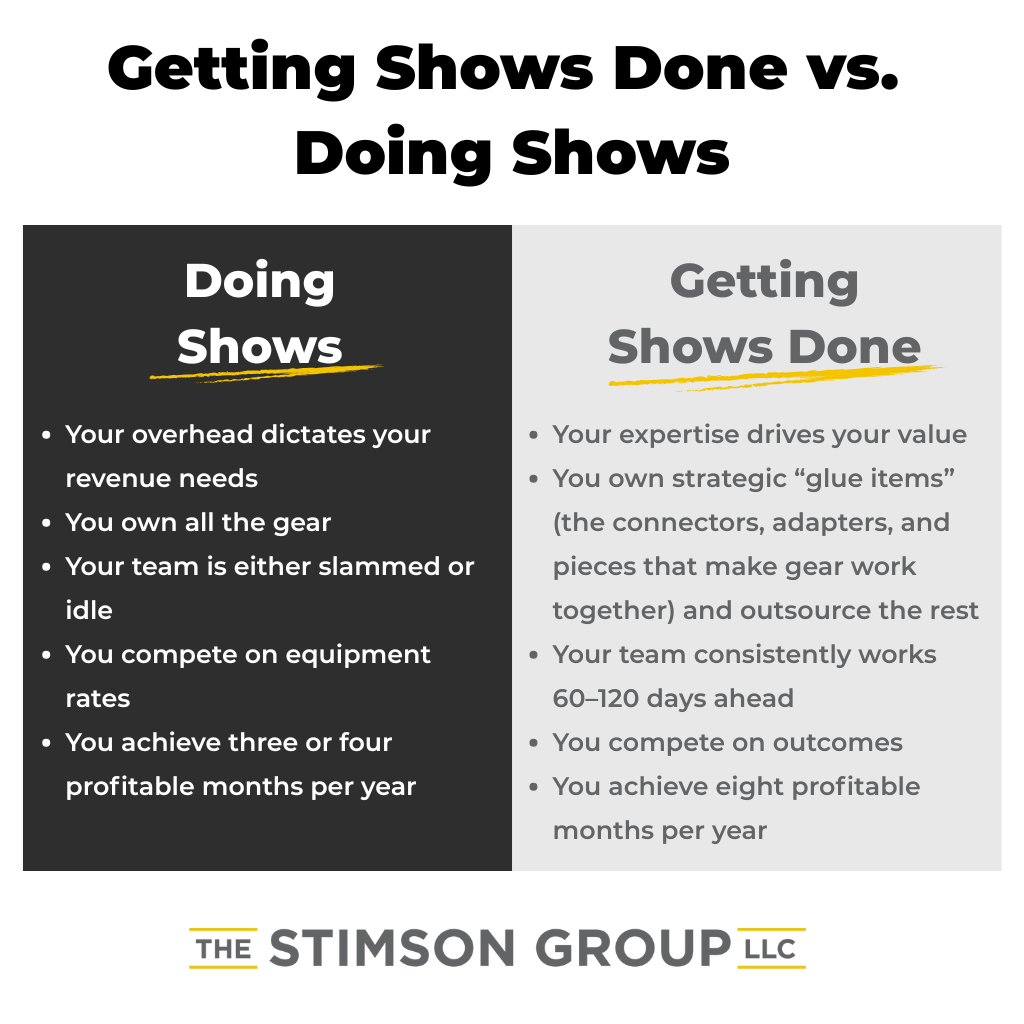
Getting Shows Done vs. Doing Shows
Companies that do shows send their best people out on site. Companies that get shows done keep their best people focused on planning and execution strategy.
Doing shows means:
- Your overhead dictates your revenue needs
- You own all the gear
- Your team is either slammed or idle
- You compete on equipment rates
- You achieve three or four profitable months per year
Getting shows done means:
- Your expertise drives your value
- You own strategic “glue items” (the connectors, adapters, and pieces that make gear work together) and outsource high ticket items
- Your team consistently works 60–120 days ahead
- You compete on outcomes
- You achieve eight or more profitable months per year
The Equipment Ownership Trap
You can rent an LED wall anywhere, and on any given day, you might get a great deal on projectors or displays. You don’t need to own all this equipment.
What you need to own are the glue items, including the cables, adapters, converters, and interfaces that make endpoints work together. These components let you connect whatever you outsource.
Owning all equipment increases overhead, which forces you to take non-ideal shows that prevent you from focusing on profitable work.
The Rental Company Reality
Rental companies don’t do shows because they aggregate equipment and add labor. The client does the show while the rental company serves as a supplier.
Rental companies send exactly what’s on the order and nothing more, but production companies that get shows done send what’s needed to deliver the outcome. They sell a scope of work, not a list of gear.
These are two different business models, and both can work if you don’t confuse them.
Your Office Should Never Be Empty
Companies that get shows done have the same number of people in the office on their busiest day as their slowest day. This is because getting shows done happens weeks before the event.
You got today’s show done through the work you did two to eight weeks ago. You’re getting the show eight weeks from now done through the work you’re doing today.
When you get shows done, you’re always working on the future through equipment prep, vendor coordination, talent recruitment, and logistics planning. This work happens regardless of this present week’s show schedule.
Lower Overhead, Higher Profit
Keep your overhead down so you’re not desperate for revenue. You can focus on ideal customers, say no to bad business, and maintain your margins.
Instead of three or four profitable months, you enjoy eight profitable months. Instead of chasing every dollar, you chase the right dollars.
In this model, smart sourcing replaces equipment debt, expertise replaces commodity pricing, and value creation replaces equipment aggregation.
Making the Change
The business owner who called me made these changes in months, not years.
He absorbed the information, applied it immediately, and transformed his business model. He eliminated the noise, focused on ideal customers, rebuilt his pricing, and started outsourcing strategically.
Most importantly, he shifted his entire philosophy from doing shows to getting shows done.
Choose Your Business Model
If you’re sending your best people out to do shows while hoping for enough revenue to cover overhead, you’re in the wrong business.
Your primary business is getting shows done through expertise, planning, coordination, and value creation, not through equipment ownership and labor deployment.
When you get shows done instead of doing them, you eliminate noise, do your highest and best work, and make money during slow months.
Stop doing shows and start getting them done.


Leave a Reply