


Listen instead on your Monday Morning Drive:
It’s only natural that successful, scalable companies eventually look to acquisition as a strategic means of accelerating growth. In an ideal scenario, you’d acquire a business with a similar scalable model ripe for leveraging synergies. But that peak profitability comes at a premium price tag.
What if, instead, you focused on buying the revenue stream of non-scalable businesses? With some fresh thinking, you can transform those underperforming assets into newfound capacity.
The Inherent Advantage of the Scalable Business Model
Scalable organizations have a lot of capacity. A small team of just 10 people can generate $5 million in annual revenue, but those same 10 people could also do $8 million, or even $10 million. Increasing revenue doesn’t require extensive additional resources.
Once your profit increases, your stress decreases, and you’re able to do more business without feeling too busy, you’ll ask, “How much more business can we do, and if we could get more revenue, what would that look like?”
Of course, investing in sales and marketing to grow the customer base organically remains crucial. But acquisition can also expedite growth.
Targeting Non-Scalable Businesses With Strategic Revenue
Buying a profitable, scalable business with your ideal customer profile may simply be too expensive. Instead, look at an unscalable business that has the right kind of revenue. You can make more money off that business initially because, as the owner of a scalable business, you can run that business better.
There are two kinds of non-scalable companies out there:
The first kind of company has what appears to be more capacity in terms of gear and technical staff, but it also has lower profits from being overbuilt. Acquiring this business would build up your scalable team, but you don’t want capacity from an acquisition — you want revenue.
The second kind of company has more revenue than capacity. Perhaps they don’t execute as well as they should. Perhaps their prices are too low because their customers don’t have much money. Or, perhaps they’re in a death spiral and taking any revenue they can get.
Focus on the second kind of company. It offers the revenue you need, hindered only by the limitations of its non-scalable model. By infusing such a company with your scalable methodology, you unlock its profit potential. Plus, you aren’t left struggling to figure out what to do with excess personnel and infrastructure.

Employee Integration Post-Acquisition
What happens to the employees of the businesses you acquire?
In most small- to mid-sized acquisitions, you purchase assetsrather than equity. That means rehiring staff you want to retain rather than absorbing employee contracts wholesale. In an equity purchase, you acquire both assets and obligations, including employees and their tenure.
Occasionally, you may acquire a firm via an equity purchase encompassing previous staff contracts. Such deals are less common in our industry, but not unheard of. Regardless of deal structure, view employee integration as an opportunity rather than an obstacle.
Assess skill sets that complement your existing teams. Transition some roles into project-based freelance work rather than traditional employment. Don’t overthink this — there’s a right solution for every person in the company you’ve acquired.
How to Integrate a Non-Scalable Business
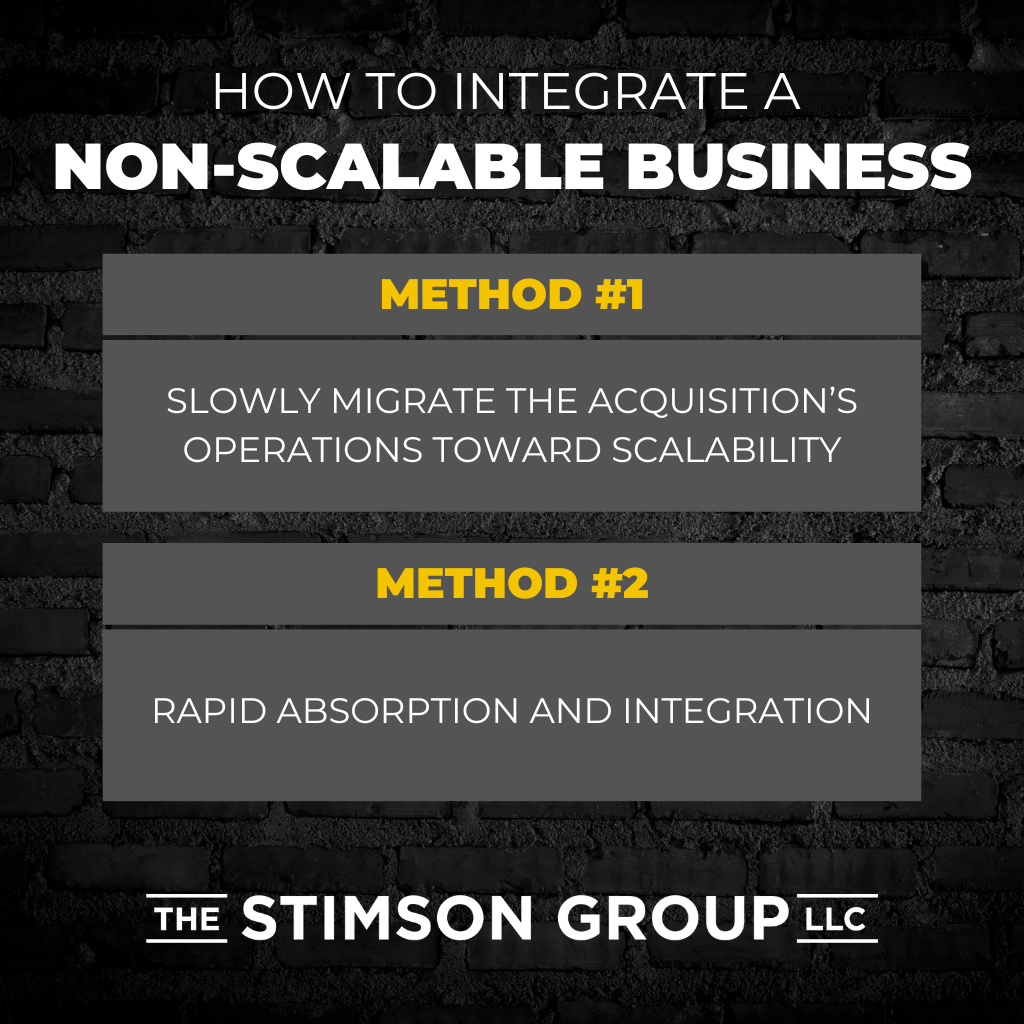
Let’s explore two methods for integrating an acquired non-scalable business.
Method #1: Slowly Migrate the Acquisition’s Operations Toward Scalability
Think of this approach as a “transition, then merge” strategy. Initially, continue operating the acquired business as a quasi-standalone entity. Begin introducing scalable changes on day one to improve its profit margin.
For example, you might shift non-scalable show staff to your freelancer pool rather than to salaried positions, because that’s what scalable companies do. Exchange resources between the parent company and this new satellite, taking on projects better suited to the respective businesses.
Over months or years, the two companies slowly merge into one unified entity. This gradual approach minimizes disruption; however, full integration can be delayed given the gradual progress. Valuable synergies also remain untouched in the meantime.
Suffice to say, it’s rarely my first choice.
Method #2: Rapid Absorption and Integration
In this method, swiftly absorb the acquired company’s operations, starting with revenue streams. Leverage your scalable capacity and proven methodology to boost profitability. Identify less desirable business to filter out while amplifying contributions from ideal clients.
You strip away unnecessary infrastructure but strategically integrate key staff members. Sprinkle these new team additions into your existing company structure. Mentor them into skilled contributors within the planning, sales, and administration spheres.
While parts of the acquired firm’s identity remain during this transition process, you work toward rapidly integrating and benefiting from newfound synergies. Within months rather than years, you operate as a single entity — and you wind up with more capacity to do it again.
The Path Forward
If methodical integration better suits your risk temperament, take Path 1. Prefer rapid results? Opt for Path 2.
Either road leads toward scalable acquisition, now more feasible than ever thanks to the expanded scalable capacity powering your enlarged empire.


Leave a Reply